
An emergency fund is easy to describe and surprisingly difficult to size.
It is money kept available for expenses you did not plan for — a job interruption, an urgent repair, an uninsured medical bill, or another financial shock that cannot simply wait for next month’s budget.
The need is not theoretical.
In the Federal Reserve’s 2025 Survey of Household Economics and Decisionmaking, 59% of U.S. adults said they had experienced at least one major unexpected expense during the previous 12 months. Only 63% said they would cover a hypothetical $400 emergency expense entirely with cash, savings, or a credit card paid off at the next statement.
But knowing that emergency savings matter does not tell you whether your target should be $1,000, $8,000, or $30,000.
That number should come from the risks in your own financial life.
For a U.S. newcomer, those risks may include more than an ordinary repair bill. A job interruption can also affect health insurance, housing, immigration-related costs, or the possibility of an international move. That is why a generic “three to six months” rule is only a starting point.
An emergency fund is insurance you provide for yourself. Its job is not to maximize return. Its job is to give you enough liquid, dependable money that an unexpected expense does not immediately force you into expensive debt, a retirement withdrawal, or the sale of long-term investments at a bad time.
This guide answers “how much cash do I need?” If your question is how high-yield savings accounts work, use our High-Yield Savings Accounts Explained guide. If you want current account-by-account eligibility and APY comparisons for newcomers, use our U.S. Newcomer HYSA comparison.
Last reviewed: September 12, 2026. Savings rates and account terms change frequently; this guide intentionally does not rank accounts by today’s APY.
Start by defining what counts as an emergency
An emergency fund is not simply a savings account with a different label.
CFPB defines an emergency fund as a cash reserve set aside specifically for unplanned expenses or financial emergencies.
That distinction matters because many expensive events are not actually unexpected.
Annual insurance premiums are predictable.
Holiday gifts occur every year.
A vacation you intend to take in December is not an emergency in November.
Those expenses belong in ordinary savings or what is sometimes called a sinking fund.
An emergency reserve is better suited to events such as:
- unexpected loss or reduction of income;
- an urgent car repair needed to continue working;
- a major home or appliance failure;
- an unexpected medical or dental expense;
- urgent travel caused by a family emergency; or
- another necessary expense that cannot reasonably be postponed.
You do not need a courtroom definition.
You need a rule you can apply consistently.
A useful test is:
Was this expense unplanned, necessary, and difficult to absorb from normal monthly cash flow?
There is no federally prescribed emergency-fund number
“Save three to six months of expenses” is one of the best-known personal-finance rules.
It is a useful planning range.
It is not a law and it is not the right target for every household.
CFPB’s emergency-savings guidance says the amount you need depends on your situation and encourages consumers to think about the unexpected expenses they have actually experienced and what those events cost.
CFPB separately uses three to six months of expenses as a rule of thumb when advising prospective homebuyers to preserve an emergency cushion.
That is a good starting framework — not a substitute for analyzing your own risk.
The Federal Reserve’s 2025 household survey adds useful context: 55% of adults said they had set aside enough in an emergency or rainy-day fund to cover three months of expenses. That means nearly half of adults had not reached that benchmark.
Calculate survival expenses, not your normal lifestyle
If the emergency you are planning for is loss of income, the relevant number is usually not everything you currently spend.
Ask what expenses would continue if the paycheck stopped tomorrow.
That can include:
- rent or mortgage;
- basic utilities;
- groceries;
- health, auto and other essential insurance;
- transportation required for work or daily life;
- minimum required debt payments;
- essential childcare;
- medications and recurring medical costs; and
- other obligations you realistically cannot suspend.
Restaurant spending, vacations, discretionary shopping and other expenses you would immediately reduce during an income shock do not necessarily need to be funded at their normal level.
Suppose your household normally spends $5,000 a month, but only $3,200 is truly difficult to cut.
A three-month reserve based on essential expenses would be approximately:
$3,200 × 3 = $9,600
A six-month reserve would be:
$3,200 × 6 = $19,200
Those numbers are more informative than taking six months of an unchanged lifestyle and assuming every dollar must be replaced.
A practical KoruVest planning formula:
Emergency-fund target ≈ essential monthly expenses × realistic recovery months + major one-time shock buffer.
This is a planning framework, not a federal rule. For a newcomer, the one-time buffer might include an insurance deductible, emergency airfare, temporary housing, immigration-related professional fees, or international relocation costs.
The right number of months depends on how quickly your finances can recover
I would think about emergency-fund size as a recovery-time problem.
If income disappeared, how long might it realistically take before the household was stable again?
| Factor | May support a smaller reserve | May justify a larger reserve |
|---|---|---|
| Household income | Two independent, stable incomes | One primary income source |
| Employment | Stable occupation with strong replacement prospects | Freelance, commission, seasonal or volatile income |
| Dependents | Few fixed family obligations | Children or others relying on your income |
| Property and transportation | Few assets likely to create large repair bills | Home, older car or other assets with repair exposure |
| Insurance | Low deductibles and broad coverage | High deductibles or meaningful uninsured exposure |
| Mobility / residency | Few costs associated with a job change | Job loss could also require relocation or an international move |
This is why I would not automatically tell every dual-income household to stop at three months or every freelancer to hold exactly six.
The range should respond to the household’s actual ability to recover.
A starter reserve can be useful long before you reach three months
A five-figure target can discourage someone who currently has $200 saved.
That does not mean the first milestone has to be exactly $1,000.
CFPB explicitly notes that even a small amount of emergency savings can provide financial security.
A more personalized starter target is:
the amount that would cover one realistic, common financial shock in your life.
For one person that may be a $750 insurance deductible.
For another it may be a $1,500 car repair.
For someone living without a car, the relevant number may be completely different.
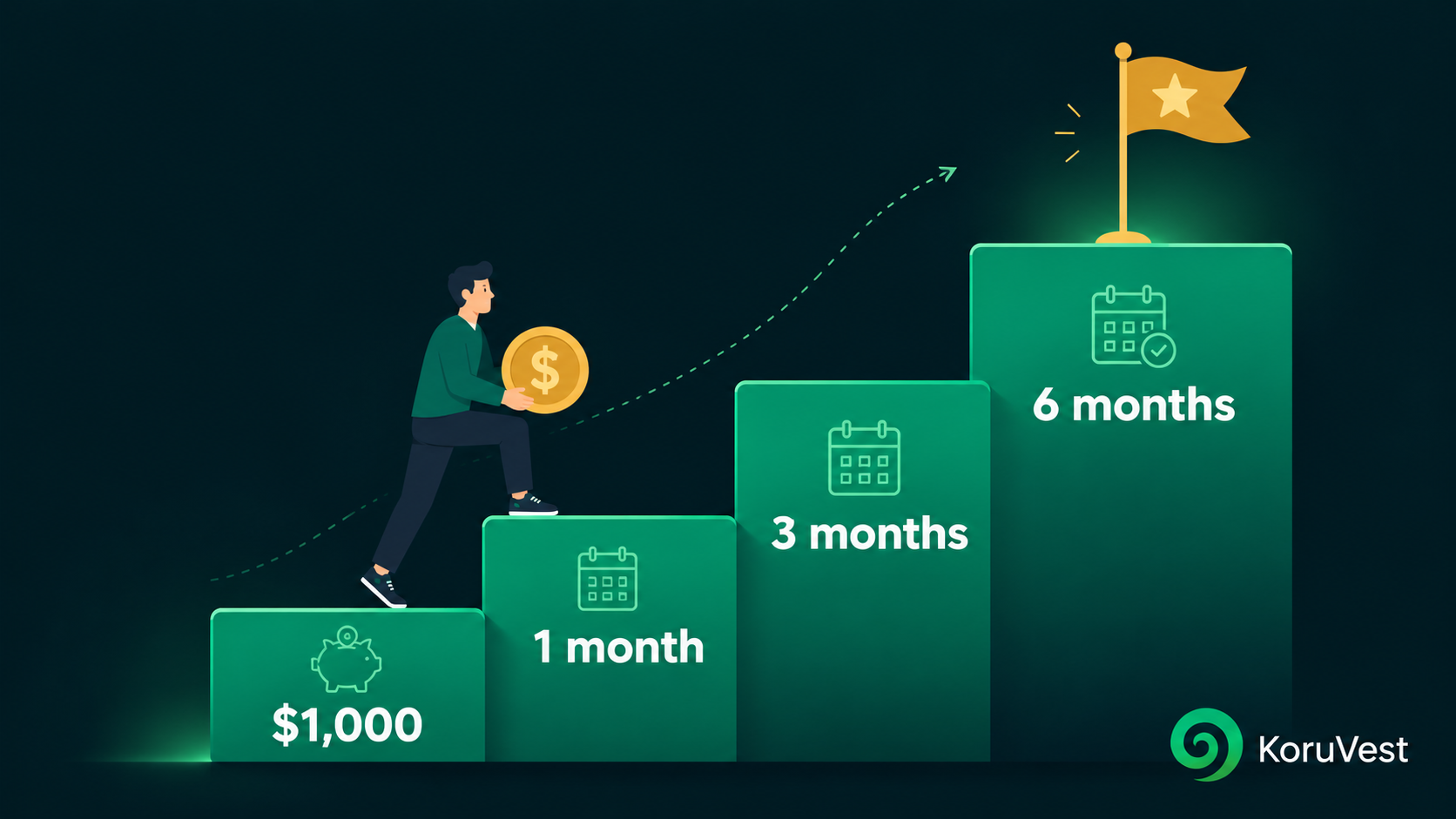
This produces a more useful sequence:
First: cover one plausible emergency.
Then: build toward roughly one month of essential expenses.
Then: decide whether three, six or more months reflects your income risk.
The milestones adapt to the household instead of forcing every household into the same $1,000 template.
Where should the money live?
The emergency fund has three competing jobs.
It should be:
safe enough that the money is still there when you need it;
liquid enough that you can reach it on the required timeline;
and
productive enough that large cash balances are not unnecessarily earning almost nothing.
A federally insured savings account is often a good way to satisfy those requirements.
A competitive high-yield savings account is one option, but the letters “HYSA” are not what make the money safe.
What matters is the institution, insurance structure, withdrawal access, fees and account terms.
FDIC insurance needs one important qualification
At an FDIC-insured bank, qualifying deposits receive federal deposit-insurance protection under applicable limits.
The standard amount is generally:
$250,000 per depositor, per FDIC-insured bank, for each ownership category.
It is not automatically $250,000 for each savings account.
If you hold several single-owner deposit accounts at the same insured bank, those balances are generally aggregated for insurance purposes within that ownership category.
Federally insured credit unions use a separate federal system administered by the NCUA, with analogous share-insurance coverage rules.
For an ordinary emergency fund well below the insurance limit, this distinction may not affect your daily decision.
It becomes important when cash balances are large.
Do not assume every financial app is itself a bank
Some savings products are offered directly by banks or credit unions.
Others appear inside financial-technology apps that place customer money with partner banks.
If you use the second type, identify the institution actually holding the deposit and understand how the insurance arrangement is supposed to work.
For a large emergency reserve, I would rather verify the legal structure than rely on a logo saying “banking services provided by…” at the bottom of a screen.
Our High-Yield Savings Accounts Explained explains the deposit-insurance issue in more detail.
Checking, savings, money market accounts and CDs solve slightly different problems
| Place for cash | Potential strength | What to check |
|---|---|---|
| Checking account | Immediate spending access | Interest rate, temptation to spend, account fees |
| High-yield savings account | Competitive yield while preserving deposit liquidity | Variable APY, transfer speed, eligibility, insurance structure |
| Money market deposit account | Deposit account that may offer additional access features | Rate, minimum balance, fees and transaction rules |
| CD | Can lock a stated rate for a defined term | Early-withdrawal penalty and whether the money is truly available when needed |
There is nothing inherently wrong with keeping a small first layer of emergency cash in checking if immediate debit-card access is valuable.
The larger reserve can sit elsewhere.
That can be more practical than demanding that every emergency dollar live in one account.
A two-layer emergency fund can solve the access problem
Consider a household with a $15,000 emergency target.
It might keep:
$2,000 close at hand in checking or immediately accessible savings for urgent bills,
and
$13,000 in a separate insured savings account that pays a competitive rate but may require an electronic transfer before spending.
The split is illustrative, not a prescribed ratio.
The point is that “liquid” is not always binary.
You may need several hundred dollars tonight while the remainder only needs to be reachable within a few business days.
Be careful with the phrase “accessible in one or two days”
Electronic bank transfers can be quick, but timing is not guaranteed merely because an account is online.
Availability can depend on:
- the sending and receiving institutions;
- weekends and holidays;
- account age;
- deposit holds;
- transfer limits;
- fraud controls; and
- the type of transaction.
If the fund’s purpose is emergency access, test the transfer process before an emergency occurs.
A good APY does not compensate for discovering at the worst possible moment that your external account link is no longer active.
Should an emergency fund ever be invested?
For the core reserve, I would prioritize principal stability and access rather than stock-market return.
A broad stock portfolio can fall sharply.
Job losses and market declines can also occur at the same time during recessions.
That combination makes stocks a poor match for money that may be required on short notice.
But the phrase “never invest a dollar beyond six months” is also too rigid.
Once someone has a well-funded liquid reserve, money beyond the amount reasonably required for emergencies becomes a different financial question.
That excess may eventually belong in retirement accounts, a taxable investment portfolio, or another goal.
The key is to distinguish the core emergency reserve from all other savings rather than allowing cash to accumulate indefinitely simply because it feels safe.
Emergency savings and investing do not always have to happen sequentially
The old version of this guide implied one universal order:
$1,000 emergency fund → eliminate credit-card debt → finish six months → only then invest.
Real financial decisions are more complicated.
Suppose your employer offers a valuable 401(k) matching contribution while you are still building emergency savings.
Stopping every retirement contribution until a six-month cash target is complete can mean giving up employer contributions during that period.
On the other hand, investing aggressively while having no accessible cash can leave you vulnerable to the first unexpected expense.
The more useful approach is to coordinate the goals.
A person might simultaneously:
- build a starter cash reserve;
- contribute enough to a workplace plan to receive an important employer match;
- pay down especially expensive debt; and
- continue growing the emergency reserve toward its longer-term target.
The percentages depend on cash flow and circumstances.
Personal finance rarely has only one priority at a time. A starter emergency reserve, expensive debt and an employer retirement match can all deserve attention simultaneously. The correct allocation among them depends on the cost and risk of neglecting each one.
Automatic saving works because it removes a recurring decision
CFPB recommends consistent savings systems and identifies automatic recurring transfers as one of the easiest ways to make savings regular.
The mechanics can be simple:
Paycheck arrives on Friday.
A transfer to emergency savings occurs automatically on Friday or Saturday.
The remaining checking balance becomes the amount available for normal spending.
If your employer permits split direct deposit, another option is to send part of each paycheck directly to savings before the entire paycheck reaches checking.
The exact dollar amount is less important than making it sustainable.
An automated $75 every two weeks contributes $1,950 over 26 pay periods before interest.
That may be more effective than repeatedly planning to save $300 and transferring nothing.
Irregular income requires a different savings system
A fixed monthly transfer works well when pay is predictable.
It can be awkward for freelancers, commission workers or business owners.
For variable income, a percentage-based rule may be easier.
For example, you might direct a chosen percentage of each payment above your baseline living needs into the emergency reserve until the target is reached.
CFPB also recommends taking advantage of one-time inflows such as tax refunds when appropriate.
A large refund, bonus or gift can move the reserve forward faster without creating a new recurring monthly obligation.
Your emergency-fund target should change when your life changes
An emergency reserve is not a number you calculate once at age 25 and preserve forever.
Recalculate after major changes such as:
- buying a home;
- having a child;
- moving from two household incomes to one;
- starting a business;
- moving into contract work;
- taking on a larger mortgage;
- changing health-insurance deductibles;
- buying an older vehicle; or
- moving to another country.
If essential monthly expenses rise from $3,000 to $4,500, a reserve built around the old budget may no longer provide the same number of months of protection.
For U.S. newcomers, a job shock can become a relocation shock
A temporary U.S. worker, international student, or recently arrived family can face an additional layer of financial risk.
A job interruption can affect more than income. Depending on the person’s visa, employer, insurance, housing, and family situation, a financial shock may also create a deadline-driven decision about where the household can live next.
Depending on the person’s circumstances, it may also create:
- immigration-related professional fees;
- urgent travel costs;
- temporary housing expenses;
- international relocation costs;
- school-transition costs for family members; or
- a period in which U.S. and home-country expenses overlap.
That does not produce one universal “visa-holder emergency fund.”
It does mean someone whose right to remain in the country or whose health insurance is closely tied to employment may reasonably choose a larger reserve than another household with identical monthly spending.
For example, two households might each have $3,500 of essential monthly expenses. If one household could stay in the same city after a layoff while the other might need international airfare, temporary lodging, shipping, deposits on a new home, and several weeks of overlapping expenses, the same three-month cash target does not provide the same protection.
Emergency money can also protect retirement accounts
Without liquid savings, an unexpected bill may cause someone to:
- carry an expensive credit-card balance;
- take a retirement-plan loan;
- request a hardship distribution;
- sell taxable investments during a market decline; or
- stop long-term contributions entirely.
CFPB specifically notes that households without savings may rely on credit or pull from other savings such as retirement funds when shocks occur.
The emergency fund therefore has a second job beyond paying the immediate bill:
it helps keep long-term money working on long-term goals.
What happens after you use the fund?
Using emergency savings for a genuine emergency is not a failure of the plan.
It is the plan working.
If a $4,000 furnace replacement reduces a $15,000 reserve to $11,000, the correct reaction is not regret that the savings balance fell.
The reserve prevented the household from needing another source of financing.
After the immediate situation is stable, decide how quickly the reserve should be rebuilt.
If the emergency also changed your underlying risk — for example, a job loss that has not yet been resolved — preserving the remaining cash may be more important than rebuilding immediately.
A simple way to build your own target
I would use four numbers rather than one generic rule.
1. Essential monthly spending
What would the household really need if income stopped?
2. Likely one-time shocks
What is your insurance deductible? What does a major car repair usually cost? What large expense has surprised you before?
3. Income-recovery time
If the main income disappeared, how long would finding replacement income realistically take?
4. Additional household risk
Dependents, homeownership, irregular income, immigration status, medical needs and insurance gaps can all change the amount of buffer that feels reasonable.
Then build the reserve in stages rather than waiting until you can fund the entire target at once.
One example
Consider a household with:
- $3,500 of essential monthly expenses;
- one primary income;
- two children;
- a $1,500 health-insurance deductible; and
- an older vehicle required for work.
A three-month expense calculation produces $10,500.
A six-month calculation produces $21,000.
Instead of declaring either number automatically correct, the household might reason this way:
A $1,500–$2,000 starter reserve would absorb one plausible repair or deductible.
One month of essentials would provide $3,500 of income interruption protection.
Because the household relies largely on one income and has dependents, moving beyond three months may be worth the additional cash drag.
The final target could therefore fall somewhere in the broader three-to-six-month range, adjusted for the family’s specific risks.
That decision process is more useful than a table saying “single income = exactly six months.”
Frequently asked questions
How much should I have in an emergency fund?
There is no universal dollar amount. Three to six months of expenses is a widely used rule of thumb, but CFPB says the appropriate amount depends on your circumstances. Start with essential expenses, likely one-time shocks, income stability and the time it could take to recover from a loss of income.
Do I have to save $1,000 before doing anything else?
No. $1,000 can be a useful starter milestone for some households, but it is not an official threshold. A better first target may be enough to cover one likely unexpected expense in your life, such as an insurance deductible or common car repair.
Where should I keep my emergency fund?
A safe and accessible bank or federally insured credit-union account is a common choice. A competitive high-yield savings account can work well, but compare insurance structure, transfer speed, fees, eligibility and account rules in addition to APY.
Should my emergency fund be invested in stocks?
The core reserve generally needs principal stability and dependable access, which makes volatile investments a poor match for money that may be required on short notice. Once your liquid emergency target is adequately funded, additional long-term money can be evaluated separately for investing.
Should I keep the whole emergency fund at one bank?
Not necessarily. Some households keep a smaller immediately accessible layer in checking or nearby savings and a larger reserve in a separate interest-bearing savings account. The important issues are access, fees and insurance — not the number of accounts.
Is an HYSA automatically FDIC-insured?
No. “High yield” describes a rate, not an insurance status. Confirm that deposits are held at an FDIC-insured bank or, for an eligible credit-union account, under the applicable federal NCUA insurance structure.
Is FDIC insurance $250,000 per account?
Not generally. The standard FDIC amount is $250,000 per depositor, per FDIC-insured bank, for each ownership category. Multiple accounts in the same ownership category at the same bank are generally combined when coverage is calculated.
Should I finish my emergency fund before contributing to a 401(k)?
Not necessarily. A starter reserve and an employer 401(k) match can both be valuable. Someone may reasonably build cash while also contributing enough to receive an employer contribution, depending on debt, cash flow and other financial risks.
What should I do after I use the fund?
First resolve the emergency. Then reassess the household’s remaining cash needs and rebuild the reserve at a pace that fits current cash flow. Using the money for the event it was designed to cover is not a financial mistake.
Where to go next
If you are choosing where to hold the reserve, read High-Yield Savings Accounts Explained: APY, FDIC Insurance & When to Use One.
For a comparison of current savings products, continue with High-Yield Savings Accounts for U.S. Newcomers: Eligibility, APY & Access Compared (2026).
If your cash reserve is taking shape and you are beginning to invest, start with How to Start Investing in the U.S.: A Step-by-Step Guide for Newcomers (2026). If you are specifically starting with a very small balance, use How to Invest Your First $100 in the U.S.: A Practical 2026 Guide.
If your employer offers retirement benefits, read our 401(k) guide before assuming emergency savings and retirement saving have to occur one after the other.
📚 Primary sources
- Consumer Financial Protection Bureau — An Essential Guide to Building an Emergency Fund
- Consumer Financial Protection Bureau — Emergency Cushion and the Three-to-Six-Month Rule of Thumb
- Federal Reserve — Economic Well-Being of U.S. Households in 2025
- FDIC — Understanding Deposit Insurance
- FDIC — Deposit Accounts Covered by FDIC Insurance
- NCUA — Federal Credit Union Share Insurance Coverage
KoruVest reviewed these primary sources on September 12, 2026. Emergency-fund targets are planning guidelines rather than federal requirements. Savings rates, account terms and household circumstances can change.
✍️ About the Author
David Han is the lead author of KoruVest, covering U.S. financial accounts, investing, tax-related rules, credit, retirement plans, and cross-border financial decisions for newcomers and international readers.
KoruVest articles are researched using official and authoritative sources and follow our standards for source review, fact checking, updates, and editorial independence.
⚠️ Disclaimer
Educational only. This article provides general information and is not personalized financial, banking, tax, investment, immigration, or legal advice.
No universal emergency-fund target exists. The appropriate reserve depends on expenses, household income, insurance, employment stability, dependents and other circumstances.
Verify account terms. Savings rates, transfer availability and deposit-insurance coverage depend on the institution and account structure. See our full Disclaimer.
Published: June 27, 2026 · Last updated: September 12, 2026