
For an F-1 student, investing can feel more complicated than it should.
You may have money saved from authorized on-campus work, CPT, OPT, a scholarship, or savings you brought from home. You would like to invest some of it, but one question stops you:
Can an F-1 student invest in stocks without violating student status?
For ordinary personal investing, the answer is generally yes — but the reason deserves a careful explanation.
F-1 rules restrict unauthorized employment. They do not create a blanket prohibition on owning stocks, ETFs, bonds, or other financial assets. USCIS describes unauthorized employment in terms of performing service or labor for an employer without authorization.
Buying securities for your own investment account is different from working for an employer or providing services for compensation.
But there is an important limit to what anyone should claim here: USCIS does not publish a special rule saying that an F-1 student may make a certain number of stock trades per week or month. There is no official “10 trades is safe, 50 trades is employment” threshold.
That is why this guide separates three issues that are often mixed together:
- Immigration: Are you engaging in employment or providing services that require authorization?
- Tax residency: Are you a resident alien or nonresident alien for U.S. tax purposes?
- Investment taxation: How are dividends and capital gains treated?
The rule to remember
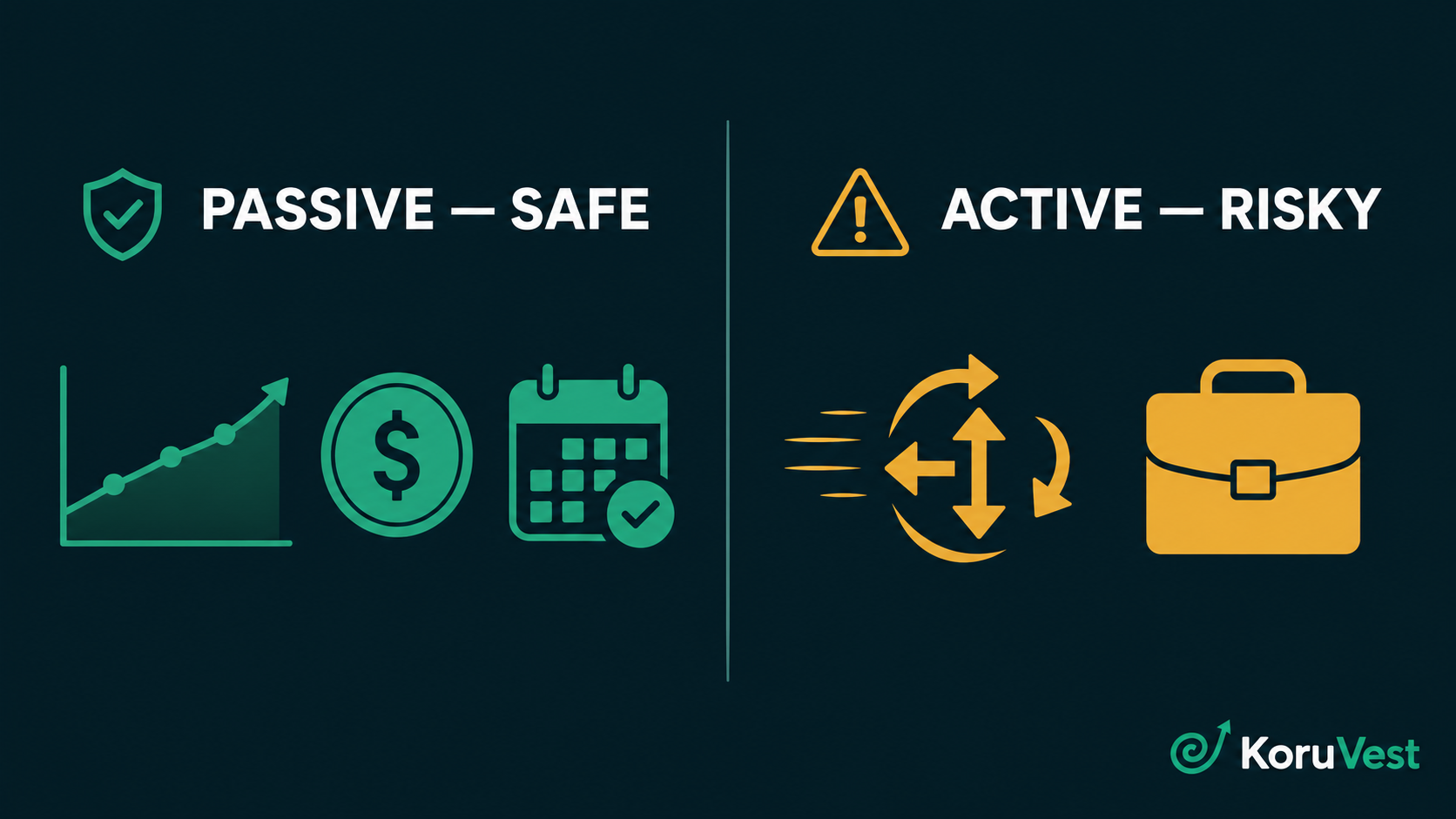
Owning investments and working are not the same thing. Ordinary investing for your own account generally does not involve providing labor or services to an employer. But operating an investment-related business, managing money for others, or receiving compensation for services raises a different immigration question.
Verified: August 18, 2026. Immigration and tax rules are fact-specific and can change.
Can an F-1 student buy stocks and ETFs?
Nothing in the F-1 employment rules creates a general ban on owning investment property.
An F-1 student can therefore generally hold personal investments such as:
- stocks;
- ETFs;
- bonds;
- bank deposits and CDs; and
- other investments that the student’s brokerage account permits.
The important distinction is whether you are simply investing your own money or performing work that requires employment authorization.
Buying an ETF, receiving a dividend, or selling an investment that appreciated in value does not by itself mean that an employer paid you for labor.
By contrast, activities such as managing another person’s portfolio for compensation, providing paid investment services, or operating an investment business can involve services or self-employment questions that should not be treated as ordinary passive investing.
What about day trading on an F-1 visa?
This is where many online articles become too confident.
There is no USCIS rule that says:
“F-1 students may make no more than X trades per month.”
Nor is there an official USCIS regulation stating that every person who day trades their own money has automatically engaged in unauthorized employment.
Tax law adds another layer of complexity. The IRS distinguishes an ordinary investor from a person engaged in the business of trading securities.
Under IRS guidance, securities activity can rise to the level of a trading business when, among other factors, the taxpayer seeks profit from daily market movements, trading is substantial, and the activity is carried on with continuity and regularity.
The IRS considers factors such as:
- typical holding periods;
- the frequency and dollar amount of trades;
- whether the activity is pursued to produce a livelihood; and
- the amount of time devoted to it.
But that is a tax classification. It is not an immigration safe harbor and it should not be used to claim that a certain trading frequency is automatically acceptable or unacceptable under F-1 rules.
Practical distinction
A student who occasionally buys and holds investments for personal savings presents a very different fact pattern from someone spending substantial time operating a trading activity as a livelihood or providing investment services to other people. If your activity is approaching the second category, get advice from a qualified immigration attorney rather than relying on a trade-count rule found online.
Your tax status is a separate question
Being in F-1 immigration status does not automatically tell you how the IRS will classify you.
For federal income-tax purposes, foreign individuals are generally classified as either:
- resident aliens, or
- nonresident aliens.
F-1 students receive an important special rule when applying the Substantial Presence Test.
The F-1 five-calendar-year rule
An eligible student temporarily present in the United States in F status can generally exclude days of U.S. presence from the Substantial Presence Test while treated as an exempt individual.
For students, this treatment generally applies for up to five calendar years.
“Exempt individual” is an unfortunate name. It does not mean that you are exempt from U.S. tax.
It means that qualifying days are excluded when determining whether you satisfy the Substantial Presence Test.
Calendar year means calendar year
If you first arrive in the United States in August 2022 in qualifying F-1 student status, 2022 counts as your first calendar year even though you were present for only part of the year. In a typical case, 2022 through 2026 would be the five calendar years.
What happens after five calendar years?
You do not automatically become a resident alien simply because year five ends.
Instead, you generally lose the automatic ability to exclude student days and must determine whether you satisfy the Substantial Presence Test using the applicable rules.
The IRS also provides a limited possibility for certain students who have been exempt for more than five calendar years to continue excluding days if they can establish that they do not intend to reside permanently in the United States and have substantially complied with their nonimmigrant status. The IRS considers facts such as a closer connection to a foreign country and steps taken toward permanent residency.
So the accurate rule is:
Five years changes the day-counting analysis. It does not automatically flip your tax residency.
For a broader explanation, see our guide to brokerage accounts for non-U.S. citizens.
Form 8843: the filing many students miss
If you are excluding days of U.S. presence because you qualify as an exempt individual student, the IRS requires you to file Form 8843, Statement for Exempt Individuals and Individuals With a Medical Condition.
This requirement can apply even if you are not otherwise required to file a federal income-tax return.
If you file Form 1040-NR, Form 8843 is generally attached to that return. If you are not required to file an income-tax return, the IRS instructs qualifying individuals to send Form 8843 separately to the address in the form instructions.
That is more precise than saying “every F-1 student must always file Form 8843.” The requirement is tied to your claim that qualifying days should be excluded as an exempt individual.
W-8BEN or W-9?
Your broker’s tax documentation depends on your tax status, not simply on the letters “F-1” on your visa.
A student who remains a nonresident alien will commonly provide Form W-8BEN to the brokerage for relevant withholding and reporting purposes.
A person who becomes a resident alien for federal income-tax purposes is generally treated as a U.S. person for these withholding purposes and normally uses Form W-9 instead.
Form W-8BEN can also be used to claim an applicable income-tax treaty benefit when the requirements are met.
The form generally remains valid through the last day of the third succeeding calendar year after it is signed unless a change in circumstances makes the information incorrect.
How dividends are taxed for an F-1 nonresident alien
For a nonresident alien, many U.S.-source dividends fall within the U.S. rules for fixed, determinable, annual, or periodical income.
The statutory rate is generally 30% unless an Internal Revenue Code provision or an applicable income-tax treaty provides a lower rate.
Do not assume the rate is always 15%.
Treaty rates differ by country, type of income, and eligibility. Some countries have no applicable treaty benefit.
If you are entitled to a reduced treaty rate, Form W-8BEN is commonly used to document that claim with the withholding agent.
The IRS publishes treaty tables that can be used to check the rate applicable to your country of tax residence.
The 183-day capital-gains rule: this is not the Substantial Presence Test
This is one of the most important tax issues for an F-1 investor — and one of the most frequently explained incorrectly.
The IRS has a special capital-gains rule for certain nonresident aliens who are physically present in the United States for 183 days or more during the tax year.
The IRS explicitly states that this rule is separate from the 183-day calculation used in the Substantial Presence Test.
It also specifically states that the rule can apply to foreign students and scholars in F, J, M, or Q status even though their days may be excluded when determining whether they are resident aliens.
That means the following situation is possible:
| Question | Possible answer |
|---|---|
| Are you still a nonresident alien? | Yes, because qualifying F-1 days are excluded under the exempt-individual rules. |
| Were you physically in the U.S. for 183+ actual days? | Also yes. |
| Could the separate capital-gains rule matter? | Potentially, yes — if the gains are U.S.-source and the other requirements are met. |
Tax home is the part many summaries leave out
The 183-day rule does not mean that every F-1 student who spends 183 days in America automatically owes 30% tax on every stock gain.
The IRS also looks at whether the gain is U.S.-source.
For personal-property gains, the student’s tax home can be important in determining the source.
The IRS explains, for example, that an NRA student who establishes a U.S. tax home through employment, self-employment, or certain scholarship circumstances and is present for 183 days or more may become subject to the special tax on U.S.-source capital gains.
By contrast, an NRA student with no U.S. employment, trade or business, or scholarship/fellowship may have a different tax-home analysis.
This is where professional advice is worth paying for
If you remain a nonresident alien, spend most of the year in the United States, and plan to realize a meaningful investment gain, ask a tax professional who regularly works with international students. The correct analysis involves actual days of presence, tax home, income sourcing, treaty provisions, and whether the income is effectively connected with a U.S. trade or business.
Opening the brokerage account
An F-1 visa by itself does not guarantee that a particular brokerage will accept your application.
Broker eligibility can depend on:
- your actual residential address;
- your federal tax status;
- whether you have an SSN or another tax identification number;
- your citizenship;
- the documents you can provide; and
- the brokerage’s own compliance rules.
If you have an SSN from authorized employment, that can make applications easier at firms that request one. But having no SSN does not automatically mean that investing is legally prohibited.
Likewise, do not assume that an “international account” is automatically the right account for an F-1 student physically living in the United States. Some international products are designed primarily for customers who actually reside abroad.
Start with the broker’s current eligibility requirements and enter your real residence and tax information.
Our brokerage comparison for non-residents and visa holders explains these differences in more detail.
Do you need an ITIN?
Not simply because you are an F-1 investor.
An ITIN is an IRS tax-processing number for certain people who have a U.S. federal tax purpose but are not eligible for an SSN.
Whether you need one depends on your tax situation and the documentation required by the financial institution.
Do not apply for an ITIN solely because an online article says every foreign investor needs one. Confirm that you actually have an IRS-recognized tax purpose and check the broker’s requirements.
Can an F-1 student contribute to a Roth IRA?
Possibly — but F-1 status alone does not determine Roth IRA eligibility.
IRA contributions depend on factors including taxable compensation, income, filing status, and the applicable contribution limits.
For 2026, the general IRA contribution limit is $7,500, or your qualifying compensation if that is lower. Income limits can further restrict Roth IRA contributions.
So a student with qualifying taxable wages from authorized on-campus employment, CPT, or OPT may be able to contribute, but the details should be checked against the IRA rules that apply to that student’s tax return.
One correction to a common myth: Roth IRA money is not simply “locked until age 59½.” Roth distributions have ordering and qualified-distribution rules, and regular Roth contributions receive different treatment from earnings and conversions.
Before using a retirement account, also consider whether a long-term U.S. retirement vehicle makes sense if you expect to leave the country.
See our Roth IRA guide for the account rules themselves.
A practical checklist for F-1 investors
- Count your F/J/M/Q exempt calendar years. Do not assume “five years” means five 365-day periods.
- Determine whether you are still a nonresident alien. After the exempt period, apply the Substantial Presence Test and any applicable exception correctly.
- File Form 8843 when required. If you claim exempt-individual days, do not skip the form simply because you have no income-tax return to file.
- Use the correct broker tax form. NRA investors commonly use W-8BEN; resident aliens generally use W-9.
- Check your treaty instead of assuming a dividend rate.
- Keep the separate 183-day capital-gains rule in mind. Actual physical presence, tax home, sourcing, and treaties can matter.
- Use accurate information when opening the account. Never invent a U.S. address or tax status just to pass an online application.
- If your trading begins to resemble a business, get immigration advice. There is no USCIS trade-count safe harbor.
Frequently asked questions
Can F-1 students invest in stocks?
Generally, an F-1 student can own stocks and other investments for a personal investment account. F-1 rules restrict unauthorized employment rather than creating a blanket prohibition on owning securities. However, USCIS does not publish a special stock-trading safe harbor, so activities involving services, compensation, or operating a business should be analyzed separately.
Can an F-1 student day trade?
There is no official USCIS rule establishing a permitted number of trades. Tax law can classify sufficiently substantial, continuous, and regular securities trading as a trading business, but tax classification and immigration classification are not identical. A student whose activity is becoming business-like should obtain immigration advice rather than relying on a numerical trading rule.
Does an F-1 student have to file Form 8843?
If you are claiming the student exempt-individual rules to exclude days of U.S. presence from the Substantial Presence Test, the IRS requires a completed Form 8843. If you do not otherwise have to file an income-tax return, Form 8843 can still have to be filed separately.
Are F-1 students always nonresident aliens for five years?
Qualifying F-1 students can generally exclude days under the student exempt-individual rules for up to five calendar years. The exact analysis depends on prior F, J, M, or Q presence and compliance with the visa requirements. After more than five calendar years, tax residency does not automatically change; you generally must apply the Substantial Presence Test unless an additional exception applies.
Do F-1 students pay 30% tax on dividends?
A nonresident alien generally faces a 30% statutory rate on applicable U.S.-source FDAP income such as many dividends, but an income-tax treaty or another Code provision may reduce the rate. The correct rate depends on the student’s country of tax residence and treaty eligibility.
Do F-1 students pay tax on stock capital gains?
Not every F-1 student has the same result. For an NRA student, the separate 183-day rule can impose a 30% or lower treaty rate on applicable U.S.-source capital gains when its requirements are met. The IRS specifically states that this 183-day test is separate from the Substantial Presence Test. Tax home and income sourcing can be critical.
Can an F-1 student open a brokerage account without an SSN?
Some brokerage arrangements may be available without an SSN, but requirements vary by broker and account type. Your actual U.S. residence, tax status, foreign tax identification information, and other documentation can matter. Check the firm’s official eligibility requirements rather than assuming an SSN is universally required or universally unnecessary.
Can an F-1 student open a Roth IRA?
An F-1 student may be able to contribute if the student has qualifying taxable compensation and meets the applicable IRA rules. For 2026, the general IRA contribution limit is $7,500, subject to compensation and income limitations. Visa status alone does not establish IRA eligibility.
Where to go next
If you are unsure whether you are a resident or nonresident alien, read Can a Non-US Citizen Open a Brokerage Account?.
If you need to compare account providers, continue with Brokerages for Non-Residents and Visa Holders.
If you are completely new to investing, start with How to Start Investing as a Beginner and then read Index Funds vs. ETFs.
📚 Official sources used for this guide
- 8 CFR § 214.2 — F-1 Student Requirements
- USCIS — Students and Employment
- USCIS Policy Manual — Unauthorized Employment
- IRS — Exempt Individual: Who Is a Student
- IRS — About Form 8843
- IRS — Substantial Presence Test
- IRS — Capital Gains of Nonresident Students and Scholars
- IRS — Nonresident Alien Students and the Tax Home Concept
- IRS — Nonresident Alien Withholding
- IRS — Tax Treaty Tables
- IRS — Instructions for Form W-8BEN
- IRS Publication 550 — Investors and Traders in Securities
- IRS — 2026 IRA Contribution Limits
KoruVest reviewed the official sources above on August 18, 2026. Immigration status, tax residency, treaty eligibility, and investment taxation can depend on facts that a general article cannot fully evaluate.
✍️ About the Author
David Han is the lead author of KoruVest, covering beginner investing, U.S. financial accounts, taxes, and cross-border financial issues for international investors.
KoruVest articles are researched using official and authoritative sources and follow our standards for source review, fact checking, updates, and editorial independence.
⚠️ Disclaimer
Educational only. This article provides general information and is not personalized financial, investment, tax, immigration, or legal advice.
No trading safe harbor. USCIS does not publish a numerical stock-trading threshold for F-1 students. The immigration consequences of business-like activity depend on the facts.
For a material immigration or cross-border tax decision, consult an appropriately qualified professional. See our full Disclaimer.
Published: July 18, 2026 · Last updated: August 18, 2026