
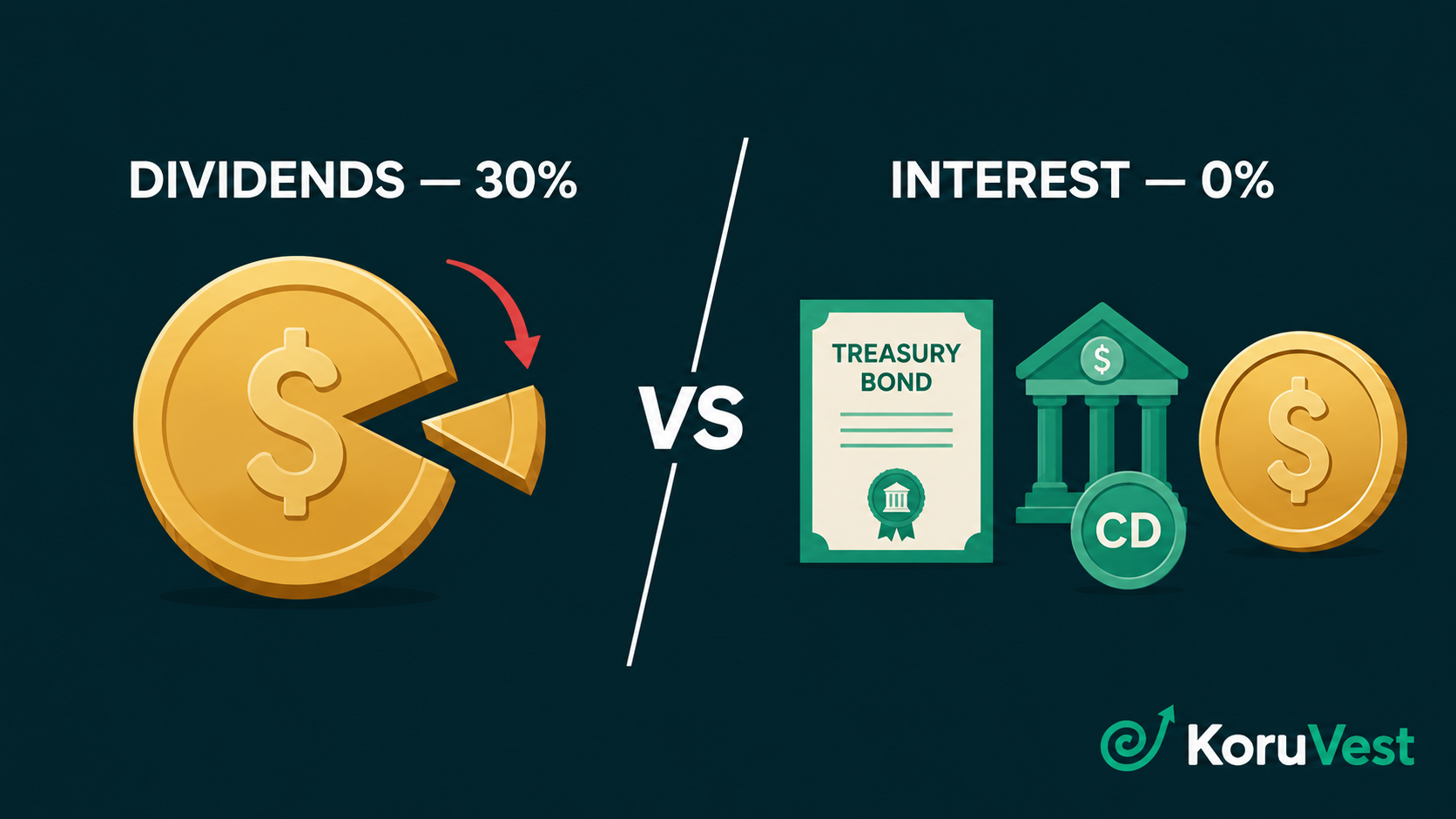
A foreign investor can receive a dividend from a U.S. company and lose part of it to U.S. withholding tax, then receive interest from a U.S. Treasury security with no U.S. federal income tax at all.
At first glance, that seems inconsistent. Both investments are American. Both may sit in the same brokerage account. Yet the tax treatment can be completely different.
The reason is that U.S. tax law cares about what kind of income you received, not simply where your brokerage account is located.
For a nonresident alien, certain U.S. bank-deposit interest and qualifying portfolio interest can be excluded from U.S. federal income tax when the statutory requirements are met and the income is not effectively connected with a U.S. trade or business.
That can make Treasury securities, bank CDs, and certain bonds unusually attractive from a U.S. tax perspective.
But there are three qualifications worth putting up front.
“Foreign investor” is not the tax status that matters. The favorable rules discussed here generally concern nonresident aliens. A foreign citizen who is a U.S. resident alien is generally taxed much more like a U.S. citizen.
Second, “0% U.S. tax” does not mean the income is tax-free everywhere. Your country of tax residence may tax the same interest.
And third, a Treasury bond, a Treasury ETF, a bank CD, and a corporate bond may look similar in a portfolio but do not necessarily produce the same U.S. tax result.
Last reviewed: August 18, 2026. This guide addresses U.S. federal tax rules for individual nonresident aliens. Home-country taxation and treaty treatment must be considered separately.
Why interest can receive better treatment than dividends
Start with the contrast most investors notice first.
A U.S.-source corporate dividend paid to a nonresident alien is generally subject to a 30% statutory withholding rate unless an income-tax treaty or another rule reduces it.
Interest is more complicated — and often more favorable.
The Internal Revenue Code contains separate exclusions for certain deposit interest and portfolio interest. When an NRA satisfies those rules and the income is not effectively connected with a U.S. trade or business, the United States generally does not impose federal income tax on that interest.
That is why the same investor might see:
| Investment income | Typical U.S. treatment for an NRA | What matters |
|---|---|---|
| U.S. stock dividend | 30% statutory withholding, potentially reduced by treaty | Treaty residence and dividend article |
| U.S. bank deposit or qualifying bank CD interest | Generally excluded from U.S. federal income tax if the deposit-interest rules apply and it is not ECI | Type of deposit and connection to a U.S. trade or business |
| Qualifying Treasury or other portfolio interest | Generally exempt from Chapter 3 withholding | Portfolio-interest requirements and documentation |
| Corporate bond interest | Often qualifies, but not automatically | Registered obligation, ownership, contingent-interest and other exceptions |
| U.S. bond or Treasury ETF distribution | Depends on how the fund characterizes and designates the distribution | Fund distribution classification |
That last row is particularly important. Buying a Treasury ETF is not tax-identical to owning a Treasury security directly.
Bank CDs are covered by a different rule from Treasury bonds
It is tempting to say that Treasuries and CDs are both tax-free because they are “interest.” Technically, they get there by different routes.
IRS Publication 515 says foreign persons are generally not subject to Chapter 3 withholding on qualifying interest from deposits with businesses such as U.S. banks when that interest is not connected with a U.S. trade or business.
The IRS definition of deposits for this purpose expressly includes certificates of deposit, along with open-account time deposits and other qualifying deposit arrangements.
That makes a conventional CD issued by a qualifying banking institution very different from a corporate dividend.
There is still a practical question to ask before assuming a product qualifies:
Is it actually a bank deposit?
A brokerage platform can show several cash-like products next to one another — brokered CDs, money-market funds, Treasury securities, sweep arrangements and other instruments. They may all look like “cash earning interest” on the screen, but the legal form of the product determines the tax treatment.
A money-market fund, for example, is a fund. It is not simply a bank deposit because its yield looks similar to a savings account.
Why Treasury securities can qualify for the portfolio-interest exemption
Treasury securities generally fit into the other major interest exclusion: portfolio interest.
IRS guidance excludes qualifying portfolio interest on covered obligations issued after July 18, 1984. Modern marketable Treasury securities and many other registered debt obligations can fall within that framework when the requirements are satisfied.
For an ordinary foreign individual holding Treasury bills, notes, or bonds as an investment, that can mean no U.S. federal income tax on qualifying interest.
This is not a treaty benefit in the ordinary sense.
That distinction matters because an investor from a country with no U.S. income-tax treaty can still potentially qualify for the statutory portfolio-interest exemption.
In other words, you should not think of the rule as:
“My country negotiated a 0% Treasury rate.”
A better way to think about it is:
U.S. domestic tax law itself excludes certain portfolio interest received by foreign investors.
Not every corporate bond automatically gets the same 0% result
Portfolio interest is broad, but it is not unlimited.
IRS Publication 515 lists situations in which interest does not qualify.
One example involves a foreign investor who owns at least 10% of the voting power of a corporate borrower. Interest on that company’s debt generally does not qualify for the portfolio-interest exemption under the ordinary 10%-owner rule.
Certain contingent interest can also fall outside the exemption — for example, interest whose amount depends on the debtor’s revenue, profit, property value, dividends, or similar measures.
There are additional rules for banks, controlled foreign corporations and other specialized situations.
For someone buying a conventional widely traded bond as a small portfolio investor, these exceptions may never become relevant. But they are the reason a professional explanation should say “qualifying portfolio interest” rather than “all U.S. bond interest is tax-free.”
A Treasury ETF is not the same tax asset as a Treasury note
This is probably the most useful distinction for an investor choosing how to hold fixed income.
Suppose you want exposure to short-term U.S. Treasury securities.
You could buy an individual Treasury security. Or you could buy shares of a U.S.-domiciled ETF that owns Treasury securities.
Economically, the two portfolios may behave similarly.
Legally, you own something different.
With the first, you own debt of the U.S. government.
With the second, you own shares of an investment company that owns the debt.
IRS Publication 515 allows certain regulated investment companies to designate distributions as interest-related dividends, and those qualifying distributions can be exempt from Chapter 3 withholding.
But that does not mean every dollar distributed by every Treasury or bond ETF automatically receives the portfolio-interest exemption.
The fund’s own tax reporting and characterization matter.
Do not assume that “the ETF owns Treasuries” means “every ETF distribution is automatically tax-free to an NRA.” Direct debt interest and a distribution from a fund are legally different payments.
This is worth checking on the fund’s annual tax information if withholding efficiency is an important part of your investment decision.
One practical obstacle: TreasuryDirect is not designed for a typical overseas NRA
Knowing that Treasury interest can receive favorable U.S. tax treatment raises the next obvious question: why not simply open TreasuryDirect and buy directly from the U.S. government?
For many overseas investors, that is not an available route.
TreasuryDirect’s current account requirements state that an individual opening an account must be a U.S. person and have a valid U.S. Social Security number, a U.S. address of record, and an account at a U.S. depository financial institution capable of ACH transactions.
So there is an important distinction between:
being legally able to own a U.S. Treasury security
and
being eligible to open a TreasuryDirect account.
A nonresident investor living abroad will therefore commonly need to look at a brokerage that serves the investor’s country and provides access to marketable U.S. Treasury securities.
Our brokerage guide for non-residents and visa holders explains why country-of-residence eligibility needs to be checked before choosing the investment itself.
W-8BEN still matters even when the U.S. tax rate is zero
An exemption does not mean documentation becomes irrelevant.
Your financial institution needs to know that you are a foreign person and, where relevant, that the payment qualifies for foreign-person withholding treatment.
That is one reason an NRA investor will commonly be asked to maintain a valid Form W-8BEN.
For bank deposits, providing appropriate foreign-status documentation helps the institution distinguish an NRA account from an account belonging to a U.S. person.
For portfolio interest, documentation of foreign status is part of the withholding framework.
If your status later changes — for example, you become a resident alien for U.S. tax purposes — you should not continue assuming that the NRA interest exclusions apply simply because the same securities remain in the same brokerage account.
For the form itself, see our W-8BEN guide for foreign investors.
Zero tax does not always mean zero reporting
This is another place where the current KoruVest article needed a correction.
It is too broad to say that U.S. bank or CD interest received by an NRA is “not even reported.”
In many ordinary cases, deposit interest can be nontaxable and may not be subject to the same reporting regime that applies to taxable interest. But the IRS also has information-reporting requirements for certain deposit interest paid to residents of specified foreign countries.
Portfolio interest presents another example: the IRS states that qualifying portfolio interest received by an NRA can be nontaxable while still being reported on Form 1042-S.
That distinction is worth remembering:
Taxable, withheld, and reportable are three different questions. An item of income can be reportable even when the U.S. tax due on it is zero.
The estate-tax difference can be just as important as the income-tax difference
For a large foreign portfolio, the story does not end with annual interest.
Nonresident noncitizens can also face U.S. estate-tax rules on certain U.S.-situated assets. The general Form 706-NA filing threshold is only $60,000 of relevant U.S.-situated assets and specified prior transfers.
But U.S. law contains important situs exceptions for certain debt and deposit assets.
The current Form 706-NA instructions state that a debt obligation issued after July 18, 1984 can generally be treated as property located outside the United States if the interest would have qualified for the portfolio-interest exemption when received by the decedent.
The instructions also treat qualifying deposits with a U.S. bank and certain similar institutions as located outside the United States when they are not effectively connected with a U.S. trade or business.
Compare that with stock.
Shares of corporations organized under U.S. law are generally treated as U.S.-situated property for an NRNC estate.
That creates a potentially important distinction between:
- holding a qualifying Treasury debt obligation directly;
- holding a qualifying bank deposit or CD; and
- holding shares of a U.S.-domiciled investment fund.
The third item should not simply be assumed to inherit the estate-tax situs of the bonds held inside the fund.
Why this matters for larger portfolios
Two investments can give you nearly identical Treasury exposure during your lifetime while producing different estate-tax questions at death. Once a cross-border U.S. portfolio becomes substantial, asset structure matters — not just yield and expense ratio.
Estate-tax treaties can change the result, and individual circumstances matter. This is an area where professional cross-border estate advice becomes worthwhile as balances grow.
What about your home country’s tax?
A U.S. exemption does not turn an investment into a globally tax-free asset.
If you live in South Korea, Japan, Canada, India, Europe, or elsewhere, your country of tax residence may tax interest from foreign bonds, Treasury securities, CDs, or bank accounts under its own rules.
It may also impose reporting requirements on foreign accounts or financial assets.
So when comparing a U.S. Treasury with an investment available at home, do not compare only the headline yields.
A more useful comparison is:
after-tax return in both countries + currency risk + investment risk + account costs.
A Treasury paying a higher dollar yield can still produce a disappointing home-currency return if the dollar falls sharply against your own currency. Conversely, currency appreciation can add to the return.
How the choices differ in practice
For an NRA investor, the four products below can all look like “safe dollar income.” They solve different problems.
| Product | U.S. tax question | Practical issue |
|---|---|---|
| Individual Treasury bill/note/bond | Can qualify for portfolio-interest treatment | Need a brokerage accessible from your country; TreasuryDirect may not be available |
| Bank CD | Qualifying deposit interest can be exempt | Issuer, maturity, early-withdrawal terms and account eligibility |
| Corporate bond | May qualify as portfolio interest | Credit risk plus portfolio-interest exceptions |
| Treasury/bond ETF | Fund distributions require separate characterization | Simple trading and diversification, but not legally identical to direct bonds |
The questions I would check before buying
For a foreign investor, the tax analysis does not need to begin with a stack of IRS forms. Start with the investment itself.
What exactly am I buying? A bank deposit, an individual bond, or shares of a fund?
Am I still a nonresident alien for U.S. tax purposes? Citizenship alone does not answer that question.
Will the payment qualify as deposit interest or portfolio interest?
Does my broker have a valid W-8BEN on file?
If this is a bond fund, how does the fund characterize distributions to foreign shareholders?
How will my country of residence tax the income?
And if the U.S. portfolio is becoming large:
Does direct ownership versus fund ownership change my U.S. estate-tax exposure?
Those questions are more useful than simply asking whether “Treasuries are tax-free for foreigners.”
Frequently asked questions
Do nonresident aliens pay U.S. tax on Treasury interest?
Qualifying interest on Treasury securities can generally fall within the portfolio-interest exemption for a nonresident alien when the statutory and documentation requirements are satisfied and the income is not effectively connected with a U.S. trade or business.
Do nonresident aliens pay U.S. tax on bank CDs?
Interest on qualifying deposits with U.S. banking institutions is generally excluded from U.S. federal income tax for an NRA when it is not effectively connected with a U.S. trade or business. IRS Publication 515 expressly includes certificates of deposit within the relevant deposit category.
Does a foreign investor need a tax treaty to get 0% on Treasury interest?
Not necessarily. The portfolio-interest exemption is a provision of U.S. domestic tax law. A treaty can matter in other interest situations, but the statutory portfolio-interest exclusion does not exist only for residents of treaty countries.
Can a nonresident alien open a TreasuryDirect account?
A typical overseas NRA generally will not satisfy TreasuryDirect’s current individual-account requirements. TreasuryDirect requires the account holder to be a U.S. person and also requires items including a valid U.S. Social Security number, U.S. address of record and qualifying U.S. bank account.
Is a Treasury ETF tax-free for a nonresident alien?
Do not assume so merely because the fund owns Treasury securities. Certain interest-related dividends designated by a U.S. mutual fund or other regulated investment company can be exempt from Chapter 3 withholding, but fund distributions must be analyzed according to their own tax characterization.
Is interest from every U.S. corporate bond tax-free?
No. Many conventional obligations can qualify for the portfolio-interest exemption, but exceptions include certain contingent interest and interest paid to specified 10% owners, among other situations.
If the U.S. tax is zero, will I receive no tax form?
Not necessarily. Taxability and information reporting are different. Qualifying portfolio interest can be nontaxable while still being reported on Form 1042-S, and special reporting rules also apply to certain deposit interest.
Are Treasuries better than U.S. stocks for estate tax?
They can present a very different estate-tax profile for a nonresident noncitizen. Qualifying portfolio debt can generally be treated as situated outside the United States under the Form 706-NA rules, while shares of U.S. corporations are generally U.S.-situated property. Fund ownership and treaty rules require separate analysis.
Where to go next
If you are not certain whether you are a resident or nonresident alien, start with Can a Non-US Citizen Open a Brokerage Account?.
If your broker is asking you to certify foreign status, read W-8BEN and U.S. Withholding Tax.
And if you need an account that can actually serve you after moving overseas, see our Brokerages for Non-Residents and Visa Holders.
📚 Primary sources
- IRS — Nontaxable Types of Interest Income for Nonresident Aliens
- IRS — Nonresident Aliens: Exclusions From Income
- IRS Publication 515 — Withholding of Tax on Nonresident Aliens and Foreign Entities
- IRS Publication 519 — U.S. Tax Guide for Aliens
- IRS — Withholding and Reporting on U.S.-Source Income Paid to NRAs
- IRS — Instructions for Form 1042-S
- IRS — Instructions for Form 706-NA
- U.S. Treasury — TreasuryDirect Account Requirements
KoruVest reviewed these sources on August 18, 2026. The favorable interest rules discussed here apply only when their statutory requirements are satisfied. Home-country tax and applicable treaties should be reviewed separately.
✍️ About the Author
David Han is the lead author of KoruVest, covering beginner investing, U.S. financial accounts, taxes, and cross-border financial issues for international investors.
KoruVest articles are researched using official and authoritative sources and follow our standards for source review, fact checking, updates, and editorial independence.
⚠️ Disclaimer
Educational only. This article provides general information and is not personalized tax, legal, financial, estate-planning, or investment advice.
“0% U.S. tax” is conditional. Deposit-interest and portfolio-interest exclusions depend on the type of asset, investor status, documentation, and whether the income is effectively connected with a U.S. trade or business.
Cross-border taxation requires both countries to be considered. Consult an appropriately qualified professional for a material tax or estate-planning decision. See our full Disclaimer.
Published: July 21, 2026 · Last updated: August 18, 2026