
“Index fund or ETF?” sounds like a straightforward either-or decision.
Technically, it is the wrong question.
An index fund describes an investment strategy: the fund seeks to track a market index rather than relying primarily on a manager to pick securities.
An ETF describes how a fund is structured and traded.
That means an index fund can be a mutual fund or an ETF. And an ETF does not have to be an index fund at all — actively managed ETFs exist too.
So when most beginners search for “index funds vs. ETFs,” what they are really asking is:
Should I buy an index mutual fund or an index ETF?
Once you frame the question that way, the differences become much easier to understand.
The investment strategy and the fund wrapper are separate decisions. Two funds can track the same S&P 500 index while one trades as an ETF and the other operates as a mutual fund. Their portfolios can look almost identical even though the way you buy, price, automate, transfer, and tax them can differ.
Last reviewed: September 12, 2026. Fund expenses, brokerage features, minimum investments, and tax rules can change.
The terminology matters more than it seems
The SEC defines an index fund as a mutual fund or exchange-traded fund that seeks to track the returns of a market index.
That gives us two separate dimensions.
Dimension one: How is the portfolio managed?
- Index / passive
- Active
Dimension two: How is the fund packaged?
- Mutual fund
- ETF
Put those together and all four combinations are possible.
| Mutual fund | ETF | |
|---|---|---|
| Index / passive strategy | Yes | Yes |
| Active strategy | Yes | Yes |
This immediately fixes two common beginner misconceptions:
ETF does not mean passive.
And:
mutual fund does not mean actively managed.
If your goal is low-cost index investing, the meaningful comparison is usually between an index mutual fund and an index ETF tracking the same or a similar benchmark.
The same S&P 500 can come in two different wrappers
Vanguard provides a useful real-world example.
Vanguard 500 Index Fund Admiral Shares (VFIAX) is a mutual fund designed to track the S&P 500.
Vanguard S&P 500 ETF (VOO) is an ETF designed to track the same benchmark.
The underlying investment idea is essentially the same: exposure to the companies in the S&P 500.
The wrapper is different.
| Feature | VFIAX | VOO |
|---|---|---|
| Structure | Mutual fund | ETF |
| Benchmark | S&P 500 | S&P 500 |
| Expense ratio | 0.04% | 0.03% |
| Current initial minimum | $3,000 | Depends on share price or fractional-share access at your broker |
| Trading | Once-daily NAV | Intraday market price |
The 0.01 percentage-point expense-ratio difference is real.
But it should not distract from the larger point.
These are not two completely different investment philosophies. They are two ways to own exposure to essentially the same index.
One useful Vanguard-specific nuance: VOO is not a completely separate portfolio from Vanguard 500 Index Fund. Vanguard describes VOO as the exchange-traded share class of Vanguard 500 Index Fund. VFIAX is an Admiral mutual-fund share class of that same fund. That makes this a particularly clean example of how the wrapper can differ while the underlying portfolio remains essentially the same.
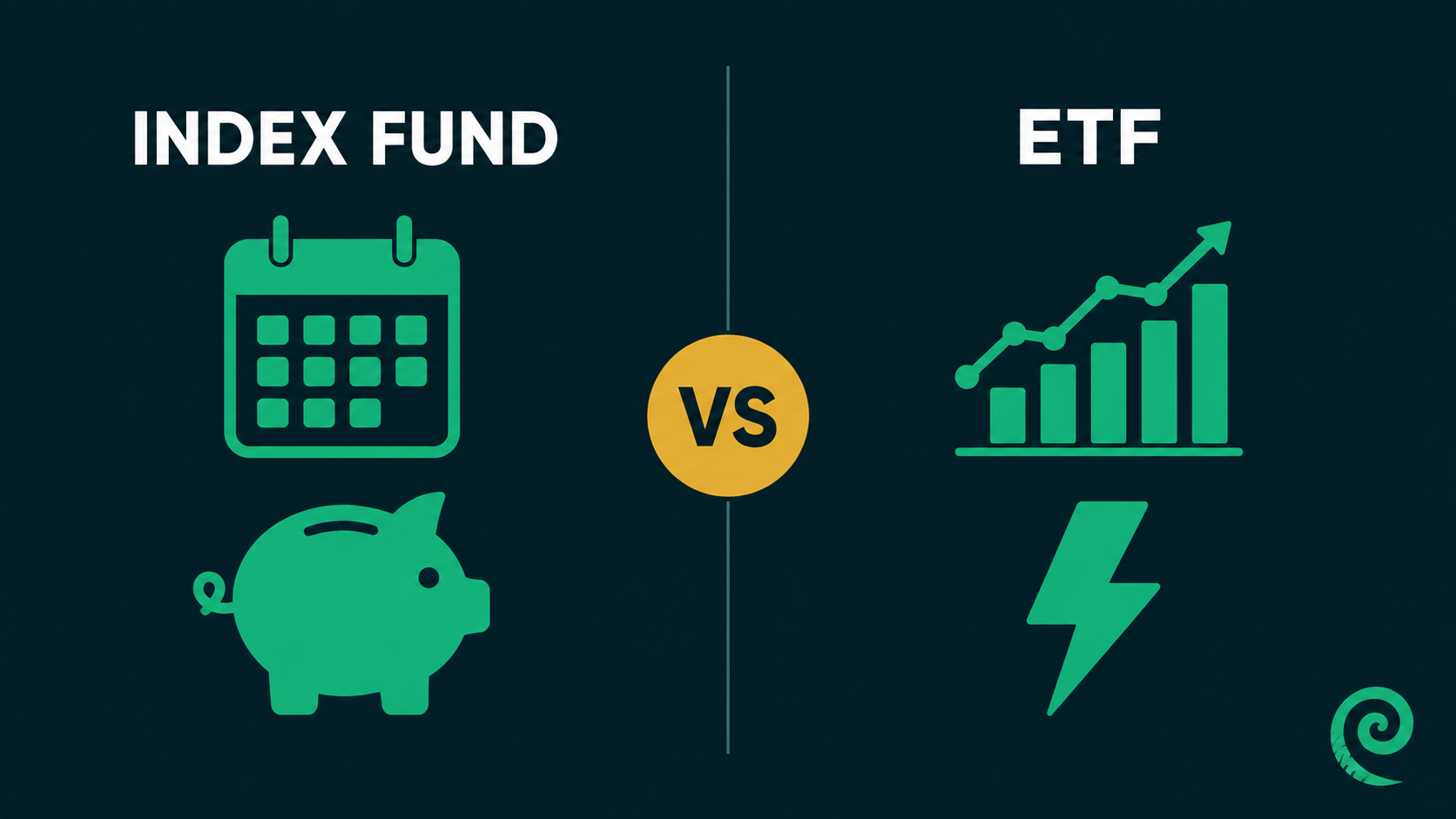
Mutual funds trade with the fund. ETFs trade with the market
This is the structural difference that explains many of the others.
When you buy or redeem a conventional mutual fund, you transact with the fund or through a financial intermediary.
The transaction occurs at the fund’s net asset value, or NAV, normally calculated after the market closes.
Suppose you submit a mutual-fund order at 11:00 a.m.
You do not lock in the 11:00 a.m. price.
You generally receive the NAV calculated at the end of that trading day, subject to applicable rules and deadlines.
An ETF works differently.
Retail investors buy and sell ETF shares on a stock exchange.
If the market is open, the ETF has a market price that changes throughout the day.
The ETF’s market price is not exactly the same thing as its NAV
A mutual-fund transaction generally occurs at NAV.
An ETF has NAV too, but retail investors normally trade at the market price.
Those two numbers can differ.
If an ETF trades above the value of its underlying portfolio, it is trading at a premium to NAV.
If it trades below that value, it is trading at a discount.
For large, liquid ETFs under ordinary market conditions, the differences may often be small.
They are still real.
That means ETF investors have trading considerations that conventional mutual-fund investors generally do not face in the same way.
The market price you see also incorporates a bid and an ask.
The distance between them represents another potential trading cost even if your brokerage advertises $0 ETF commissions.
“Commission-free” and “cost-free” are not the same thing. An ETF can have a very low expense ratio and $0 brokerage commission while the investor still encounters bid-ask spreads, premiums or discounts, taxes, and other trading costs.
Intraday trading is an advantage only if you need it
ETF marketing often presents real-time trading as an obvious advantage.
For some investors, it is.
You can place market orders, limit orders, and other permitted order types while the exchange is open. You can see an approximate execution price before the trade occurs.
A trader may value that flexibility.
A person investing $500 into the same broad-market index every month for 30 years may barely use it.
In fact, real-time pricing can create another temptation: watching and trading a long-term investment far more often than the investment plan requires.
A mutual fund’s once-a-day pricing can feel restrictive to an active trader.
To a long-term investor, it can be irrelevant.
The tax advantage of ETFs is real — but often overstated
One of the strongest practical arguments for ETFs appears inside a taxable brokerage account.
Mutual funds can realize capital gains as securities inside the portfolio are sold.
When those gains are distributed to shareholders, an investor can owe tax on a capital-gain distribution even if the investor personally did not sell any fund shares.
ETFs can generate capital-gain distributions too.
But many ETFs use an in-kind creation and redemption process that can reduce the need for the fund itself to sell appreciated securities for cash.
That structure has historically allowed many ETFs to make fewer capital-gain distributions than comparable mutual funds.
The important word is many.
Not every ETF is guaranteed to be more tax-efficient than every mutual fund.
Fund turnover, portfolio strategy, redemptions, asset class, and structure can affect the result.
Vanguard’s VFIAX/VOO pair is also a reminder not to turn the usual ETF tax-efficiency rule into an absolute. Because VOO is an ETF share class of the Vanguard 500 Index Fund rather than an unrelated standalone portfolio, this specific pair should not be used as proof that the ETF wrapper must always produce a dramatically different tax result from the mutual-fund share class.
In an IRA or 401(k), that ETF tax advantage largely disappears
This is where the usual advice needs context.
If you hold a mutual fund or ETF inside a tax-advantaged retirement account such as an IRA or 401(k), you generally are not paying current federal tax every time the fund makes a normal capital-gain distribution inside the account.
The SEC therefore notes that the relative ETF-versus-mutual-fund tax-efficiency distinction does not create the same difference when the investments are held in a tax-advantaged account.
So if you are choosing between two low-cost index options inside an IRA, the question:
“Which one distributes fewer capital gains?”
may be far less important than:
- which investment is available in the account;
- which has the lower total cost;
- which is easier to automate;
- whether there is a minimum investment; and
- whether both actually track the exposure you want.
Automatic investing is no longer a simple mutual-fund advantage
Older articles often say:
“Use mutual funds if you want automatic investing. Use ETFs if you want to trade manually.”
That distinction has become increasingly outdated.
Mutual funds have long been convenient for dollar-based recurring purchases.
But several major brokerages now also support recurring ETF investing and fractional ETF purchases.
Fidelity, for example, currently allows recurring investments in stocks, ETFs, mutual funds, and baskets. Fidelity says recurring stock and ETF plans can be set from $1, while recurring mutual-fund plans generally start at $10, subject to a fund’s own minimums. Eligible U.S. stocks and ETFs can also be purchased fractionally from as little as $1.
Broker capabilities still differ, so this is no longer something you can infer from the word “ETF.”
The relevant question is:
Does my brokerage let me automatically invest the dollar amount I want into this particular fund?
The same change has weakened the old minimum-investment argument
Mutual-fund minimums vary enormously.
Some have no meaningful minimum. Others require hundreds or thousands of dollars.
VFIAX, for example, currently requires a $3,000 initial investment.
ETFs traditionally had their own de facto minimum: the price of one share.
Fractional-share programs have weakened that limitation.
At a broker that supports fractional ETF purchases, a $700 ETF share does not necessarily require $700.
You may be able to invest by dollar amount instead. Fidelity, for example, currently permits eligible U.S. stock and ETF fractional purchases from $1, but minimums and eligible securities vary by broker.
That means there is no longer a reliable universal rule such as:
“ETFs are for small balances and mutual funds are for large balances.”
You need to check the actual fund and actual brokerage.
Expense ratio matters — wrapper alone does not tell you which is cheaper
An ETF is not automatically inexpensive.
A mutual fund is not automatically expensive.
The fund’s expense ratio tells you what proportion of assets is being used for the fund’s recurring operating expenses.
If two portfolios perform identically before expenses, the lower-cost fund generally leaves more of that return with investors.
But expense ratio is only one part of the comparison.
With a mutual fund, look for:
- expense ratio;
- sales loads, if any;
- transaction fees charged by your broker;
- purchase or redemption fees, if applicable;
- account minimums; and
- share-class differences.
With an ETF, look for:
- expense ratio;
- brokerage commissions, if any;
- bid-ask spread;
- premium or discount to NAV;
- fractional-share rules; and
- other trading costs.
A fund with a 0.03% expense ratio is not automatically cheaper for your particular transaction than every fund showing 0.04%.
The fund’s underlying portfolio matters far more than the wrapper
Suppose Investor A owns an S&P 500 ETF.
Investor B owns an S&P 500 index mutual fund.
Investor C owns a leveraged technology ETF.
Which two investors have more similar investment risk?
A and B.
The words “ETF” and “mutual fund” tell you how the investment is packaged.
They do not tell you whether the portfolio is conservative, aggressive, concentrated, global, leveraged, short-term, or diversified.
The SEC specifically notes that mutual funds and ETFs can both range from broadly diversified portfolios to much narrower products.
Some ETFs can even provide exposure to a single stock.
So when evaluating risk, I would look first at:
What does the fund own?
Only then:
What wrapper does it use?
An index fund does not always own every security in the index
Another common shortcut is:
“The fund simply buys every security in the index.”
Sometimes it does.
But the SEC notes that an index fund may use full replication or a representative sampling approach.
Some may also use derivatives to help achieve their investment objective.
This creates the possibility of tracking error — the difference between the return of the index and the return actually delivered by the fund.
Fees contribute to that difference too.
If the S&P 500 rises 10%, an S&P 500 fund is not contractually promising that your account will rise exactly 10.000%.
The goal is to track the benchmark as closely as the strategy permits, before and after real-world costs.
ETF transparency does not make every ETF simple
The ETF wrapper has become associated with low-cost index investing because many of the world’s largest ETFs follow broad indexes.
But the ETF market is much broader than that.
There are:
- actively managed ETFs;
- sector ETFs;
- single-country ETFs;
- thematic ETFs;
- leveraged ETFs;
- inverse ETFs; and
- other specialized products.
Buying something because it has “ETF” at the end of its name does not guarantee diversification, low cost, or suitability for a beginner.
Likewise, the phrase “index fund” does not tell you whether the index itself is broad and sensible for your purpose.
An index can be highly concentrated or built around a narrow theme.
Portability can matter if you eventually change brokerages
ETFs are exchange-traded securities, which can often make them relatively portable between brokerage firms that support the security.
Mutual funds are less uniform.
A mutual fund available without a transaction fee at one brokerage might be unavailable or carry a transaction charge at another.
Some proprietary mutual funds can create additional friction when you decide to transfer your account.
That does not make ETFs universally superior.
It simply means that an investor planning to keep the same portfolio for decades should consider not only how easy the investment is to buy today, but how easily it could be held elsewhere later.
The comparison changes for someone who may leave the United States
This is especially relevant to KoruVest readers.
A U.S. resident investor might compare an index mutual fund and an index ETF entirely on cost and convenience.
A visa holder or international investor has another layer.
Brokerages can impose different restrictions on mutual-fund purchases after a customer moves abroad, and investment availability can vary by country.
A U.S.-domiciled ETF also carries its own U.S. tax considerations for a nonresident alien, including the treatment of distributions and potentially U.S. estate-tax exposure.
That means the answer to:
“Which wrapper is easiest while I live in the United States?”
may not be the same as the answer to:
“Which investment structure will still make sense after I return home?”
If an international move is realistic, read Brokerage Accounts for Non-U.S. Residents & Visa Holders: Firstrade vs. IBKR vs. Schwab (2026) and our W-8BEN guide before building a portfolio around a product that may become difficult to buy later.
So which wrapper fits your account and investing process?
I would not choose based on the label alone.
I would start with the account.
Inside a 401(k):
You may not have a meaningful ETF-versus-mutual-fund choice. Workplace plans often provide a menu of mutual funds, collective investment trusts, target-date funds, or other plan investments. Choose among what the plan actually offers rather than worrying about an ETF you cannot buy there.
Inside an IRA:
If a low-cost index mutual fund and an index ETF provide similar exposure, either can work well. The ETF’s usual taxable-account capital-gains advantage matters much less inside the IRA. Minimum investment and automation may become more useful tie-breakers.
Inside a taxable brokerage account:
A low-cost ETF can have a structural tax-efficiency advantage because many ETFs historically distribute fewer capital gains. That makes the ETF wrapper particularly attractive when comparable investments are available.
If you invest very small dollar amounts:
Check fractional-share support. If the broker allows $1 or $5 ETF purchases, a high ETF share price is no longer much of an obstacle.
If automatic investing matters:
Check the brokerage rather than assuming only mutual funds can automate recurring purchases.
If you expect to move abroad:
Check future country restrictions before choosing a U.S. mutual fund or ETF solely on present-day convenience.
A better decision table
| If this matters most… | Index mutual fund | Index ETF |
|---|---|---|
| Exact end-of-day NAV pricing | Natural fit | Trades at market price instead |
| Intraday trading | No | Yes |
| Taxable-account tax efficiency | Can distribute capital gains | Often has structural advantage, but not guaranteed |
| IRA tax treatment | Wrapper tax difference largely muted | Wrapper tax difference largely muted |
| Very small starting amount | Depends on fund minimum | Can be excellent if broker supports fractional ETFs |
| Automatic recurring purchases | Widely available | Increasingly available; check brokerage |
| Avoiding market-price premium/discount | Transactions occur at NAV | Market price can differ from NAV |
| Broker-to-broker portability | Depends more heavily on fund and receiving broker | Often straightforward for widely traded ETFs |
The wrapper should usually be the second decision, not the first
Suppose you want long-term exposure to the broad U.S. stock market.
The important decision is that you want broad U.S. equity exposure.
Whether you implement that decision through a low-cost total-market index mutual fund or a low-cost total-market ETF may change trading mechanics and taxes.
It does not transform the portfolio into a different asset class.
Now suppose you compare:
a diversified total-market index mutual fund
with
a leveraged technology ETF.
The wrapper distinction is now almost beside the point.
The underlying investment strategies are radically different.
This is why I would choose in this order:
Goal → asset allocation → index or strategy → fund → wrapper.
Not:
ETF first, then figure out what it owns.
Owning both is not automatically diversification
A beginner can easily own an S&P 500 mutual fund in a 401(k), buy VOO in an IRA, and then add IVV in a taxable brokerage account.
That is three fund positions.
Economically, they can still represent almost the same large-cap U.S. stock exposure.
The accounts may have different tax purposes, so owning different wrappers across accounts can be perfectly reasonable.
But the number of funds should not be confused with the number of genuinely different risks in the portfolio.
As we explained in What Is the S&P 500?, diversification comes from what the portfolio owns underneath the ticker symbols.
Frequently asked questions
Is an index fund the same thing as a mutual fund?
No. An index fund is a fund that follows a passive strategy designed to track an index. It can be structured as a mutual fund or an ETF. Mutual funds can also be actively managed.
Are all ETFs index funds?
No. Many ETFs track indexes, but actively managed ETFs also exist. Some ETFs use specialized, concentrated, leveraged, or other strategies that look very different from conventional broad-market index investing.
Are ETFs always cheaper than index mutual funds?
No. Both structures can have very low expense ratios, and both can also be expensive. Compare the actual fund’s expense ratio and other costs rather than assuming the wrapper determines the price.
Why are ETFs often more tax-efficient?
Many ETFs use in-kind creation and redemption transactions that can reduce the need to sell appreciated securities inside the portfolio. That has historically resulted in fewer capital-gain distributions for many ETFs compared with similar mutual funds. The advantage is not universal.
Does ETF tax efficiency matter inside a Roth IRA?
Usually far less. The SEC notes that the mutual-fund-versus-ETF capital-gains tax distinction does not create the same difference when the investment is held inside a tax-advantaged account such as an IRA or 401(k).
Can I automatically invest in ETFs?
At some brokerages, yes. ETF automation has expanded considerably. Fidelity, for example, currently supports recurring ETF investments as well as fractional ETF purchases. Capabilities vary by brokerage and security.
Do I need enough money to buy a whole ETF share?
Not necessarily. Many brokers support fractional ETF trading, allowing eligible purchases by dollar amount. If your brokerage does not support fractions for a particular ETF, the price of one share can still be the practical minimum.
Are ETFs safer than mutual funds?
No. Risk comes mainly from what the fund owns and how it is managed. A diversified bond mutual fund can be less volatile than a concentrated equity ETF, while a broad index ETF and a mutual fund tracking the same index can have very similar market risk.
Should I use an ETF or an index mutual fund?
Either can be reasonable. In an IRA, low cost, investment exposure, minimums, and automation may matter more than the wrapper. In a taxable account, a comparable ETF can offer a structural tax-efficiency advantage. The right choice also depends on the brokerage and how you plan to invest.
Should a non-U.S. investor prefer ETFs?
Do not make that decision from the wrapper alone. Broker availability, country-of-residence restrictions, dividend withholding, local tax rules, and U.S. estate-tax considerations can all matter. An international investor should compare the legal fund structure as well as the underlying index.
Where to go next
If the index itself is still unclear, read What Is the S&P 500?.
If you have not opened an investment account yet, continue with Brokerage Accounts for Non-U.S. Citizens: Eligibility, Documents & How to Open One (2026).
If you are starting with a small balance, see How to Invest Your First $100 in the U.S.: A Practical 2026 Guide.
If you would rather have the portfolio selected and maintained automatically, read Robo-Advisors for U.S. Newcomers: Fees, Minimums, Tax-Loss Harvesting & Eligibility (2026).
And if you are a visa holder or live outside the United States, use Brokerage Accounts for Non-U.S. Residents & Visa Holders: Firstrade vs. IBKR vs. Schwab (2026) before assuming a U.S. mutual fund or ETF will remain available after an international move.
📚 Primary sources
- SEC / Investor.gov — Index Funds
- SEC / Investor.gov — Characteristics of Mutual Funds and ETFs
- SEC / Investor.gov — Mutual Funds
- SEC / Investor.gov — Exchange-Traded Funds (ETFs)
- Vanguard — 500 Index Fund Admiral Shares (VFIAX)
- Vanguard — S&P 500 ETF (VOO)
- Vanguard — VOO fund details and ETF share-class structure
- Vanguard — Mutual Fund Share Classes and Minimums
- Fidelity — Recurring Investments
- Fidelity — Fractional Stock and ETF Investing
- IRS — Form 1099-DIV and Capital Gain Distributions
KoruVest reviewed these sources on September 12, 2026. Fund expenses, minimum investments, brokerage automation, tax treatment, and product availability can change. Review the current prospectus before investing.
✍️ About the Author
David Han is the lead author of KoruVest, covering U.S. financial accounts, investing, tax-related rules, credit, retirement plans, and cross-border financial decisions for newcomers and international readers.
KoruVest articles are researched using official and authoritative sources and follow our standards for source review, fact checking, updates, and editorial independence.
⚠️ Disclaimer
Educational only. This article provides general information and is not personalized financial, investment, tax, or legal advice.
Fund structure does not eliminate investment risk. Mutual funds and ETFs can both lose value, and index funds are subject to the risks of the securities and markets they track.
Verify current terms. Expense ratios, investment minimums, tax consequences, brokerage functionality, and fund availability can change. Read the current prospectus before investing. See our full Disclaimer.
Published: June 27, 2026 · Last updated: September 12, 2026