
“Just buy the S&P 500” may be the most repeated sentence in beginner investing.
It is also incomplete advice.
The S&P 500 is one of the most important benchmarks in global finance, and buying a low-cost fund that tracks it can be a remarkably simple way to own a large slice of corporate America.
But the index is not the entire U.S. stock market. It does not hold companies equally. It is not simply a mechanical list of the 500 biggest companies. And the often-quoted “10% annual return” is a historical observation, not a return investors should plug into every future plan.
Understanding those distinctions makes the S&P 500 much more useful.
For a U.S. newcomer or global investor, there is one more layer: choosing the index exposure and choosing the legal fund/account structure are separate decisions. The S&P 500 may be the same benchmark, but dividend withholding, estate-tax exposure, brokerage eligibility, and what happens after an international move can differ sharply depending on your tax residency and the product you use.
The S&P 500 is best understood as a large-cap U.S. equity benchmark. It contains 500 leading U.S. companies and represents roughly four-fifths of available U.S. market capitalization. That makes it broad, but not complete.
This guide answers three separate questions: what the S&P 500 actually owns, how concentrated the index is despite holding hundreds of companies, and what changes when a newcomer or non-U.S. investor accesses that exposure through a U.S.-domiciled fund.
Last reviewed: September 12, 2026. Index weights, constituents, fund expenses, and other market data change over time.
The S&P 500 is an index, not an investment you can buy directly
Start with the basic distinction.
The S&P 500 is a stock-market index. It is a measurement system maintained by S&P Dow Jones Indices.
The index itself does not hold your money.
You cannot open a brokerage account and place an order for “one share of the S&P 500.”
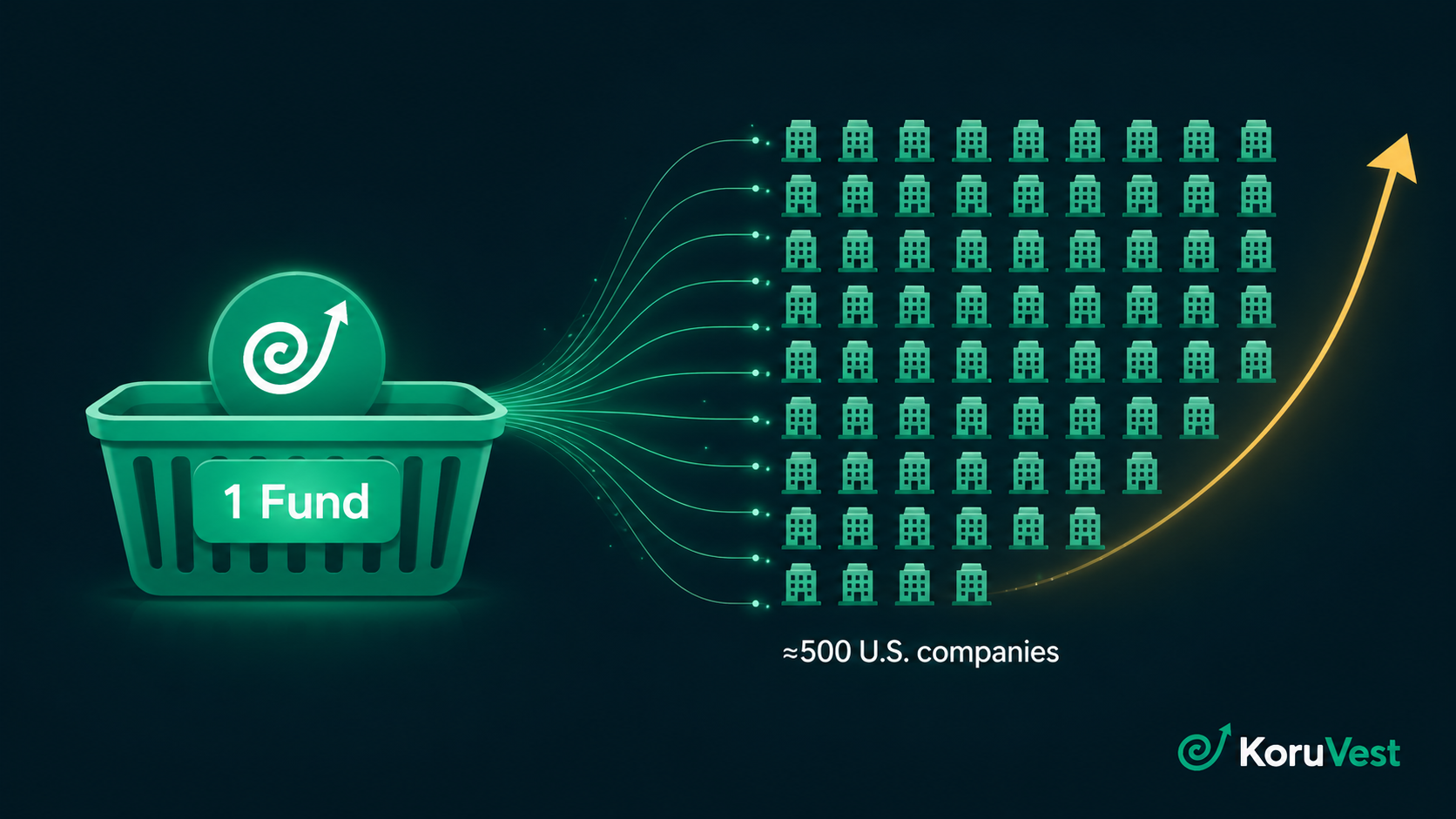
What investors actually buy are financial products designed to track it — most commonly an index mutual fund or ETF.
Those funds own substantially the same companies in approximately the proportions required to follow the index.
That sounds like a technical distinction, but it matters.
The index has no expense ratio. The fund tracking it does.
The index does not generate a tax form for you. The ETF or mutual fund you own can.
And two funds tracking the same S&P 500 can differ slightly in fees, trading structure, distributions, and how conveniently they fit into your account.
It is not simply “the 500 largest U.S. companies”
This is one of the most common shortcuts used to explain the S&P 500.
It is close enough for a casual conversation, but not technically correct.
S&P Dow Jones Indices describes the S&P 500 as measuring the large-cap segment of the U.S. market. Companies must satisfy eligibility requirements that include factors such as U.S. domicile, market capitalization, liquidity, public float, and financial viability.
Index construction also considers the representation of the U.S. equity market.
So a company does not automatically enter the S&P 500 on the day it becomes the 500th-largest U.S. public company.
Nor does another company automatically disappear simply because its market capitalization slips one place in a ranking.
This matters because the S&P 500 is a curated benchmark governed by a methodology, not a live spreadsheet that mechanically sorts every U.S. stock from largest to smallest.
Why can an index of 500 companies show more than 500 securities? S&P Dow Jones Indices describes the benchmark as 500 constituent companies, while its August 31, 2026 characteristics page listed 503 constituents. That can happen because a company may have more than one publicly listed share class represented in the index. Company count and security-line count are therefore not always identical.
Five hundred companies do not get five hundred equal votes
If the S&P 500 were equally weighted, each company would begin with roughly 0.2% of the index.
That is not how the standard S&P 500 works.
The index is weighted by float-adjusted market capitalization.
In practical terms, larger publicly available companies receive larger weights.
If Company A represents 6% of the index and Company B represents 0.05%, a 10% move in Company A has vastly more effect on the index than a 10% move in Company B.
This explains something investors often notice during earnings season.
A handful of giant companies can rise sharply and pull the S&P 500 higher even while many smaller constituents are flat or falling.
The opposite can happen as well.
That weighting has created a real concentration issue
Market-cap weighting has an intuitive logic: the index gives the most weight to the companies with the greatest investable market value.
But it also means successful companies become increasingly influential as their valuations rise.
As of August 31, 2026, S&P Dow Jones Indices reported that the 10 largest constituents represented 37.8% of the standard S&P 500. The largest single constituent represented 8.1%.
Nvidia, Apple, and Microsoft were among the largest constituents at that point.
So when you buy an S&P 500 fund, you are certainly diversified across hundreds of companies.
You are not investing 1/500th of your money in each one.
Diversified does not mean equally distributed. The S&P 500 dramatically reduces single-company risk compared with owning one or two stocks, but market-cap weighting still leaves investors meaningfully exposed to the fortunes and valuations of the largest companies.
The S&P 500 is not the entire U.S. stock market
The index is broad enough that people frequently use “the S&P 500” and “the U.S. stock market” as though they were interchangeable.
They are not.
S&P Dow Jones Indices says the S&P 500 covers approximately 80% of available U.S. equity market capitalization.
That is enormous coverage.
It still leaves a meaningful part of the market outside the index.
Companies in the mid-cap and small-cap segments are represented by other benchmarks, including the S&P MidCap 400 and S&P SmallCap 600.
The S&P Total Market Index is broader still and is designed to cover eligible U.S. common equities across the market.
This distinction matters more than it may appear.
An investor who buys only an S&P 500 fund has large-cap U.S. equity exposure.
That investor does not automatically own:
- the full U.S. small-cap market;
- the full U.S. mid-cap market;
- foreign developed-market stocks;
- emerging-market stocks;
- bonds; or
- cash.
The S&P 500 can therefore be a major building block in a portfolio without necessarily being the entire portfolio.
It is also not a perfect measure of the U.S. economy
Another shortcut appears every time markets move sharply:
“The S&P 500 is up, so the economy must be doing well.”
That conclusion can be too simplistic.
The S&P 500 measures the market value of large public companies.
The U.S. economy includes far more than those companies: private businesses, small employers, government activity, household consumption, labor markets, housing, and other sectors that are not represented by an equity index in the same way.
Stock prices also incorporate expectations about the future rather than merely describing today’s economic conditions.
A company can rise because investors expect profits to improve six or twelve months from now even when current economic data remain weak.
So the S&P 500 is an extraordinarily important market benchmark.
It is not a real-time report card for every part of the American economy.
What does the famous “10% return” actually mean?
One of the most repeated investing statistics is that the S&P 500 has returned “about 10% a year.”
There is a legitimate historical basis for that shorthand.
S&P Dow Jones Indices says the index, which reached its current 500-company format in 1957, has produced an estimated total return of roughly 10% annually over its long history.
But several words in that sentence matter.
Historical. It describes what happened over a long period. It does not establish what investors will earn over the next 10, 20, or 40 years.
Total return. The calculation includes reinvested dividends. The price index you often see quoted on television does not include dividends in the same way.
Annualized. It does not mean investors received 10% every calendar year.
Stock-market returns arrive unevenly.
A year can produce a large gain. Another can produce a deep loss. A multi-year stretch can deliver very little despite an attractive long-term average.
This is why using exactly 10% as a guaranteed input in a retirement calculator creates false precision.
Price return and total return are not the same number
This distinction is worth learning early.
Suppose an S&P 500 company trades at $100 and pays a $2 dividend during the year.
If the share price finishes at $105:
the price return reflects the move from $100 to $105.
The total return also accounts for the dividend.
For an investor trying to understand how a long-term S&P 500 investment performed, total return is generally the more relevant concept because shareholders receive distributions from the companies held by the fund.
This is another reason headline index levels and an investor’s actual fund return are not always identical.
Why index funds became so difficult for active managers to beat
The appeal of an S&P 500 fund is not that the index always produces the highest possible return.
It clearly does not.
Individual stocks, sectors, and other markets can outperform it.
The appeal is that an investor gets broad large-cap U.S. exposure at very low cost without having to identify those future winners in advance.
The long-running SPIVA scorecards from S&P Dow Jones Indices illustrate how difficult that alternative can be.
In 2025, 79% of active U.S. large-cap equity funds underperformed the S&P 500, according to the year-end SPIVA report.
One year’s result should not be treated as proof that active management can never work.
It does show why the index is a formidable benchmark.
An active manager must overcome fees, trading costs, portfolio decisions, and the possibility of missing the small number of very large stocks that drive an outsized portion of index returns.
How investors actually buy S&P 500 exposure
The most common route is an index fund designed to track the S&P 500.
Several large U.S. products do essentially the same benchmark-tracking job but package it differently.
| Fund | Ticker | Structure | Current expense ratio |
|---|---|---|---|
| State Street SPDR Portfolio S&P 500 ETF | SPYM | ETF | 0.02% |
| Vanguard S&P 500 ETF | VOO | ETF | 0.03% |
| iShares Core S&P 500 ETF | IVV | ETF | 0.03% |
| State Street SPDR S&P 500 ETF Trust | SPY | ETF | 0.0945% |
| Fidelity 500 Index Fund | FXAIX | Mutual fund | 0.015% |
Expense ratios are from current provider materials reviewed in September 2026 and can change. This table is illustrative, not a ranking or recommendation.
The cheapest fund is not automatically the only sensible choice
When funds follow the same index, expense ratio deserves attention because lower recurring costs leave more of the portfolio return with the investor.
But expense ratio is not the only structural difference.
An ETF trades throughout the market day.
A traditional mutual fund such as FXAIX is bought and sold at its end-of-day net asset value.
Your brokerage may support automatic mutual-fund purchases differently from recurring ETF purchases.
Fractional-share policies can also vary by broker.
SPY, for example, carries a higher expense ratio than several newer S&P 500 ETFs but has a long trading history and an established options market.
Those characteristics can matter to an institutional or active trader while being largely irrelevant to someone putting $300 a month into a retirement account.
This is why “Which S&P 500 fund is best?” is not completely answered by sorting one column from lowest expense ratio to highest.
For a long-term beginner, cost, account compatibility, automatic investing, portability, and simplicity are usually more useful considerations.
Owning VOO, IVV and SPY together does not give you three times the diversification
This is a surprisingly common beginner portfolio.
An investor hears that VOO is good.
Then reads that IVV is good.
Then buys SPY because it is famous.
The account now contains three ticker symbols, which looks diversified.
But all three seek to track the same S&P 500 benchmark.
The underlying economic exposure therefore overlaps almost completely.
Diversification is determined by what you own underneath the ticker symbols, not by the number of funds shown in the account.
If you want exposure that the S&P 500 does not provide, adding another S&P 500 tracker does not solve the problem.
Is an S&P 500 fund enough for an entire portfolio?
For some investors, it may be the only stock fund they choose to own.
That is different from saying it is a complete portfolio for every person.
An S&P 500 fund gives you:
- broad exposure to U.S. large-cap companies;
- representation across all major U.S. equity sectors;
- a low-cost way to participate in corporate earnings growth; and
- substantially less single-company risk than owning a handful of individual stocks.
It does not provide direct diversification into:
- international stocks;
- the full U.S. small- and mid-cap universe;
- bonds;
- cash; or
- other asset classes.
Whether those exposures belong in your portfolio depends on your goal, time horizon, risk tolerance, tax situation, and other assets.
A concentration problem does not automatically mean the index is “broken”
With the top 10 stocks representing more than a third of the index in mid-2026, concentration deserves attention.
But there are two very different conclusions an investor could draw.
One is:
“The largest companies are too expensive, so I should avoid the S&P 500 entirely.”
The other is:
“The S&P 500 currently has meaningful mega-cap concentration, so I should understand that exposure when building the rest of my portfolio.”
The second statement requires far less ability to predict the future.
Market-cap weighting intentionally lets successful companies become larger parts of the index. If those companies continue to grow, that mechanism can benefit investors.
If their valuations decline sharply, the same weighting creates downside concentration.
That is not a hidden defect.
It is a feature of the index methodology.
What about the S&P 500 Equal Weight Index?
There is an alternative version that holds the same constituent universe but periodically gives each company approximately equal weight.
That reduces the dominance of mega-cap companies.
It also creates a different portfolio.
Equal weighting means more exposure to smaller S&P 500 constituents and requires periodic rebalancing back toward equal weights.
Its performance can therefore differ substantially from the conventional market-cap-weighted S&P 500.
Neither weighting system guarantees a better future return.
The important point for a beginner is simply that “S&P 500” usually means the standard float-adjusted market-cap-weighted index unless a fund specifically says otherwise.
How much could an S&P 500 investment lose?
A portfolio containing 500 companies can still lose a lot of money.
Diversification reduces the damage caused by one company failing.
It does not eliminate broad stock-market risk.
When investors suddenly expect lower corporate profits, higher interest rates, recession, financial instability, or other major risks, hundreds of companies can fall together.
That is why money needed for rent next month, tuition next year, or a near-term home purchase should not automatically be invested in an S&P 500 fund just because the index is diversified.
Time horizon still matters.
A retirement investor and a homebuyer should view the same index differently
Consider two investors, each with $20,000.
The first is 30 years old and investing inside a retirement account that will not be used for decades.
The second plans to buy a home 12 months from now.
The S&P 500 has exactly the same expected market behavior for both investors.
But the consequences of a 30% decline are completely different.
The retirement investor may have decades to wait for a recovery and continue buying along the way.
The homebuyer may lose the ability to make the down payment next year.
This is why the question:
“Is the S&P 500 a good investment?”
is incomplete without:
For what money, and for how long?
The account can matter almost as much as the fund
The same S&P 500 fund can sit inside a taxable brokerage account, Traditional IRA, Roth IRA, or certain workplace retirement plans.
The investment exposure may be similar.
The tax consequences are not.
A taxable account can generate taxable dividend income and capital gains when shares are sold at a profit.
Retirement accounts follow their own contribution, withdrawal, and tax rules.
That is why someone starting with $100 should not focus exclusively on choosing VOO versus IVV before deciding whether the money belongs in a taxable account or a retirement account.
If that decision is still unclear, see Brokerage Accounts for Non-U.S. Citizens: Eligibility, Documents & How to Open One (2026) and How to Invest Your First $100 in the U.S.: A Practical 2026 Guide.
For a global investor, the ticker symbol is only part of the decision
This is where a standard U.S. beginner article stops being sufficient.
An investor living outside the United States may be able to buy a U.S.-domiciled S&P 500 ETF such as VOO, IVV, SPY, or SPYM through an eligible brokerage.
That does not mean the tax result is identical to that of a U.S. taxpayer.
The first distinction is tax status, not citizenship label alone. A non-U.S. citizen can still be a U.S. tax resident, while another investor may be a nonresident alien for U.S. tax purposes.
For a nonresident alien, U.S.-source dividends are generally subject to a 30% statutory withholding rate, although an applicable income-tax treaty may reduce that rate. Form W-8BEN is commonly used by an eligible foreign individual to establish foreign status and, where applicable, claim treaty benefits.
Estate-tax considerations can matter as well. The IRS states that an executor of a nonresident who was not a U.S. citizen generally must file Form 706-NA if U.S.-situated assets exceed the $60,000 filing threshold, subject to treaty and other rules.
Do not infer tax treatment from a visa label. Immigration status, physical residence, U.S. tax residency, and brokerage eligibility are separate concepts. A visa holder should determine the applicable tax status before assuming W-8BEN treatment or nonresident-alien rules apply.
This does not mean foreign investors should avoid the S&P 500.
It means:
“Which index do I want?” and “Which legal fund structure should I use to obtain that exposure?” are separate questions.
An investor outside the United States may also have local-market, UCITS, or other fund structures available. Their tax, estate, currency, and regulatory consequences can differ by country.
For the U.S. withholding side, read our W-8BEN guide. If you first need an account that can serve your country of residence, see Brokerage Accounts for Non-U.S. Residents & Visa Holders: Firstrade vs. IBKR vs. Schwab (2026).
What I would actually compare before buying an S&P 500 fund
First, confirm that large-cap U.S. stocks fit the goal.
The cheapest S&P 500 fund is still the wrong product for money that should not be exposed to stock-market risk.
Then choose the account.
Taxable brokerage, Roth IRA, Traditional IRA, and workplace retirement accounts solve different problems.
Then decide whether you want an ETF or mutual fund.
Trading mechanics, automatic investing, portability, and account availability can make this choice more important than a basis point or two of expense ratio.
Compare ongoing cost.
When two funds track the same index, unnecessary recurring expenses deserve scrutiny.
Check what your brokerage actually supports.
Fractional ETF trading, automatic purchases, and mutual-fund availability differ among firms.
And if you are not a U.S. person, check the tax structure before assuming the U.S.-domiciled ETF is automatically the best implementation.
The useful version of “just buy the S&P 500”
There is a reason the phrase became popular.
For an investor with an appropriate long time horizon, a low-cost S&P 500 fund offers an unusually simple way to obtain exposure to hundreds of leading U.S. businesses.
It removes the need to predict which individual company will become the next market leader.
It can be inexpensive.
It is easy to understand compared with many investment products.
And historical evidence shows that beating the benchmark consistently has been difficult for active large-cap managers.
But a better version of the advice would be:
An S&P 500 fund can be a simple, low-cost core holding for long-term U.S. equity exposure — provided you understand its market-cap concentration, know what it leaves out, choose the right account and fund structure, and can tolerate stock-market losses along the way.
That is not as catchy as “just buy the S&P 500.”
It is much closer to the decision an investor is actually making.
Frequently asked questions
Does the S&P 500 contain exactly the 500 biggest U.S. companies?
No. Size matters, but S&P Dow Jones Indices also applies eligibility criteria involving factors such as U.S. domicile, liquidity, public float, and financial viability. The S&P 500 is a methodology-based large-cap benchmark, not simply an automatic list of the top 500 companies by market value.
Does the S&P 500 represent the entire U.S. stock market?
No. S&P Dow Jones Indices says the index represents roughly 80% of available U.S. market capitalization. Mid-cap and small-cap companies outside the S&P 500 make up part of the remaining market.
Are all 500 companies equally weighted?
No. The standard index uses float-adjusted market-capitalization weighting. Larger companies therefore have much greater influence over index performance than smaller constituents.
How concentrated is the S&P 500 in its largest companies?
S&P Dow Jones Indices reported that the top 10 constituents represented 37.8% of the index as of August 31, 2026. That percentage changes as stock prices and index membership change.
Does the S&P 500 really return 10% every year?
No. Roughly 10% is a commonly cited long-term historical total-return estimate, not an annual guarantee. Individual years can produce large gains or large losses, and future long-term returns can differ from historical averages.
What is the difference between S&P 500 price return and total return?
Price return measures changes in constituent stock prices. Total return also reflects reinvested dividends. For understanding long-term investor experience, total return is usually the more relevant concept.
Should I buy VOO, IVV, SPY, SPYM, or FXAIX?
All are designed to provide exposure to the S&P 500, but they differ in structure, expense ratio, trading mechanics, and account compatibility. VOO, IVV, SPY, and SPYM are ETFs; FXAIX is a mutual fund. There is no need to own several simply to obtain the same S&P 500 exposure.
Is the S&P 500 diversified enough for retirement?
It is highly diversified across U.S. large-cap companies but does not directly provide international stocks, the full U.S. small- and mid-cap market, or bonds. Whether additional diversification is appropriate depends on the investor’s overall portfolio, age, goals, risk tolerance, and other assets.
Can a non-U.S. citizen invest in the S&P 500?
Potentially, yes. Account eligibility depends on the brokerage, residence, documentation, and provider policy. Tax treatment depends on tax status rather than citizenship alone. A nonresident alien may face U.S. dividend withholding and U.S. estate-tax considerations that do not apply in the same way to a U.S. tax resident.
Where to go next
If you are deciding whether an ETF or mutual fund is the better wrapper, continue with Index Mutual Funds vs. ETFs: Trading, Taxes, Minimums & Which Fits You (2026).
If you do not yet have an investment account, read Brokerage Accounts for Non-U.S. Citizens: Eligibility, Documents & How to Open One (2026).
If you are beginning with a very small amount, see How to Invest Your First $100 in the U.S.: A Practical 2026 Guide.
If you are a visa holder or investor living outside the United States, use Brokerage Accounts for Non-U.S. Residents & Visa Holders: Firstrade vs. IBKR vs. Schwab (2026) before choosing a U.S. fund solely by ticker symbol.
📚 Primary sources
- S&P Dow Jones Indices — S&P 500
- S&P Dow Jones Indices — U.S. Indices Methodology
- S&P Dow Jones Indices — The U.S. 500
- S&P Dow Jones Indices — SPIVA U.S. Scorecard
- Vanguard — Vanguard S&P 500 ETF (VOO)
- BlackRock iShares — Core S&P 500 ETF (IVV)
- State Street — SPDR S&P 500 ETF Trust (SPY)
- State Street — SPDR Portfolio S&P 500 ETF (SPYM)
- Fidelity — Fidelity 500 Index Fund (FXAIX)
- IRS Publication 519 — U.S. Tax Guide for Aliens
- IRS — U.S.-Source Dividend Withholding for Nonresident Aliens
- IRS — Estate Tax for Nonresidents Not Citizens of the United States
KoruVest reviewed these sources on September 12, 2026. Index composition, constituent weights, expense ratios, and fund terms change over time. Historical performance does not guarantee future results.
✍️ About the Author
David Han is the lead author of KoruVest, covering U.S. financial accounts, investing, tax-related rules, credit, retirement plans, and cross-border financial decisions for newcomers and international readers.
KoruVest articles are researched using official and authoritative sources and follow our standards for source review, fact checking, updates, and editorial independence.
⚠️ Disclaimer
Educational only. This article provides general information and is not personalized financial, investment, tax, or legal advice.
Investing involves risk. An S&P 500 fund can decline substantially in value, and diversification does not guarantee against loss.
Historical returns are not forecasts. Long-term historical averages should not be interpreted as promised future returns. Confirm current fund expenses, tax consequences, and account eligibility before investing. See our full Disclaimer.
Published: July 1, 2026 · Last updated: September 12, 2026