
The 50/30/20 budget is useful for one reason that has little to do with the numbers 50, 30 and 20.
It forces you to answer three questions:
How much of my income is already committed to things I have to pay?
How much am I choosing to spend?
And how much am I directing toward my future?
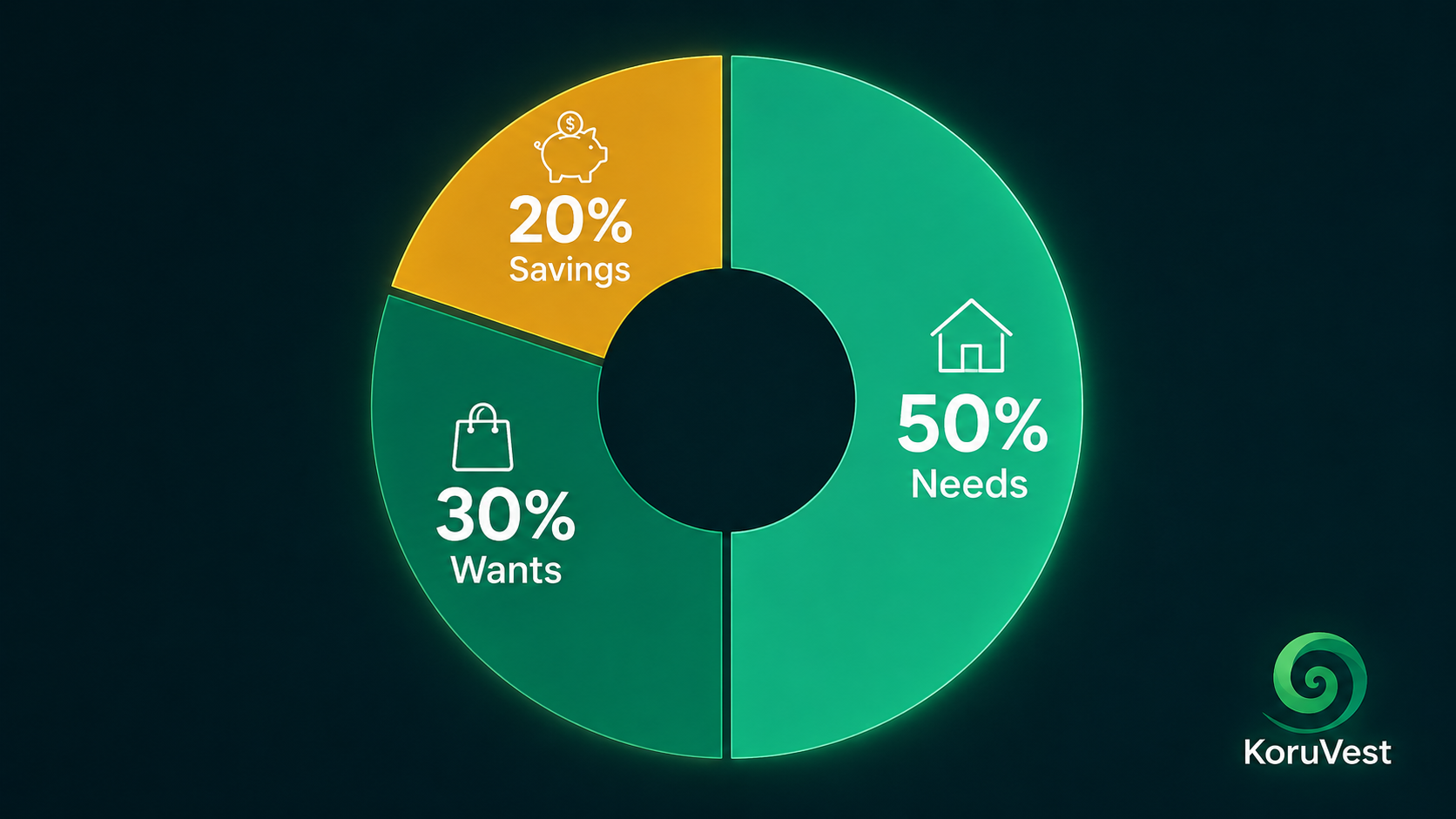
The familiar version divides take-home pay into 50% for needs, 30% for wants, and 20% for savings and debt goals.
That can be an excellent first diagnostic.
It is not a financial law.
The Consumer Financial Protection Bureau itself presents the framework as a common rule of thumb and explicitly notes that not everyone can follow it. Consumers can develop a personal rule that better fits their financial circumstances.
That distinction is especially important in 2026, when housing, transportation, energy and other basic costs can make the neat 50% “needs” bucket unrealistic for some households.
For a U.S. newcomer, the framework can be even harder to apply. A first year in the United States may include security deposits, relocation costs, immigration-related professional fees, money sent to family abroad, or savings for a possible move home. Those costs are real, but forcing every one of them into the standard three buckets can make the budget less useful rather than more useful.
The best use of 50/30/20 is as a dashboard, not a commandment. If your actual split is 63/22/15, the important question is not whether you “failed” the rule. It is why needs are 63%, whether that can realistically change, and whether 15% toward future goals is enough for what you are trying to accomplish.
For newcomers: separate temporary settling-in costs from recurring monthly life before judging your ratio. A one-time apartment deposit or international relocation bill should not automatically become evidence that your normal monthly budget is broken.
Last reviewed: September 12, 2026. Economic data and individual household expenses change over time.
What the 50/30/20 framework actually says
The CFPB has published a consumer spending worksheet using the same basic framework:
- 50% of take-home pay for needs;
- 20% for savings and debt payments; and
- no more than 30% for wants.
It is often written as “50/30/20” because people usually list needs, wants and savings in that order.
The order of the last two numbers does not change the idea.
On $4,000 of monthly take-home pay, the benchmark would look like this:
| Bucket | Benchmark | On $4,000 take-home pay | Typical examples |
|---|---|---|---|
| Needs | 50% | $2,000 | Housing, basic food, utilities, transportation, insurance, essential childcare |
| Wants | 30% | $1,200 | Dining out, entertainment, discretionary shopping, upgrades, leisure travel |
| Future goals | 20% | $800 | Emergency savings, retirement savings, other goals and accelerated debt repayment |
The table is useful because it lets you compare your actual spending with a simple reference point.
It becomes less useful when the percentages turn into moral judgments.
Begin with what you actually spend, not what the rule says you should spend
This is where I would start differently from most budgeting guides.
Do not immediately force every transaction into a perfect 50/30/20 spreadsheet.
Pull one or two months of bank and credit-card activity first.
Then ask what is actually happening.
CFPB similarly advises consumers assessing their spending not to rewrite the budget to show what they think they should be spending. First establish the real picture; then decide what can change.
Suppose your current split is:
62% needs
23% wants
15% savings and additional debt reduction
That information is valuable.
You now know that the biggest difference from the benchmark is not restaurant spending. It is the cost structure of the household.
If the 62% consists mostly of rent, childcare and transportation needed for work, cancelling two subscriptions is not going to transform the budget into 50/30/20.
“Take-home pay” sounds simple until you look at a real paycheck
The CFPB framework uses take-home pay — the income available after taxes and other payroll deductions.
For someone with a simple paycheck, the net-pay line can be a practical starting point.
But modern payroll can create a budgeting complication.
You may already be sending money toward retirement before the remainder reaches your bank account.
Suppose your monthly payroll looks like this:
- Gross pay: $6,000
- Taxes, insurance and other deductions: $1,500
- 401(k) contribution: $500
- Deposit to checking: $4,000
If you simply take $4,000 and then insist that another $800 must leave checking to satisfy a 20% savings target, you have ignored the $500 already being saved through payroll.
Saving $1,300 may be excellent.
But you should know that you deliberately chose that result rather than believing the original ratio required it.
Do not double-count payroll savings
There are two reasonable ways to handle payroll retirement contributions.
The simple method: use the bank-deposit amount as your practical spending budget, and separately keep track of the retirement savings that occurred before the paycheck arrived.
The adjusted method: add voluntary payroll savings back to the budgeting base and then count those same contributions inside the savings bucket.
Using the example above:
Checking deposit = $4,000
401(k) contribution = $500
Adjusted budget base = $4,500
A 20% future-goals benchmark would equal $900.
Because $500 is already being directed to the 401(k), another $400 would bring the household to that illustrative $900 target.
This is not an IRS calculation or an official CFPB modification.
It is simply a way to keep your numerator and denominator consistent when payroll deductions would otherwise make the budget misleading.
Needs and wants are not defined by the name of the expense
Some expenses are easy.
Basic housing is a need.
A luxury vacation is a want.
The difficult categories sit between them.
A car can be essential for one worker and optional for another.
Internet service may be required for remote employment.
A phone is likely necessary; the newest premium phone every year is not.
Food is necessary. A restaurant meal is usually discretionary.
Even housing can contain both components.
You need somewhere to live. You may not need every feature included in the particular home you chose.
This is why I would not ask:
“Is a car a need or a want?”
I would ask:
“What portion of this expense is necessary to maintain housing, health, work or essential family responsibilities, and what portion reflects a lifestyle choice?”
Debt is one reason the three buckets are not perfectly clean
Debt creates an accounting problem for simple budget rules.
A required minimum payment cannot simply be ignored; it is a legal financial obligation.
At the same time, paying more than required to eliminate expensive debt is clearly a form of improving your future balance sheet.
A practical way to keep the framework useful is:
Required payment: treat it as part of committed monthly expenses.
Additional principal payment: count it toward the future-goals / debt-reduction bucket.
That is not the only possible classification.
The important thing is to use one method consistently so that the same payment does not quietly appear in two categories.
The 20% bucket is not necessarily “20% into an investment account”
CFPB’s materials include retirement saving, emergency saving and debt payments within the savings-and-debt part of the framework.
That makes sense because households have different balance sheets.
Consider three people who each direct 20% toward improving their finances.
One is building an emergency fund.
Another is eliminating a high-interest credit-card balance.
A third already has cash reserves and is contributing to retirement and a brokerage account.
Those are different uses of money, but all move the household’s financial position forward.
That is more meaningful than insisting that every person immediately invest exactly 20% of take-home pay.
Emergency savings, debt and investing may need to happen at the same time
There is no universal sequence requiring one goal to reach 100% before the next can begin.
For example, someone might simultaneously:
- build a starter emergency reserve;
- make required debt payments;
- use additional cash to reduce particularly expensive debt; and
- contribute to a workplace retirement plan that offers an employer match.
The allocation depends on the cost of delaying each priority.
Our Emergency Funds for U.S. Newcomers: How Much to Save & Where to Keep It (2026) explains why a cash reserve and retirement saving do not always need to occur in strict sequence.
The 50% needs target can be difficult for reasons that have little to do with budgeting discipline
The cost of basic living is not evenly distributed across households.
Location matters.
Family size matters.
Childcare matters.
Health costs matter.
Whether you need a car to work matters.
And whether housing was purchased or leased years ago versus recently can matter enormously.
Official U.S. expenditure data illustrate why the 50% line can become tight.
In the Bureau of Labor Statistics’ 2024 Consumer Expenditure Survey, housing represented 33.4% of average household expenditures and transportation another 17.0%.
Together, those two categories represented just over half of average expenditures.
That does not mean the average American spends 50% of take-home income on two “needs.”
The BLS denominator is total expenditures, not take-home income, and each broad BLS category also contains spending that would not necessarily be classified as a “need” under a household budget.
But the data do demonstrate something important:
Housing and transportation dominate many household budgets before groceries, healthcare, childcare and other obligations are considered.
2026 inflation is another reason to use current numbers carefully
Budget articles age quickly when they hard-code economic statistics.
In the Bureau of Labor Statistics’ August 2026 CPI release, overall U.S. consumer prices were 3.4% higher than a year earlier.
But that headline number hides large differences among categories.
Food prices were up 2.7% over the year.
Shelter was up 3.0%.
Energy prices were up 16.3%, including a 27.4% increase in gasoline prices.
A household driving long distances can therefore experience a very different budget squeeze from someone whose primary expense is groceries.
This is another reason a national inflation rate cannot determine your personal budget ratio.
Inflation does not tell you what your budget should be. It tells you how a broad basket of prices is changing. Your actual spending pattern determines which of those price changes matter most to you.
If your needs are 65%, changing the ratio is not the first question
Imagine monthly take-home pay of $4,500 with this actual breakdown:
- Needs: $2,925 — 65%
- Wants: $675 — 15%
- Future goals: $900 — 20%
This household misses the textbook 50/30/20 split by a wide margin.
But it still saves 20%.
Calling the budget a failure because needs equal 65% would tell us almost nothing.
Instead, inspect the $2,925.
If $1,800 is rent, $600 is childcare and the remaining $525 covers utilities, basic food, insurance and transportation, the budget may have very little short-term flexibility.
The meaningful changes may require:
- moving when the lease ends;
- changing transportation arrangements;
- altering childcare;
- increasing household income; or
- accepting a different long-term savings rate temporarily.
Those are larger decisions than cancelling Netflix.
If needs are high because of lifestyle choices, the diagnosis changes
Now consider another household with the same 65% “needs” figure.
But part of that category comes from:
- a significantly more expensive apartment than nearby alternatives;
- two high car payments;
- premium cell-phone plans;
- subscriptions bundled into utility bills; and
- other expenses labeled “necessary” because cancelling them would be inconvenient.
The percentage is the same.
The financial problem is not.
This is the real value of categorization.
It helps separate structural cost from discretionary cost disguised as structural cost.
There is nothing sacred about 60/30/10 or 70/20/10 either
A common response to the 50/30/20 rule is to invent another fixed rule:
60/30/10 for expensive cities.
70/20/10 for very expensive cities.
50/20/30 for aggressive savers.
Those can be useful examples.
They are not evidence-based thresholds that automatically become correct when your ZIP code changes.
If you need 63% for essential expenses, the right customized budget may be 63/17/20.
If you can comfortably live on 40% and want to save 35%, there is no reason to increase wants to 30% just to make the original formula balance.
The percentages should describe and guide your plan.
Your life should not be forced to serve the percentages.
A better way to customize the rule
Instead of choosing another internet ratio, I would calculate three numbers.
1. Your minimum sustainable needs percentage
After reviewing realistic alternatives, what does it actually cost to maintain housing, work, health and necessary family obligations?
2. Your required future-goals percentage
How much must be directed toward emergency savings, debt reduction and retirement to reach the goals that actually matter?
3. Your remaining discretionary percentage
Whatever is left is the amount available for wants.
Suppose your realistic minimum needs equal 57% and you have decided that 18% toward future goals is appropriate.
Your working framework becomes:
57% needs + 25% wants + 18% future goals = 100%
There is nothing inherently inferior about that budget because it does not contain a round 50.
Budgeting can reveal an income problem that expense cutting cannot solve
This is one of the limitations of almost every percentage-budget article.
If essential expenses consume nearly all take-home income even after reasonable cost reductions, the problem may no longer be primarily a spending-allocation problem.
It may be an income-to-cost mismatch.
Suppose monthly take-home income is $3,000 and unavoidable essentials are $2,700.
That is 90% of available cash.
You cannot create a 20% savings rate by “being more disciplined” when only 10% remains after necessities.
There are only a few mathematical levers:
- reduce a major fixed cost;
- increase income;
- change the financial obligation itself;
- use available assistance or benefits where eligible; or
- accept a lower temporary savings rate while working on the structural problem.
A useful budget identifies that reality rather than turning it into personal failure.
Newcomers should separate recurring living costs from settling-in costs
The first few months after moving to the United States can distort a normal monthly budget.
You may pay expenses such as:
- an apartment security deposit or prepaid rent;
- utility or mobile-service deposits;
- basic furniture and household setup;
- driver’s-license, transportation or vehicle setup costs;
- immigration-related professional or filing costs;
- international airfare or shipping; or
- temporary overlap between U.S. expenses and obligations in another country.
These are real expenses, but many are transition costs rather than normal recurring monthly needs.
If you mix all of them into one month’s 50/30/20 calculation, the result may say “needs = 85%” even though your stabilized monthly cost structure is much healthier.
A more useful newcomer setup:
Track recurring monthly needs / wants / future goals using the 50/30/20 framework, and track one-time transition costs separately until the move is complete.
This is not a new official “four-bucket rule.” It is simply a bookkeeping adjustment that prevents temporary relocation expenses from distorting the recurring budget you are actually trying to manage.
What about irregular income?
The monthly 50/30/20 framework assumes something many people do not have: a predictable monthly paycheck.
Freelancers, commission workers and business owners need an additional step.
I would begin with a conservative baseline income rather than automatically budgeting from the best month of the year.
Another approach is to separate:
- business or income-producing expenses;
- tax reserves;
- household spending; and
- personal savings.
Only after the appropriate business and tax amounts are accounted for does the household ratio become meaningful.
A freelancer who receives a $10,000 client payment does not necessarily have $10,000 of household take-home income available for a 50/30/20 split.
Cross-border obligations can change what the percentages mean
A newcomer, temporary visa holder, or international worker can have obligations that a conventional U.S. budgeting article never sees.
Examples include:
- regular support for family abroad;
- international tuition obligations;
- visa or immigration-related professional fees;
- periodic flights home;
- maintaining financial commitments in another country; or
- saving for a possible international relocation.
Whether an individual item is a need, a want or a future goal depends on the facts.
But those payments should not disappear simply because they do not fit neatly into a standard American budget example.
If $700 of a $5,000 monthly take-home income is a genuine recurring family obligation abroad, build the budget around that reality first.
Do not automatically label every remittance a “want” merely because the recipient lives outside the United States. Nor should every cross-border payment automatically be called a “need.” Classify it by its actual purpose: essential family support may be a committed obligation, optional gifts may be discretionary, and money accumulated for a possible move home may belong in future goals.
A budget should eventually become easier, not more complicated
You may need detailed transaction review for the first month or two.
You should not necessarily need to categorize every $7 purchase forever.
Once you understand the household’s major flows, the system can become much simpler.
For example:
Income arrives.
Retirement and other automatic savings happen.
Fixed needs are reserved.
A defined amount remains for variable needs and wants.
The purpose of budgeting is to make decisions clearer.
If the tracking system requires so much maintenance that you stop using it, the system has defeated its own purpose.
How I would set up a 50/30/20 diagnostic
Start with one month of actual cash flow.
Use pay statements, bank records and credit-card statements rather than estimates from memory.
Identify payroll savings separately.
Know whether retirement contributions or other savings have already occurred before the paycheck reaches checking.
Separate committed expenses from discretionary ones.
Do not worry about making every ambiguous expense philosophically perfect. Be consistent.
Calculate your actual three percentages.
Do not change anything yet.
Compare them with 50/30/20.
Ask what explains the largest difference.
Change the largest meaningful lever.
If wants are 42%, discretionary reductions may solve the problem.
If rent alone consumes 50%, the important decision is unlikely to be coffee.
Automate whatever future-goal amount you decide is realistic.
Then review the ratio after a raise, move, new child, major debt payoff or other material life change.
One complete example
Jordan has $5,000 a month of usable household income after accounting consistently for payroll deductions.
Actual monthly spending is:
- Housing and utilities: $1,650
- Groceries: $500
- Transportation and insurance: $600
- Other essential obligations: $300
- Dining, subscriptions and entertainment: $750
- Travel and discretionary shopping: $300
- Emergency and retirement savings: $600
- Additional debt reduction: $300
Total needs are $3,050, or 61%.
Wants are $1,050, or 21%.
Future goals are $900, or 18%.
The budget is 61/21/18.
Is that bad?
Not enough information.
If Jordan’s housing and transportation can be changed easily, the 61% deserves investigation.
If those expenses are reasonably efficient and temporary, maintaining 18% toward future goals may be a very good outcome.
The budget ratio has done its job.
It showed Jordan where the money goes and where the biggest decision sits.
Frequently asked questions
Is the 50/30/20 rule based on gross income or take-home pay?
The CFPB version uses take-home pay. If voluntary retirement savings already come out through payroll, keep track of those contributions so you do not accidentally treat them as though no saving has occurred simply because the money never reached checking.
Is 50/30/20 an official government budgeting requirement?
No. CFPB presents it as a common rule of thumb and specifically notes that not everyone can follow it. It is a planning framework rather than a regulatory or financial requirement.
What counts as a need?
Needs generally include expenses necessary for housing, basic living, work, health and essential family responsibilities. Some categories contain both necessary and discretionary components, so consistency matters more than finding one universal classification for every purchase.
What if my needs are more than 50%?
First determine why. High needs can reflect unavoidable housing, childcare, transportation or medical costs, or they can contain discretionary choices that have gradually been treated as necessities. The solution depends on which is true.
Should I switch to a 60/30/10 budget?
You can use any ratio that helps manage your finances, but 60/30/10 is not inherently more correct than 50/30/20. Calculate the minimum cost of your actual needs and the future-goal rate required for your priorities, then let the remaining percentage determine discretionary spending.
Does paying off debt count in the 20%?
CFPB’s framework includes savings and debt payments in the 20% category. For practical household tracking, some people treat required minimum payments as committed expenses and additional debt reduction as a future financial goal. Whichever method you use, avoid double-counting the same payment.
Does my 401(k) contribution count as savings?
Yes, retirement contributions are savings. If the contribution occurs through payroll before the rest of your paycheck reaches the bank, account for it when evaluating your total savings effort rather than looking only at transfers from checking.
Do I need to save exactly 20%?
No. Twenty percent is a benchmark, not a federal requirement. The appropriate rate depends on income, existing assets, debt, retirement goals, age, household obligations and other circumstances.
How often should I recalculate the budget?
Review it frequently while establishing the system, then revisit it when income, housing, family obligations or other major expenses change. The purpose is to identify meaningful changes, not to continually optimize insignificant transactions.
Where to go next
If your budget shows that your first priority is building cash reserves, read Emergency Funds for U.S. Newcomers: How Much to Save & Where to Keep It (2026).
If that money needs a better place to sit, continue with High-Yield Savings Accounts Explained: APY, FDIC Insurance & When to Use One.
If your cash flow is stable and you are ready to begin investing, see How to Start Investing in the U.S.: A Step-by-Step Guide for Newcomers (2026).
If your employer offers a retirement plan, read our 401(k) guide so payroll retirement contributions are included correctly when you evaluate your savings rate.
📚 Primary sources
- Consumer Financial Protection Bureau — My Spending Rule to Live By
- Consumer Financial Protection Bureau — Learning About Budgets
- Consumer Financial Protection Bureau — Assess Your Spending
- U.S. Bureau of Labor Statistics — Consumer Price Index, August 2026
- U.S. Bureau of Labor Statistics — Housing and Transportation in Household Expenditures
KoruVest reviewed these sources on September 12, 2026. The 50/30/20 framework is a budgeting rule of thumb, not a required allocation. Household costs, income and appropriate savings rates differ substantially.
✍️ About the Author
David Han is the lead author of KoruVest, covering U.S. financial accounts, investing, tax-related rules, credit, retirement plans, and cross-border financial decisions for newcomers and international readers.
KoruVest articles are researched using official and authoritative sources and follow our standards for source review, fact checking, updates, and editorial independence.
⚠️ Disclaimer
Educational only. This article provides general budgeting and personal-finance information and is not individualized financial, investment, tax, immigration, or legal advice.
The percentages are guidelines. Household income, expenses, debt, dependents, location and financial goals can justify a substantially different allocation.
Use current information. Economic statistics and household costs change over time. See our full Disclaimer.
Published: June 27, 2026 · Last updated: September 12, 2026