
Opening a brokerage account sounds like it should require a suit, a phone call, and a minimum balance with a lot of zeros. In 2026, it takes about 10 minutes, $0 to start, and a phone.
A brokerage account is simply the account you use to buy investments — stocks, ETFs, index funds. Think of it as a bank account that can hold investments instead of just cash. Once it’s open and funded, you can start buying with as little as a dollar.
This guide walks you through exactly how to open one, which account type to pick, how your money is protected, and the “free” fees that aren’t actually free.
📌 KEY TAKEAWAYS
- A brokerage account is the account that lets you buy and hold investments like stocks and ETFs.
- In 2026, most major brokers charge $0 commissions, have no account minimum, and offer fractional shares — you can start with about $1.
- You’ll need a Social Security number (or ITIN), a government ID, and a bank account to fund it. Setup takes roughly 10 minutes.
- Beginners should choose a cash account, not a margin account, which involves borrowing.
- Your account is protected by SIPC up to $500,000 if the broker fails — but SIPC does not cover market losses.
What is a brokerage account?
Quick answer: A brokerage account is an investment account you open with a licensed brokerage firm to buy and sell securities like stocks, ETFs, and mutual funds. You deposit cash, then use it to invest. Any growth, dividends, or losses happen inside the account.
Here’s the simplest way to picture it. Your checking account holds dollars. A brokerage account holds dollars and investments — and lets you move between the two.
You’re not handing your money to the broker. They’re just the platform that connects you to the market. Your investments belong to you, held in your name.
One thing worth clearing up early: a brokerage account isn’t a single product. There are a few types, and picking the right one is step one.
What you need to open a brokerage account
Quick answer: To open a brokerage account, you generally need to be at least 18, and have a Social Security number or ITIN, a government-issued photo ID, a U.S. mailing address, and a bank account to transfer money from. Brokers also ask for basic employment info for regulatory reasons.
None of this is complicated. Have these ready before you start, and the application flies by:
- Social Security number (or ITIN)
- Government-issued photo ID (driver’s license or passport)
- A U.S. mailing address and date of birth
- Your bank’s routing and account numbers (to fund the account)
- Employment details — brokers are required to ask
If you’re opening an account for a child, that’s a custodial account, which an adult manages until the child is of age. For everyone else, an individual account is the standard starting point.
How to open a brokerage account in 6 steps
Quick answer: Choose a brokerage, pick your account type, gather your info, apply online, link your bank to fund it, and place your first order. Most people finish in under 15 minutes, and you can start investing the same day.
Let’s walk through it.
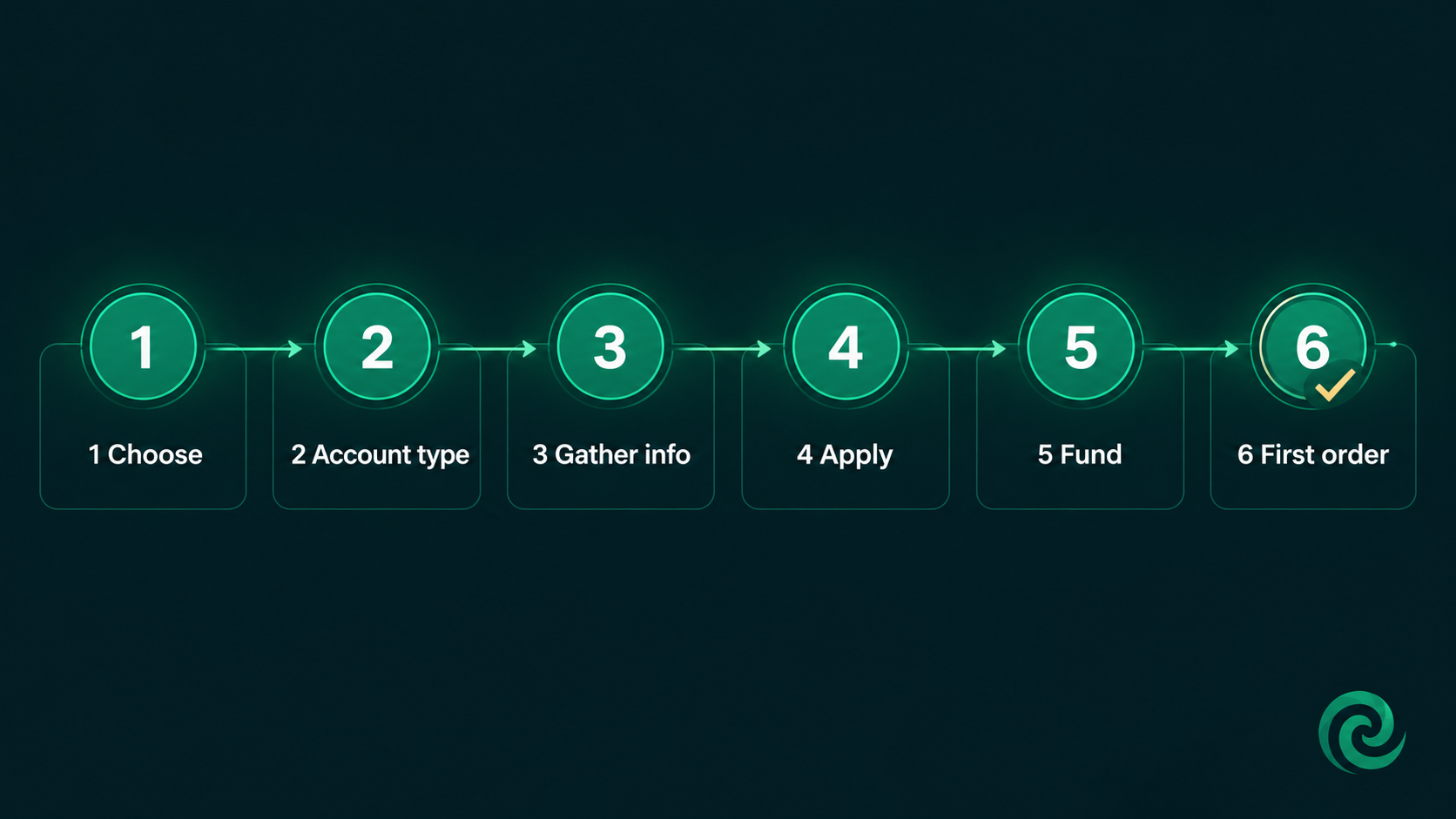
1. Choose a brokerage. Compare a few major online brokers on the things that matter: $0 commissions (now standard), no account minimum, fractional shares, and beginner-friendly tools. Well-known options include Fidelity, Charles Schwab, Robinhood, and SoFi, among others — pick the one whose app and features fit you.
2. Pick your account type. For most beginners, a standard individual taxable account is the right start. If you’re investing specifically for retirement, an IRA (a tax-advantaged retirement account) may make more sense. You can always open more than one later.
3. Gather your info. Have your SSN, ID, and bank details handy from the checklist above.
4. Apply online. Fill out the application on the broker’s website or app. It usually takes 10–15 minutes, and approval is often instant.
5. Fund the account. Link your bank account and transfer money in. Thanks to fractional shares, you don’t need much — even $20 is enough to begin.
6. Place your first order. Start simple. Many beginners begin with a low-cost, broadly diversified index ETF rather than picking individual stocks. If you’re unsure what to buy, our guide on index funds vs. ETFs breaks down the options, and how to start investing as a beginner covers the bigger picture.
One small tip: turn on DRIP (dividend reinvestment), which automatically reinvests any dividends to buy more shares. It’s a quiet way to compound over time.
Cash account vs. margin account: which should a beginner choose?
Quick answer: Beginners should choose a cash account. With a cash account, you can only invest money you actually have. A margin account lets you borrow from the broker to invest more — which amplifies both gains and losses and can trigger a forced sale called a margin call.
When you apply, the broker may ask whether you want a cash or margin account. The answer for new investors is easy.
A cash account is exactly what it sounds like: you spend the cash you’ve deposited, nothing more. It’s the safest way to learn.
A margin account lets you borrow money to buy more investments. That borrowing — called leverage — can boost your returns, but it can just as easily magnify your losses. If your investments drop too far, the broker can demand you add money or sell, sometimes at the worst possible time. Skip it until you really know what you’re doing.
Is your money safe in a brokerage account?
Quick answer: Yes, against the right risk. If a SIPC-member brokerage fails and your assets go missing, SIPC protects you up to $500,000 (including a $250,000 cash limit). But SIPC does not protect you from investment losses — if your stocks fall in value, that’s normal market risk.
This is where a lot of beginners get confused, so let’s be precise.
The SIPC (Securities Investor Protection Corporation) steps in if a brokerage firm fails and customer assets go missing. According to SIPC, coverage is up to $500,000 per customer, with a $250,000 sub-limit on cash. Always check that your broker is a “FINRA/SIPC member” — reputable ones state it clearly.
But here’s the line that matters: SIPC does not cover market losses. If you buy a stock and it drops, that’s investing, not a failure SIPC fixes. It also generally doesn’t cover crypto. SIPC is different from FDIC, which protects bank cash. Here’s the contrast.
| FDIC (banks) | SIPC (brokerages) | |
|---|---|---|
| Protects | Bank deposits (cash) | Securities + cash in a brokerage |
| Standard limit | $250,000 per depositor, per bank | $500,000 ($250,000 cash) |
| Covers market losses? | N/A (cash only) | No |
| Backed by | U.S. government | Non-profit (not government) |
If you’re keeping pure cash for an emergency, a bank is the place — see high-yield savings accounts. A brokerage is for money you’re ready to invest.
“Commission-free” doesn’t mean free: fees beginners miss
Quick answer: Most brokers offer $0 commissions on stock and ETF trades, but they still make money. Watch for options contract fees, fund expense ratios, account transfer fees (often $75–$100), possible inactivity fees, and low interest paid on your uninvested cash.
“Free” is a great headline. It’s just not the whole story.
Brokers earn revenue in quieter ways, and a few small fees can add up. Keep an eye on these:
Fund expense ratios. The ETF or mutual fund itself charges a small annual fee — not the broker, but it still comes out of your returns. Lower is better; many index funds charge well under 0.10%.
Options contracts. Stock and ETF trades may be free, but options often cost around $0.50–$0.65 per contract.
Transfer-out fees. Move your whole account to another broker and you may pay roughly $75–$100. Worth knowing before you commit.
Inactivity and cash drag. Some brokers charge a fee if your account sits idle, and many pay very little interest on uninvested cash. If you’ll hold cash for a while, check that rate.
How to choose the right brokerage
Quick answer: Look for $0 commissions, no account minimum, fractional shares, the account types you need, SIPC membership, and an app you’ll actually enjoy using. For most beginners, several major brokers check all of these boxes.
Use this as a quick scorecard when you’re comparing options.
| What to check | Look for |
|---|---|
| Commissions | $0 on stocks & ETFs (now standard) |
| Account minimum | $0 to open |
| Fractional shares | Yes — start with ~$1 |
| Account types | Has what you need (taxable, IRA) |
| Safety | FINRA/SIPC member |
| Tools & education | Beginner-friendly app + learning content |
Prefer not to pick investments yourself? A robo-advisor builds and manages a portfolio for you automatically — a hands-off alternative to a self-directed brokerage account.
🌿 Our Take
Don’t agonize over the “perfect” broker — for a beginner, the big names are far more alike than different, and almost all of them now offer $0 commissions and fractional shares. The bigger mistake is waiting months to decide while your money sits idle. Open a cash account at a reputable SIPC-member broker, start small, and learn by doing. You can always switch later if your needs change.
Mistakes to avoid when opening your first account
Choosing a margin account by accident. Stick with a cash account unless you fully understand the risks of borrowing to invest.
Assuming “free” means no costs. Check the fee schedule for expense ratios, options fees, and transfer charges before you commit.
Confusing SIPC with FDIC. SIPC protects against broker failure, not market losses. Investing always carries the risk of losing money.
Waiting for the perfect moment. The account itself takes 10 minutes. Don’t let analysis paralysis cost you months of getting started.
✅ Your Next Steps
- Pick one reputable, $0-commission broker that offers fractional shares and is a FINRA/SIPC member.
- Open an individual cash account online — have your SSN, ID, and bank details ready.
- Fund it with a small amount you’re comfortable investing, and place one simple first order.
Rule of thumb: build your emergency fund first, then open a brokerage account for money you won’t need for 5+ years.
🎯 The Bottom Line
Opening a brokerage account in 2026 is fast, free to start, and beginner-friendly. Choose a cash account at a SIPC-member broker, watch the small fees, and remember: the account is just the door. What matters is starting and staying consistent.
Frequently asked questions
How much money do I need to open a brokerage account?
Usually $0 to open. Most major brokers have no account minimum, and fractional shares let you make your first investment with as little as $1. You only need enough to buy what you want once the account is funded.
How long does it take to open a brokerage account?
About 10 to 15 minutes online, and approval is often instant. Funding by linking your bank account can take a day or two to clear, but many brokers let you start once the transfer is initiated.
Is a brokerage account the same as a bank account?
No. A bank account holds cash and is FDIC-insured. A brokerage account holds investments like stocks and ETFs, is protected by SIPC against broker failure, and carries market risk — your balance can go up or down.
Can I lose money in a brokerage account?
Yes. Investments rise and fall in value, so you can lose money if your holdings drop. SIPC protects you if the brokerage itself fails, but it does not protect against normal market losses. Invest money you won’t need soon.
Do I need to pay taxes on a brokerage account?
Generally, yes, in a standard taxable account. You may owe taxes on dividends and on gains when you sell investments for a profit. Tax-advantaged accounts like IRAs work differently. Your broker provides tax forms each year to help.
Ready for the next step? Pair this with how to start investing as a beginner, learn how to begin with just $100, and make sure your emergency fund is in place first.
📚 Sources
- U.S. Securities and Exchange Commission — Investor.gov (getting started)
- SIPC — What SIPC Protects (coverage limits)
- NerdWallet — Best Online Brokers for Beginners 2026
Broker features and fees verified as of June 2026 and subject to change. Confirm current terms with the brokerage before opening an account.
✍️ Written by the KoruVest Editorial Team
The KoruVest Editorial Team brings more than 40 years of combined experience in management consulting and corporate finance, including hands-on work in Asian capital markets. We explain investing in plain English, ground every article in primary sources (SEC, the Federal Reserve, FINRA, FDIC, Morningstar), and never let commissions shape our recommendations.
⚠️ Disclaimer
Educational only. This article is general information, not personalized financial, investment, tax, or legal advice.
Risk. Investing involves risk, including the possible loss of principal. Past performance doesn’t guarantee future results.
Consult a professional. Please speak with a licensed financial professional before making decisions. See our full Disclaimer.
Published: June 30, 2026 · Last updated: June 30, 2026 · Reviewed by the KoruVest Editorial Team