
Roth or traditional?
It looks like a two-button decision when you open an IRA. In reality, the choice is less about the account name and more about which tax treatment you want to buy.
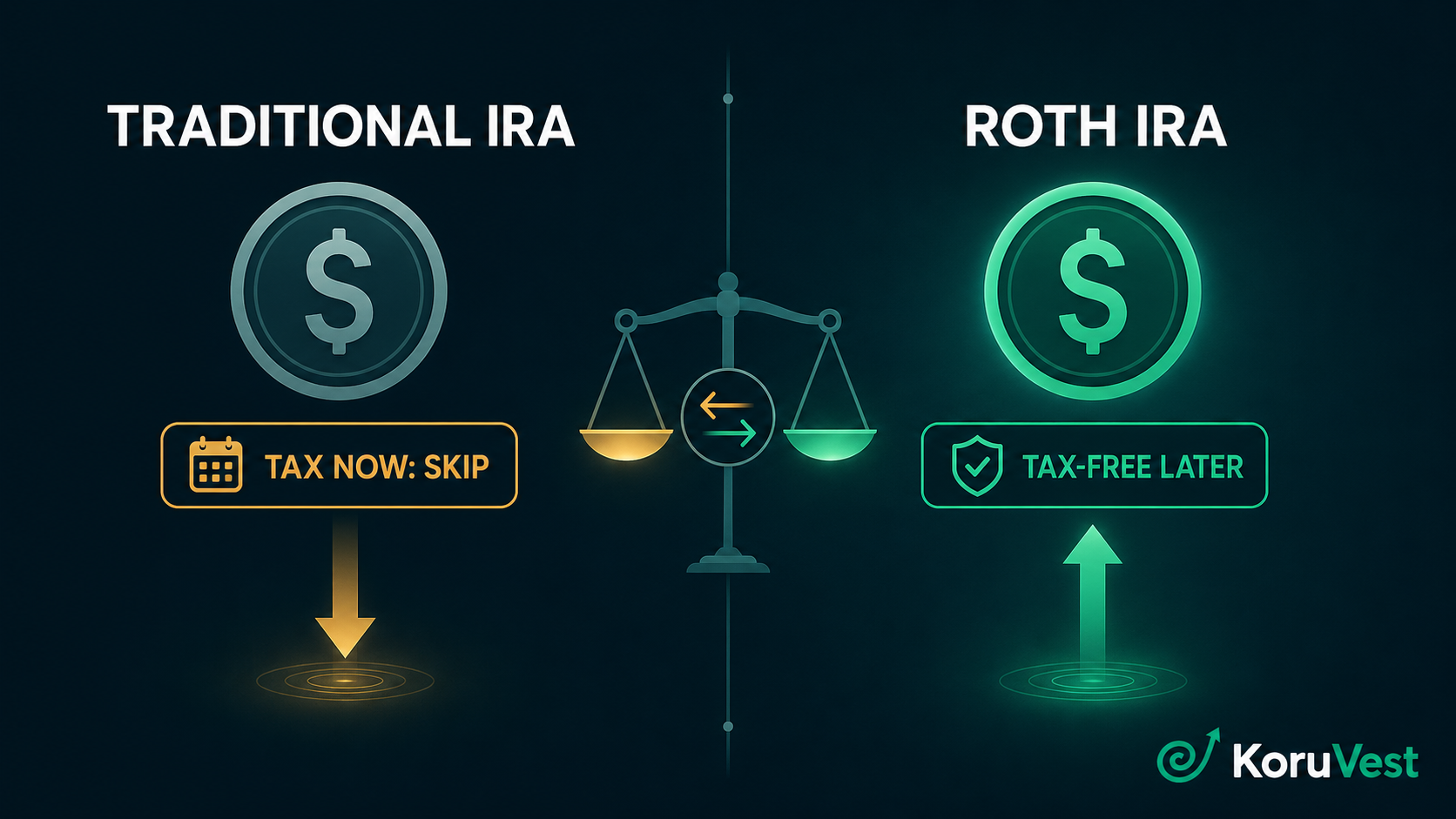
A Roth IRA generally asks you to give up a deduction today in exchange for potentially tax-free qualified withdrawals later.
A traditional IRA can offer the opposite bargain — a deduction today and taxable distributions later — but only if you actually qualify for the deduction.
That last part changes the comparison.
A traditional IRA contribution is not automatically “pre-tax money.” A contribution can be fully deductible, partially deductible, or nondeductible depending on your workplace retirement-plan coverage, filing status, and income.
So the useful question is not simply:
Would I rather pay tax now or later?
It is:
What tax benefit am I actually eligible for today, and what tax flexibility am I likely to value later?
The most important distinction: Roth contributions are never deductible. Traditional IRA contributions may be deductible, partially deductible, or nondeductible. If the traditional contribution is not deductible, the familiar “tax break now versus tax break later” comparison no longer describes the decision accurately.
This guide is the decision article. It compares deduction eligibility, current versus future tax rates, nondeductible Traditional IRA basis, Form 8606, RMDs, and tax diversification. For Roth-specific mechanics such as withdrawal ordering, five-year rules, and conversions, use Roth IRA Rules for 2026.
Last reviewed: September 12, 2026. IRA contribution limits, deduction phase-outs, Roth income limits, and retirement tax rules can change.
Both IRAs share one contribution limit
For 2026, the general contribution limit across your Traditional and Roth IRAs is $7,500.
If you are age 50 or older by year-end, the IRA catch-up amount is $1,100, bringing the potential total to $8,600.
That is a combined limit.
A 35-year-old cannot contribute $7,500 to a Traditional IRA and another $7,500 to a Roth IRA as regular contributions for the same year.
You could instead contribute, for example:
- $7,500 to Roth and $0 to Traditional;
- $7,500 to Traditional and $0 to Roth; or
- $4,000 to Roth and $3,500 to Traditional.
Assuming all other eligibility requirements are satisfied, each of those examples uses the same $7,500 annual IRA limit.
Your taxable compensation can impose a lower limit as well.
The Traditional IRA deduction is conditional
This is the rule that most simplified comparisons skip.
You can generally make a regular contribution to a Traditional IRA if you have eligible taxable compensation.
But whether you can deduct that contribution is a separate question.
If neither you nor your spouse is covered by a retirement plan at work, the IRS says the normal workplace-plan income phase-outs do not apply to the Traditional IRA deduction.
If you or your spouse is covered, income can reduce or eliminate the deduction.
| Your situation | 2026 MAGI phase-out | What changes |
|---|---|---|
| Single / Head of household and covered by a workplace plan | $81,000–$91,000 | Deduction phases from full to zero |
| Married filing jointly; contributor is covered by workplace plan | $129,000–$149,000 | Deduction phases from full to zero |
| Contributor not covered, but spouse is covered by workplace plan | $242,000–$252,000 | Deduction phases from full to zero |
| Married filing separately and applicable workplace-plan coverage | $0–$10,000 | Special narrow phase-out applies |
These are deduction limits.
They are not the same thing as saying, “You earn too much to have a Traditional IRA.”
A person whose deduction has disappeared can still potentially make a nondeductible Traditional IRA contribution.
That creates a different tax profile, which we will come back to.
Roth IRA income rules answer a different question
A Roth IRA contribution never creates a federal income-tax deduction.
Instead, MAGI can determine whether you are allowed to make the regular Roth contribution directly in the first place.
| Filing status | Full contribution | Reduced contribution | No direct contribution |
|---|---|---|---|
| Single / Head of household | Below $153,000 | $153,000 to under $168,000 | $168,000 or more |
| Married filing jointly | Below $242,000 | $242,000 to under $252,000 | $252,000 or more |
| Married filing separately and lived with spouse during the year | Special rules begin at $0 | More than $0 but under $10,000 | $10,000 or more |
This creates situations that cannot be summarized by “Traditional for high earners, Roth for young people.”
A worker might earn too much to deduct a Traditional IRA contribution because of workplace-plan coverage while still being fully eligible for a direct Roth contribution.
Another taxpayer might earn too much for a direct Roth contribution but still be able to make a Traditional IRA contribution — although the contribution may be nondeductible.
The simplest tax comparison begins with equal tax rates
There is a useful piece of mathematics behind Roth-versus-Traditional decisions that rarely makes it into beginner articles.
If:
- the Traditional contribution is fully deductible;
- you compare the same amount of pre-tax income;
- the investments earn the same return;
- your marginal tax rate is identical when contributing and withdrawing; and
- the current tax savings from the Traditional contribution are not simply spent,
then Roth and Traditional can produce essentially the same after-tax result.
Consider an illustration using $7,500 of pre-tax income, a 22% tax rate, and a hypothetical 7% annual return for 30 years.
This is not a forecast. It is simply tax math.
| Deductible Traditional IRA | Roth IRA | |
|---|---|---|
| Pre-tax income available | $7,500 | $7,500 |
| Tax paid before contribution at 22% | $0 in this simplified deductible example | $1,650 |
| Amount invested | $7,500 | $5,850 |
| Value after 30 years at hypothetical 7% | About $57,092 before withdrawal tax | About $44,532 |
| After 22% tax at withdrawal | About $44,532 | About $44,532 |
The result is not a coincidence.
If the tax rate on the same dollars is exactly the same before and after growth, moving the tax payment from the beginning to the end does not create wealth by itself.
That tells us where the decision really comes from:
differences in tax rates and tax rules.
If the future tax rate is lower, Traditional gains an advantage
Keep the same hypothetical assumptions, but change the withdrawal tax rate.
If the $7,500 Traditional contribution grows to about $57,092 and the future marginal tax rate is only 12%, the hypothetical after-tax value becomes approximately $50,241.
That is more than the roughly $44,532 Roth outcome created from the same original $7,500 of pre-tax income taxed at 22% today.
In that scenario, paying tax later at 12% instead of today at 22% was valuable.
If the future tax rate is higher, Roth gains the advantage
Now imagine the future marginal rate is 32%.
The same $57,092 Traditional IRA would leave approximately $38,823 after a simplified 32% withdrawal tax.
The Roth side of our example still has approximately $44,532 because the tax was already paid at the assumed 22% rate before the money went in.
In that scenario, Roth wins.
This is the core economic question: A fully deductible Traditional IRA tends to become more attractive when the tax rate avoided today is higher than the rate ultimately paid on withdrawals. Roth tends to become more attractive when today’s tax rate is lower than the rate that would otherwise apply later.
Unfortunately, nobody knows their exact retirement tax rate
This is why Roth versus Traditional cannot be reduced to a calculator with one perfectly knowable input.
Your future tax situation can depend on:
- future federal tax law;
- your retirement income;
- pensions;
- Social Security;
- withdrawals from other retirement accounts;
- investment income;
- filing status;
- where you live; and
- how much pre-tax money you have accumulated elsewhere.
A 28-year-old earning $65,000 knows today’s tax situation reasonably well.
They do not know the tax code that will exist at age 70.
That uncertainty is why holding both pre-tax and Roth retirement assets over a career can create useful tax diversification.
You are not required to choose one tax treatment for every retirement dollar for the rest of your life.
The annual IRA limit gives a maxed-out Roth another advantage
The equal-tax-rate example above deliberately compared the same amount of pre-tax income.
But real contribution limits create another wrinkle.
The statutory IRA limit is stated in nominal contribution dollars.
A person can contribute the full $7,500 of after-tax money to a Roth IRA in 2026 if eligible.
Putting $7,500 into a Roth therefore represents more pre-tax earning power than putting $7,500 into a deductible Traditional IRA.
At a hypothetical 22% marginal tax rate, earning enough to have $7,500 left after federal income tax alone would require more than $7,500 of pre-tax income.
So for an investor who can comfortably max out either account, a fully funded Roth can effectively shelter more after-tax retirement wealth inside the same nominal contribution limit.
This does not make Roth universally better.
The Traditional IRA may still be superior if today’s deduction is sufficiently valuable and the tax savings are deployed productively.
It does explain why comparing a $7,500 Roth contribution directly with a $7,500 Traditional contribution without accounting for the deduction is not an apples-to-apples cash-flow comparison.
Nondeductible Traditional IRA is a third case, not simply “Traditional without the deduction”
Suppose your income and workplace-plan coverage eliminate the Traditional IRA deduction.
You may still be able to make a regular Traditional IRA contribution.
That contribution creates basis in your Traditional IRA because you already paid income tax on that money.
The investment earnings can remain tax-deferred while inside the IRA.
When distributions eventually occur, the basis is not supposed to be taxed again.
But you generally cannot point to one withdrawal and simply declare:
“This $5,000 is my nondeductible contribution, so it is entirely tax-free.”
Taxable and nontaxable portions of Traditional IRA distributions can have to be calculated under the IRA basis rules, with Form 8606 used to track nondeductible contributions and related transactions.
This can make a nondeductible Traditional IRA substantially more complicated than a deductible Traditional contribution or a direct Roth contribution.
This is also why the backdoor Roth needs more than one sentence
A taxpayer whose income is too high for a direct Roth IRA contribution may consider what is commonly called a backdoor Roth.
This generally means making a nondeductible Traditional IRA contribution and then converting eligible Traditional IRA money to a Roth IRA.
The conversion is not a separate kind of IRA contribution.
And the fact that one contribution was nondeductible does not necessarily mean the entire conversion will be tax-free.
Existing pre-tax balances in Traditional, SEP, and SIMPLE IRAs can affect the taxable calculation reported through Form 8606.
For someone with substantial existing pre-tax IRA money, “just do a backdoor Roth” can therefore produce a much less simple tax result than the phrase suggests.
The withdrawal rules are not mirror images either
The old version of this article described Traditional and Roth primarily as the same account with tax timing reversed.
The distribution rules show why that is incomplete.
With a Traditional IRA, withdrawals generally include taxable income to the extent they represent deductible contributions and earnings. If you have nondeductible basis, part of a distribution can be nontaxable under the applicable calculation.
Taking a distribution before age 59½ can also trigger the 10% additional tax unless an exception applies.
A Roth IRA follows a different ordering system.
For a nonqualified distribution, regular Roth contributions are generally treated as coming out before conversion amounts and earnings.
That gives regular Roth contributions significantly more withdrawal flexibility.
But conversions and earnings have separate rules, including Roth five-year rules.
For those details, use our Roth IRA Rules for 2026 guide rather than assuming every Roth dollar can be withdrawn the same way.
RMDs create another long-term difference
Traditional IRAs are subject to required minimum distribution rules during the owner’s lifetime.
The applicable starting age is governed by federal law and birth year. Current law uses age 73 for many people reaching RMD age today, while SECURE 2.0 also provides for a later age 75 for younger cohorts as that provision takes effect.
The original owner of a Roth IRA, by contrast, does not have lifetime RMDs under current rules.
That can matter even to someone who does not care about leaving an inheritance.
Imagine reaching retirement with:
- Social Security;
- a pension;
- a large Traditional IRA;
- a taxable brokerage account; and
- a Roth IRA.
The Traditional IRA eventually forces a minimum level of distributions under the RMD rules.
The Roth IRA does not force the original owner to withdraw merely because of age.
That difference gives the Roth owner more control over when that particular account is used.
The comparison looks different once the major rules are on one page
| Feature | Traditional IRA | Roth IRA |
|---|---|---|
| 2026 regular IRA contribution limit | Shared $7,500 limit; $8,600 if age 50+ | Shared $7,500 limit; $8,600 if age 50+ |
| Contribution deduction | May be full, partial, or unavailable depending on circumstances | Never deductible |
| High-income restriction | Income can restrict the deduction; it does not create the same direct-contribution ceiling as Roth | MAGI can reduce or eliminate direct regular contributions |
| Investment taxation inside account | Generally tax-deferred while inside IRA | Generally not taxed annually while inside IRA |
| Retirement distributions | Generally taxable to extent attributable to deductible/pre-tax amounts and earnings; basis rules can make part nontaxable | Qualified distributions are federally income-tax free |
| Early access | Tax and 10% additional tax may apply; statutory exceptions exist | Regular contributions receive first-out treatment; conversions and earnings have separate rules |
| Lifetime RMDs for original owner | Yes, under applicable RMD rules | No |
| Investment menu | Generally determined by IRA provider | Generally determined by IRA provider |
When Roth deserves the stronger look
A Roth IRA becomes particularly interesting when the tax cost of contributing today appears relatively low compared with the tax rate you expect those dollars to face later.
That can occur when someone is:
- temporarily in a low tax bracket;
- early in a career with substantially higher expected future earnings;
- experiencing an unusually low-income year;
- already building a large pool of pre-tax retirement assets; or
- placing significant value on having retirement assets without lifetime owner RMDs.
Notice that “young” is not itself the deciding factor.
A 27-year-old earning unusually high income may face a very different Roth-versus-Traditional calculation from another 27-year-old earning $45,000.
Age affects time horizon.
Tax rate affects the Roth-versus-Traditional trade.
When a deductible Traditional IRA deserves the stronger look
A fully deductible Traditional IRA becomes more compelling when the deduction shelters income at a relatively high marginal tax rate and you expect the eventual distributions to face a lower rate.
Examples can include someone who:
- is currently in a high tax bracket;
- qualifies for the Traditional IRA deduction;
- expects substantially lower taxable income after retirement;
- places a high value on reducing current taxable income; or
- will invest rather than spend the cash-flow benefit created by the deduction.
The last point is important.
If a deductible Traditional contribution saves you $1,500 of tax today and you immediately spend that $1,500 on consumption, comparing its eventual account balance directly with a Roth investor who committed more after-tax cash to retirement is misleading.
When the answer may be “both over time”
You do not have to predict your lifetime tax situation correctly at age 25.
Your preferred contribution type can change as your income changes.
You might:
- favor Roth during lower-income early-career years;
- favor deductible pre-tax savings during peak-earning years;
- return to Roth during another low-income period; or
- hold both types by retirement.
That creates multiple tax buckets.
In retirement, having both pre-tax and Roth assets can give you more flexibility than having every retirement dollar subject to exactly the same future tax treatment.
Your workplace plan can change the IRA decision
A 401(k) or 403(b) does not prevent you from contributing to an IRA.
But workplace-plan coverage can affect the deductibility of a Traditional IRA contribution, as the 2026 phase-out rules above show.
This means someone with a good employer plan should not mechanically follow:
Employer match → Roth IRA → back to 401(k).
A more useful comparison includes:
- the employer match;
- plan fees;
- available investments;
- Traditional versus Roth options inside the employer plan;
- IRA deduction eligibility;
- Roth IRA income eligibility; and
- the amount you can realistically save.
If you are not yet comfortable with the workplace account itself, read What Is a 401(k)? before trying to optimize the IRA around it.
One lower-income example
Consider Elena, age 26.
She has taxable compensation, qualifies for either IRA type, and is currently in a relatively low marginal tax bracket. She expects her earnings to rise substantially as her career develops.
A Roth IRA deserves serious consideration.
The current tax cost of the contribution is relatively modest, and she receives decades of potential Roth compounding plus qualified tax-free distributions later.
That does not mean we know her retirement tax rate.
It means the price she is paying today for Roth treatment is relatively low.
A peak-earning example can point the other way
Now consider Daniel, age 52.
He is in a high marginal tax bracket, qualifies for a deductible Traditional IRA contribution under his circumstances, and expects taxable income to fall materially after retirement.
The deduction could be valuable today.
If the eventual distribution is taxed at a meaningfully lower rate, the Traditional IRA can produce the better after-tax result.
His age did not make Traditional better.
The tax-rate spread did.
A nondeductible Traditional contribution requires a different comparison
Now consider Priya.
Her workplace retirement-plan coverage and income eliminate her Traditional IRA deduction, but she remains eligible to contribute directly to a Roth IRA.
For her, this is not:
deduction today versus tax-free withdrawal later.
The Traditional contribution would provide no current deduction.
That makes the direct Roth option comparatively more attractive than a superficial “Traditional vs. Roth” table would suggest, assuming the Roth otherwise fits her situation.
This is exactly why checking deduction eligibility should come before choosing based on age.
For an international worker, there may be a third tax system in the room
KoruVest readers also need to consider something conventional U.S. retirement comparisons often ignore.
Suppose you contribute to an IRA while living and working in the United States, then move permanently to another country before retirement.
The U.S. characterization of the account does not automatically determine how your future country of residence will treat:
- investment growth;
- Traditional IRA distributions;
- Roth distributions;
- conversions;
- foreign-account reporting; or
- inheritance.
Tax treaties can matter, and treatment varies by jurisdiction.
That means a visa holder’s comparison can involve not just:
tax now versus U.S. tax later
but potentially:
U.S. tax now versus another country’s tax system later.
If an international move is realistic, I would not execute a large Roth conversion or build a retirement plan around assumed future tax-free treatment without checking the destination country’s rules.
A more useful way to make the choice
I would ask the questions in this order.
Can I make the contribution?
Check eligible compensation and the shared IRA contribution limit.
Can I deduct the Traditional contribution?
Workplace-plan coverage, filing status, and MAGI determine this.
Can I contribute directly to Roth?
Check the Roth MAGI range separately.
What marginal tax rate does the Traditional deduction avoid today?
A deduction against a high marginal rate is worth more than the same deduction against a low rate.
What do I reasonably expect my future taxable income to look like?
You do not need an exact number. You need to know whether today’s tax rate appears unusually low, unusually high, or somewhere in the middle of your likely lifetime range.
How much pre-tax retirement money do I already have?
An investor whose 401(k) and IRA assets are almost entirely pre-tax may value Roth diversification differently from someone who already has substantial Roth assets.
Do I expect to leave the United States?
If yes, the destination country’s tax treatment belongs in the analysis.
The decision in one sentence: Do not choose Roth simply because you are young, and do not choose Traditional simply because you want a deduction. First determine whether the deduction actually exists, then compare the tax rate you would avoid today with the tax exposure and flexibility you are likely to have later.
Frequently asked questions
Is Roth or Traditional IRA better in 2026?
Neither is universally better. A deductible Traditional IRA tends to become more attractive when the current tax rate avoided is higher than the expected tax rate on future distributions. Roth becomes more attractive when today’s tax rate is relatively low, when future tax-free qualified distributions are especially valuable, or when the absence of lifetime owner RMDs matters to the plan.
Can I have both a Roth and Traditional IRA?
Yes. You can own both. Regular contributions to the two accounts share the same annual IRA contribution limit, which is $7,500 for 2026 or $8,600 for eligible individuals age 50 or older.
Is every Traditional IRA contribution tax-deductible?
No. Deductibility can depend on whether you or your spouse is covered by a workplace retirement plan, your filing status, and MAGI. A nondeductible Traditional contribution can still create IRA basis that must be tracked for future tax purposes.
Can I contribute to a Traditional IRA if I earn too much for a Roth?
Potentially, yes. Traditional IRA contributions do not use the same MAGI ceiling that restricts direct Roth contributions. However, the Traditional contribution may be nondeductible, and Roth conversion strategies can create additional tax-reporting issues.
Does a Traditional IRA always save taxes?
It can defer taxes and may provide a current deduction, but a nondeductible contribution does not provide that immediate deduction. Distributions can later contain both taxable amounts and nontaxable basis, depending on the account’s history.
Does a Roth IRA have required minimum distributions?
The original Roth IRA owner does not have lifetime RMDs under current federal rules. Traditional IRAs are subject to RMD rules. Beneficiaries of Roth IRAs can still face distribution requirements after the owner’s death.
Can I switch from Traditional to Roth later?
You can make different types of regular IRA contributions in different years if eligible. You can also convert eligible Traditional IRA assets to a Roth IRA, but the taxable portion of a conversion is generally included in income and the transaction follows rules different from a regular Roth contribution.
Is Roth automatically better for someone in their twenties?
No. A young investor may benefit from Roth treatment if today’s marginal tax rate is relatively low, but age alone does not establish that. Current income, deduction eligibility, future earnings expectations, existing retirement assets, and other circumstances matter.
What happens if I move abroad after choosing Roth or Traditional?
U.S. tax treatment continues to follow U.S. law, but another country may apply its own rules to the account and distributions. Treaty treatment and local law vary, so an international move can materially change the comparison.
Where to go next
If you need the Roth withdrawal, conversion, and five-year rules in detail, read Roth IRA Rules for 2026.
If your employer offers a retirement account, continue with What Is a 401(k)?.
If the IRA is already open but you have not chosen investments, see Index Funds vs. ETFs and What Is the S&P 500?.
If you are a visa holder or international investor, also verify whether your brokerage can continue serving you after a future move with Brokerage Accounts for Non-U.S. Citizens: Eligibility, Documents & How to Open One (2026).
📚 Primary sources
- IRS — 2026 IRA Contribution and Income Limits
- IRS Notice 2025-67 — 2026 Retirement Plan and IRA Adjustments
- IRS Publication 590-A — Contributions to Individual Retirement Arrangements
- IRS Publication 590-B — Distributions From Individual Retirement Arrangements
- IRS — Traditional IRA Deduction Limits
- IRS — Form 8606, Nondeductible IRAs and Roth Conversions
- IRS — Required Minimum Distribution Comparison
- IRS Publication 519 — U.S. Tax Guide for Aliens
KoruVest reviewed these primary sources on September 12, 2026. The numerical growth examples use a hypothetical 7% annual return solely to illustrate tax mechanics and are not forecasts. IRA rules and individual tax results can change.
✍️ About the Author
David Han is the lead author of KoruVest, covering U.S. financial accounts, investing, tax-related rules, credit, retirement plans, and cross-border financial decisions for newcomers and international readers.
KoruVest articles are researched using official and authoritative sources and follow our standards for source review, fact checking, updates, and editorial independence.
⚠️ Disclaimer
Educational only. This article provides general information and is not personalized financial, investment, tax, immigration, or legal advice.
Tax outcomes are individual. IRA deductibility, Roth eligibility, conversions, distributions, RMDs, and foreign tax treatment depend on the taxpayer’s facts and applicable law.
Illustrations are not forecasts. The growth calculations above are mathematical examples and do not predict future investment returns or tax rates. See our full Disclaimer.
Published: July 14, 2026 · Last updated: September 12, 2026