
A 401(k) can look deceptively simple from the employee side.
Your employer asks you to choose a contribution percentage, a few investment options appear on a benefits website, and part of every paycheck begins moving into the account.
Behind that simple payroll deduction, however, are several separate decisions:
How much of your pay should you defer? Does your employer match contributions? When does that match become yours? Should your own contributions be traditional or Roth? What happens to uninvested money? What will happen if you change jobs — or leave the United States?
Those questions matter more than memorizing the definition of a 401(k).
For a U.S. newcomer or visa holder, there is another question that ordinary retirement guides often skip: what happens to the account if your job, address, or U.S. tax residency later changes? Participation in an employer plan, immigration status, and future tax treatment are related in practice but are not the same legal question.
A 401(k) is the account structure, not the investment. Your paycheck contributions go into a tax-advantaged workplace retirement plan, but the eventual return depends on the investments held inside it, the fees you pay, and how long the money remains invested.
This guide is the working-in-the-U.S. 401(k) guide. It covers contribution limits, employer match and vesting, traditional vs. Roth treatment, catch-up rules, fees, withdrawals, loans, and job-change choices. If you are specifically preparing to leave the United States on H-1B status, use our separate departure guide for the cross-border decision.
Last reviewed: September 13, 2026. Contribution limits, catch-up rules, employer-plan terms, investment options, and tax rules can change.
What actually happens when money leaves your paycheck
A 401(k) is a type of employer-sponsored defined contribution retirement plan.
You elect to defer part of your compensation into an individual account maintained under the employer’s plan.
The employer may also contribute through a matching formula, a nonelective contribution, profit-sharing contribution, or another arrangement permitted under the plan.
The account can then hold investments selected from the menu offered by that particular 401(k).
Depending on the plan, those investments might include:
- target-date retirement funds;
- U.S. stock index funds;
- international stock funds;
- bond funds;
- stable-value or capital-preservation options;
- company stock; or
- other mutual funds or investment vehicles.
This is why enrolling in a 401(k) and investing the money are related but separate actions.
If your plan automatically enrolls you and places contributions into a default investment, you may already be invested without making an affirmative fund selection.
You should still review where the money went.
An automatic contribution rate is not a personal recommendation
Many workplace plans use automatic enrollment.
Under an automatic-enrollment arrangement, the employer can begin deducting a default percentage from wages unless the employee elects another percentage or opts out.
That can help people begin saving without paperwork becoming a barrier.
But a plan’s default percentage was not calculated from your mortgage, emergency fund, spouse’s pension, student debt, retirement age, or savings goal.
It is a plan default.
If you were automatically enrolled at 3%, for example, that does not mean 3% is the “correct” retirement contribution rate for you.
The same is true of the default investment.
Many plans use a target-date or balanced fund as a qualified default investment alternative, but you remain responsible for reviewing whether the investment fits your situation.
The employer match is compensation, not an investment return
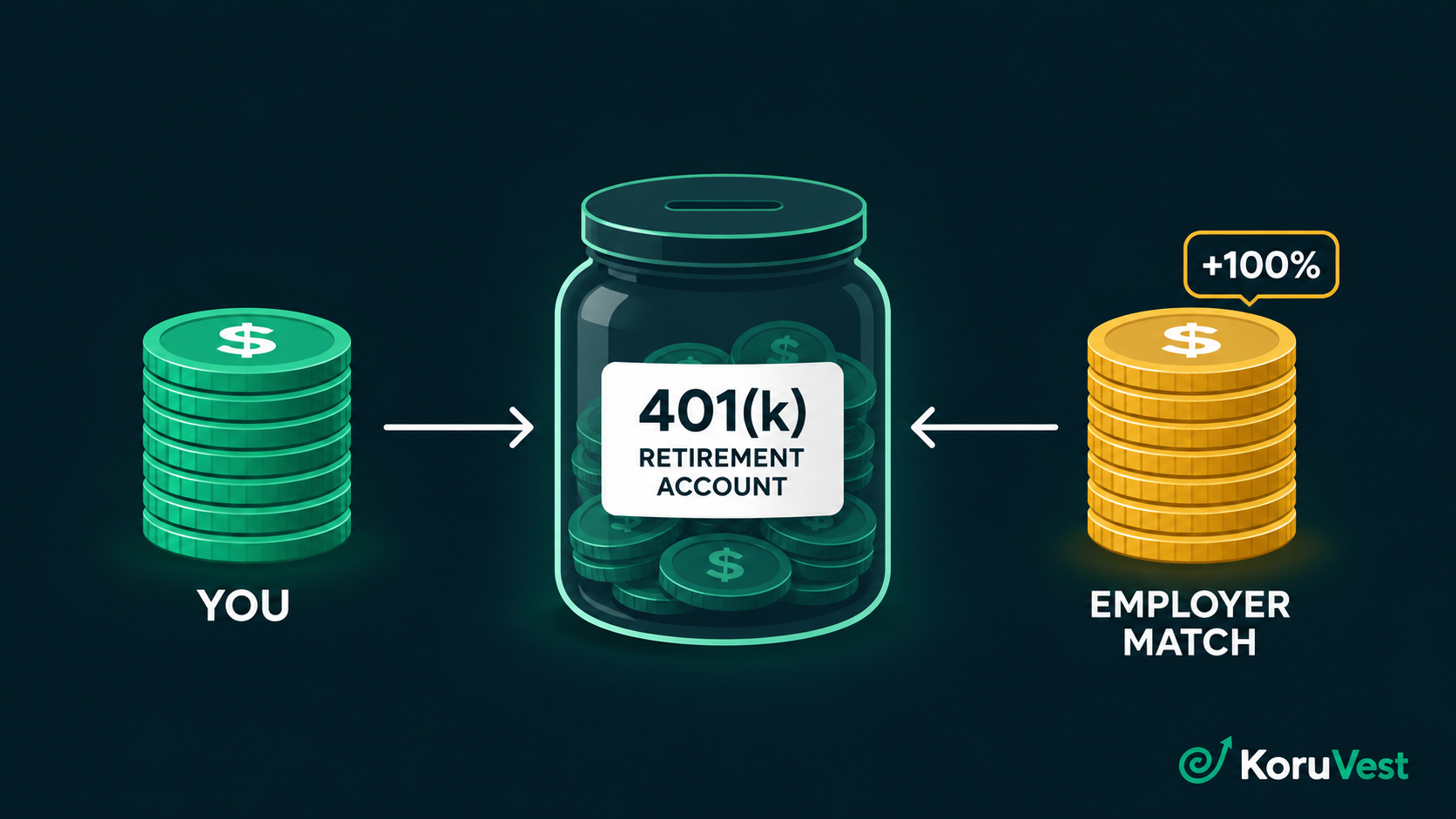
Employer matching contributions can be one of the most valuable features of a 401(k).
But calling a match a “guaranteed 100% investment return” mixes together two different things.
A match is an employer contribution made under the plan’s formula.
The investments purchased with that contribution can still rise or fall afterward.
Consider an employee earning $60,000.
| Plan formula | Employee action | Potential employer contribution |
|---|---|---|
| 100% match up to 4% of pay | Employee contributes at least $2,400 | $2,400 |
| 50% match up to 6% of pay | Employee contributes at least $3,600 | $1,800 |
| 3% nonelective contribution | May not require employee deferral, depending on plan | $1,800 |
In the first example, contributing enough to receive the full match causes another $2,400 to be allocated to the account.
That is valuable employer compensation.
But whether you ultimately keep every dollar of the employer contribution can depend on vesting.
Your contributions and your employer’s contributions can have different ownership rules
Your own salary-deferral contributions to a 401(k), together with the investment gains or losses attributable to them, are always fully vested.
They do not become your employer’s money again because you resign.
Employer contributions can be different.
A traditional 401(k) plan may use a vesting schedule under which you gradually earn nonforfeitable ownership of employer contributions over time.
Other plans may provide immediate vesting.
Safe-harbor plans, for example, apply special vesting requirements to required employer contributions.
Suppose your account shows:
- $18,000 from your own contributions and investment results; and
- $6,000 of employer contributions.
If only 60% of those employer contributions are vested when you leave, the amount you are entitled to take with you can differ from the headline balance you have been watching on the website.
The exact answer is in your plan documents and benefit statement.
Traditional and Roth 401(k) contributions share the same employee limit
If your plan offers both, you may be able to direct your salary deferrals to a traditional 401(k), a designated Roth 401(k), or a combination of the two.
The two options do not receive separate $24,500 employee limits.
For 2026, the ordinary employee elective-deferral limit is $24,500.
For example, an eligible employee could elect:
- $24,500 traditional and $0 Roth;
- $0 traditional and $24,500 Roth; or
- $14,500 traditional and $10,000 Roth.
Each example uses the same $24,500 elective-deferral limit.
The tax difference is more precise than “tax now or tax later”
A traditional 401(k) elective deferral generally reduces the wages currently subject to federal income tax.
Those pre-tax amounts and their investment earnings are generally taxed when distributed later.
A designated Roth 401(k) contribution is included in current taxable income rather than excluded like a traditional deferral.
If the Roth distribution later satisfies the qualified-distribution rules, the distribution can be federally income-tax free.
That makes the tax-rate question similar to the Roth-versus-Traditional IRA analysis:
Which marginal tax rate are you avoiding or paying today, and what tax exposure are you likely to face when the money eventually comes out?
Age alone does not answer that question.
A young worker in a high tax bracket and another young worker in a low tax bracket can reasonably reach different conclusions.
For the underlying tax logic, see our Roth vs. Traditional IRA: How to Choose in 2026 guide.
Roth 401(k)s no longer have the lifetime RMD disadvantage they once had
Older comparisons often say that Roth IRAs have no lifetime required minimum distributions while Roth 401(k)s do.
That is now outdated.
Under current federal rules, designated Roth accounts in 401(k) and 403(b) plans are not subject to required minimum distributions during the original owner’s lifetime.
Beneficiaries can still face distribution requirements after the owner’s death.
This change makes the Roth IRA and Roth 401(k) more similar on this particular retirement-planning issue than older articles suggest.
2026 quick snapshot:
- Employee elective-deferral limit: $24,500
- Standard age-50+ catch-up: $8,000
- Age 60–63 catch-up: $11,250
- Defined-contribution annual-additions limit: $72,000, before eligible catch-up contributions
- For 2026 catch-up contributions, the Roth catch-up requirement can apply when 2025 FICA wages from the plan sponsor exceeded $150,000
The 2026 contribution limits have three different numbers worth knowing
There is not one single “401(k) limit.”
There is an employee salary-deferral limit, a catch-up limit for eligible older participants, and a broader annual-additions limit that can include employer money.
| Participant | Employee elective deferral | Catch-up | Potential total including catch-up* |
|---|---|---|---|
| Under 50 | $24,500 | — | Up to $72,000 |
| Age 50–59 or 64+ | $24,500 | $8,000 | Up to $80,000 |
| Age 60–63 | $24,500 | $11,250 | Up to $83,250 |
*The normal annual-additions limit for 2026 is the lesser of 100% of compensation or $72,000 and generally includes employee elective deferrals, employer matching and nonelective contributions, and certain other additions. Eligible catch-up contributions sit above that limit. Plan-specific restrictions can produce lower limits.
Age 60 through 63 now has a special catch-up rule
The usual 2026 catch-up limit for participants age 50 or older is $8,000.
SECURE 2.0 created a larger catch-up for people who attain age 60, 61, 62, or 63 during the calendar year.
For 2026, that amount is $11,250.
The age is determined by the age you attain during the year.
So an employee who turns 60 in December 2026 can potentially fall under the special 60–63 limit for 2026 if the applicable plan and other requirements permit it.
High earners face another catch-up change in 2026
There is also a new Roth-related catch-up rule.
Current IRS participant guidance states that beginning in 2026, a participant whose 2025 FICA wages from the employer sponsoring the plan exceeded $150,000 must make applicable 2026 catch-up contributions on a Roth basis when the rule applies.
This should not be confused with:
- adjusted gross income;
- household income;
- investment income; or
- total wages from every unrelated employer.
The implementation rules are technical, and the plan administrator determines how the rule operates in the particular plan.
If you are age 50 or older and earned above the threshold from the plan sponsor in the prior year, check your 2026 benefits information rather than assuming your catch-up can still be entirely pre-tax.
Changing jobs does not give you a fresh $24,500 limit
This is a practical rule that matters whenever someone changes employers during the year.
The $24,500 employee elective-deferral limit generally follows you across the applicable plans in which you participate.
Suppose you contribute $14,500 to Employer A’s 401(k) between January and June.
You then start a new job in July.
You do not normally receive another full $24,500 employee deferral limit simply because Employer B has a different plan.
You would generally have $10,000 of the ordinary 2026 elective-deferral limit remaining, assuming no other relevant deferrals and no catch-up contribution.
This is one reason a new employer’s payroll system may not automatically protect someone who changed jobs from exceeding the annual individual limit.
The $72,000 limit is not simply “employee plus employer match”
The broader annual-additions rule can include several types of amounts:
- your elective deferrals, excluding eligible catch-up amounts;
- employer matching contributions;
- employer nonelective contributions; and
- certain forfeiture allocations.
The 2026 limit is generally the lesser of 100% of participant compensation or $72,000.
This distinction matters most to people receiving substantial employer contributions or using plan designs that permit additional after-tax employee contributions.
For many ordinary employees, the $24,500 elective-deferral limit will be the number they encounter first.
Do not judge a plan by the match alone
A generous match can make a 401(k) significantly more attractive.
The investment menu and costs still matter.
Department of Labor rules require participants in participant-directed plans to receive information about plan and investment fees.
The fee disclosure may show:
- fund expense ratios;
- administrative charges;
- loan processing fees;
- individual service fees; and
- other plan expenses.
Suppose two funds both track the same broad U.S. stock index.
One costs 0.03% per year and another costs 0.70%.
They are not economically interchangeable simply because both appear under a heading called “U.S. Equity.”
For a long-term participant, recurring investment expenses compound in the wrong direction.
A target-date fund can be useful — but read the year and the holdings
Many 401(k) plans offer target-date retirement funds.
These funds typically combine stocks and bonds and adjust their asset allocation as the target year approaches.
For someone who wants a single diversified retirement fund, that can be a practical option.
But two target-date funds with “2060” in their names can have different:
- stock allocations;
- international exposure;
- bond exposure;
- glide paths;
- underlying funds; and
- expenses.
The date is a useful starting point, not a complete investment analysis.
Taking money out before retirement is more complicated than “10% penalty before 59½”
The age 59½ rule is important, but it is not the complete distribution rule.
A taxable retirement-plan distribution before age 59½ may be subject to ordinary income tax and an additional 10% early-distribution tax.
But federal law contains exceptions.
For qualified plans such as a 401(k), one important example applies when an employee separates from service during or after the calendar year in which they reach age 55.
Qualifying public-safety employees can have a different age threshold.
Other statutory exceptions exist for certain medical expenses, disability, death, qualified domestic relations orders, some emergency expenses, and other circumstances.
Do not assume an IRA and a 401(k) have identical early-withdrawal exceptions. For example, the age-55 separation-from-service exception applies to qualified employer plans but not to an IRA. Rolling a 401(k) to an IRA before evaluating that rule can therefore change the options available to you.
A hardship withdrawal and a 401(k) loan are not the same thing
Some 401(k) plans permit loans.
Some permit hardship distributions.
Neither is guaranteed to be available simply because the account is a 401(k).
A qualifying plan loan is generally intended to be repaid to the plan under its terms.
A hardship distribution is different.
The IRS describes it as a distribution made because of an immediate and heavy financial need, limited under the applicable rules to the amount necessary to satisfy that need.
A hardship distribution generally cannot be repaid to the plan or rolled over.
Previously untaxed amounts can be subject to income tax, and an additional 10% tax can also apply unless an exception is available.
This is why “my 401(k) balance is available for emergencies” is an incomplete way to think about retirement savings.
What happens when you leave the employer?
Your vested balance does not disappear when employment ends.
Depending on the plan and your balance, common choices can include:
- leaving the money in the former employer’s plan;
- rolling eligible amounts into a new employer’s plan if the new plan accepts rollovers;
- rolling eligible amounts into an IRA; or
- taking a distribution.
Those choices are not economically identical.
An IRA may offer a much broader investment menu.
The old 401(k) may offer an inexpensive institutional fund unavailable in retail accounts.
A new employer’s plan can simplify account consolidation.
And, as noted earlier, the age-55 early-distribution exception can make retaining certain assets in the employer plan important for some people.
Cashing out is often expensive — but “tax plus 10% every time” is not accurate
Suppose someone leaves a job with a $30,000 traditional 401(k) balance and asks the plan to send the money directly to their bank account.
Previously untaxed amounts are generally included in taxable income.
If the participant is under 59½, the additional 10% early-distribution tax may also apply.
But it is not correct to say that every early 401(k) distribution automatically incurs that additional tax.
Federal exceptions can apply depending on the participant’s age and circumstances.
The larger long-term cost can also be the retirement money that is no longer invested in a tax-advantaged account.
A direct rollover usually avoids a problem that a check payable to you can create
When moving retirement assets, the method matters.
An eligible direct rollover moves money from the employer plan directly to another eligible retirement account.
That can avoid the mandatory withholding complications associated with certain eligible rollover distributions paid directly to the participant.
If you are changing jobs or consolidating retirement accounts, ask the receiving and distributing institutions for their direct-rollover procedures before requesting a check to yourself.
Your Roth 401(k) and Roth IRA are not the same account
Both use Roth tax treatment, but the rules are not identical.
A Roth IRA is individually established.
A Roth 401(k) is part of an employer plan.
The employer plan controls:
- the available investments;
- whether loans are available;
- when plan distributions are permitted;
- the matching formula;
- plan fees; and
- other administrative features.
For a nonqualified distribution, Roth IRA ordering rules and designated Roth account rules also work differently.
So the phrase “Roth money can always be withdrawn contribution-first” should not simply be copied from a Roth IRA article and applied to a Roth 401(k).
Employer matching contributions can also have their own tax treatment
Do not assume that selecting Roth for your salary contribution automatically makes every employer dollar Roth too.
Employer matching and nonelective contributions follow the terms of the plan.
SECURE 2.0 permits plans to offer certain employer matching or nonelective contributions as designated Roth contributions when the applicable requirements are met.
Many plans may still place ordinary employer contributions into a pre-tax source.
Your payroll election screen and plan document should tell you how the employer contribution is treated.
For visa holders, leaving the U.S. is a separate 401(k) decision
A temporary worker can participate in a U.S. employer retirement plan when eligible under the plan. Leaving the United States later does not automatically require the 401(k) to be cashed out.
What changes is the decision framework. Former-employer plan rules, a foreign address, future U.S. withholding, tax treaties, destination-country taxation, and IRA brokerage access can all become relevant.
That cross-border analysis is intentionally not duplicated here. If departure is the actual decision you are facing, use Leaving the U.S. on H-1B: What Happens to Your 401(k)? before choosing among keeping the plan, rolling over, or taking a distribution.
Five things I would check in the benefits portal
I would spend less time asking whether a 401(k) is “worth it” in the abstract and more time reading the actual plan.
The matching formula.
How much must you contribute to receive the maximum available employer contribution?
The vesting schedule.
How much of the employer contribution would remain yours if you left today?
The investment menu.
What diversified funds are available, and what do they cost?
The traditional-versus-Roth election.
Which tax treatment fits the dollars you are contributing now?
The contribution percentage.
Does the current payroll percentage reflect your savings plan, or is it simply the automatic-enrollment default?
A match can change the decision without deciding the entire financial plan
Imagine an employer offers a 100% match on the first 4% of compensation.
An employee earning $80,000 who contributes 4% would defer $3,200 and could receive another $3,200 under the matching formula.
That is a substantial employee benefit.
It is reasonable to place significant weight on capturing available vested employer contributions.
But “always get the full match before doing anything else” is still too absolute for every financial circumstance.
An employee facing a genuine cash-flow emergency, extremely expensive debt, or another immediate financial obligation may have competing priorities.
The point of the match is not to replace financial planning.
It is to make sure you understand the compensation you may be giving up when you choose a lower contribution rate.
The contribution percentage matters more than finding a clever fund
Consider two workers with similar investment portfolios.
One contributes 3% of pay for 30 years.
The other eventually contributes 12%.
The second person’s result will be driven heavily by the fact that far more money entered the account.
Investment cost and asset allocation matter.
But a perfect low-cost fund cannot compound dollars that were never contributed.
This is why reviewing your contribution rate after raises can be more valuable than constantly switching among similar index funds.
What a 401(k) does not guarantee
A 401(k) is tax-advantaged.
It is not a guaranteed-return product.
A normal defined contribution 401(k) account rises and falls with the investments held inside it.
If your stock fund declines 30%, the government does not restore that market loss simply because the security was held inside a retirement plan.
Likewise, the Pension Benefit Guaranty Corporation’s insurance program for many private defined-benefit pension plans should not be confused with a guarantee of an ordinary participant-directed 401(k) investment balance.
Frequently asked questions
What is the 401(k) contribution limit for 2026?
The general employee elective-deferral limit is $24,500 for 2026. Eligible participants age 50 or older can make catch-up contributions. The ordinary catch-up is $8,000, while participants who attain age 60 through 63 during 2026 can have a higher $11,250 catch-up limit.
Does my employer match count against my $24,500 limit?
No. The $24,500 limit applies to the employee’s ordinary elective deferrals. Employer contributions are instead included in the broader annual-additions calculation, which is generally limited to the lesser of 100% of compensation or $72,000 for 2026 before eligible catch-up contributions.
Can I contribute $24,500 to two different 401(k)s if I change jobs?
Generally no. Your elective deferrals to applicable plans are aggregated for the annual individual deferral limit. A midyear job change does not ordinarily restart the $24,500 limit.
Are employer matching contributions always mine?
Your own employee deferrals are always fully vested. Employer contributions can be subject to a vesting schedule unless the plan rules provide immediate vesting or special rules require it.
Is an employer match a guaranteed 100% return?
No. A dollar-for-dollar match can add one employer dollar for each qualifying employee dollar under the plan formula, but that is an employer contribution rather than an investment return. The resulting account remains exposed to investment gains and losses, and employer contributions may also be subject to vesting.
Is a traditional or Roth 401(k) better?
Neither is universally better. The comparison depends primarily on the current tax cost of Roth contributions, the tax rate avoided through traditional deferrals, expected future tax exposure, and the rest of the household’s retirement assets.
Do Roth 401(k)s have RMDs?
Under current federal law, designated Roth accounts in 401(k) and 403(b) plans do not require lifetime RMDs from the original owner. Beneficiaries can still be subject to distribution rules after death.
Can I withdraw my 401(k) before age 59½?
A plan must first permit the distribution. Taxable early distributions can then be subject to income tax and an additional 10% tax unless an exception applies. Qualified-plan exceptions include, among others, certain distributions after separation from service in or after the year the participant reaches age 55.
Can I have both a 401(k) and an IRA?
Yes. A workplace 401(k) and an IRA have separate contribution systems. Workplace-plan participation can, however, affect whether a Traditional IRA contribution is deductible, so the accounts should be planned together rather than treated as unrelated.
What happens to my 401(k) if I leave the United States?
Leaving the U.S. does not automatically require a distribution. The available choices and eventual tax treatment depend on the employer plan, U.S. tax residency, future distributions, the destination country, and any applicable tax treaty.
Where to go next
If you are deciding between pre-tax and Roth contributions, continue with Roth vs. Traditional IRA: How to Choose in 2026 for the underlying tax-rate framework.
If you need the Roth withdrawal and five-year rules, read Roth IRA Rules for 2026: Limits, Withdrawals, Five-Year Rules & Conversions.
If you are choosing funds inside your plan, see Index Mutual Funds vs. ETFs: Trading, Taxes, Minimums & Which Fits You (2026) and S&P 500 for Newcomers & Global Investors: What It Owns, Concentration & Tax Issues (2026).
If you are leaving the United States on H-1B status, use our dedicated 401(k) guide for departing H-1B workers before deciding whether to keep, roll over, or distribute the account.
📚 Primary sources
- IRS — 401(k) Plans
- IRS — 401(k) Contribution Limits
- IRS — 2026 Retirement Contribution Limits
- IRS — Catch-Up Contributions and 2026 Roth Catch-Up Rule
- U.S. Department of Labor — What You Should Know About Your Retirement Plan
- U.S. Department of Labor — Understanding Your Retirement Plan Fees
- IRS — Exceptions to the 10% Additional Tax
- IRS — Hardships, Early Withdrawals and Loans
- IRS — Required Minimum Distribution FAQs
- IRS — Roth IRA vs. Designated Roth Account
KoruVest reviewed these primary sources on September 13, 2026. Contribution limits, Roth catch-up requirements, plan investments, matching formulas, vesting schedules, loans, and distribution options can differ by plan or change under federal law.
✍️ About the Author
David Han is the lead author of KoruVest, covering U.S. financial accounts, investing, tax-related rules, credit, retirement plans, and cross-border financial decisions for newcomers and international readers.
KoruVest articles are researched using official and authoritative sources and follow our standards for source review, fact checking, updates, and editorial independence.
⚠️ Disclaimer
Educational only. This article provides general information and is not personalized financial, investment, retirement-plan, tax, immigration, or legal advice.
Your plan controls many features. Matching formulas, vesting, loans, hardship withdrawals, investment choices, fees, Roth options, and distribution rights differ among employers.
Verify current rules. Review your Summary Plan Description and current IRS guidance before making contributions, distributions, loans, or rollovers. See our full Disclaimer.
Published: July 2, 2026 · Last updated: September 13, 2026