
A Roth IRA is often described in one sentence:
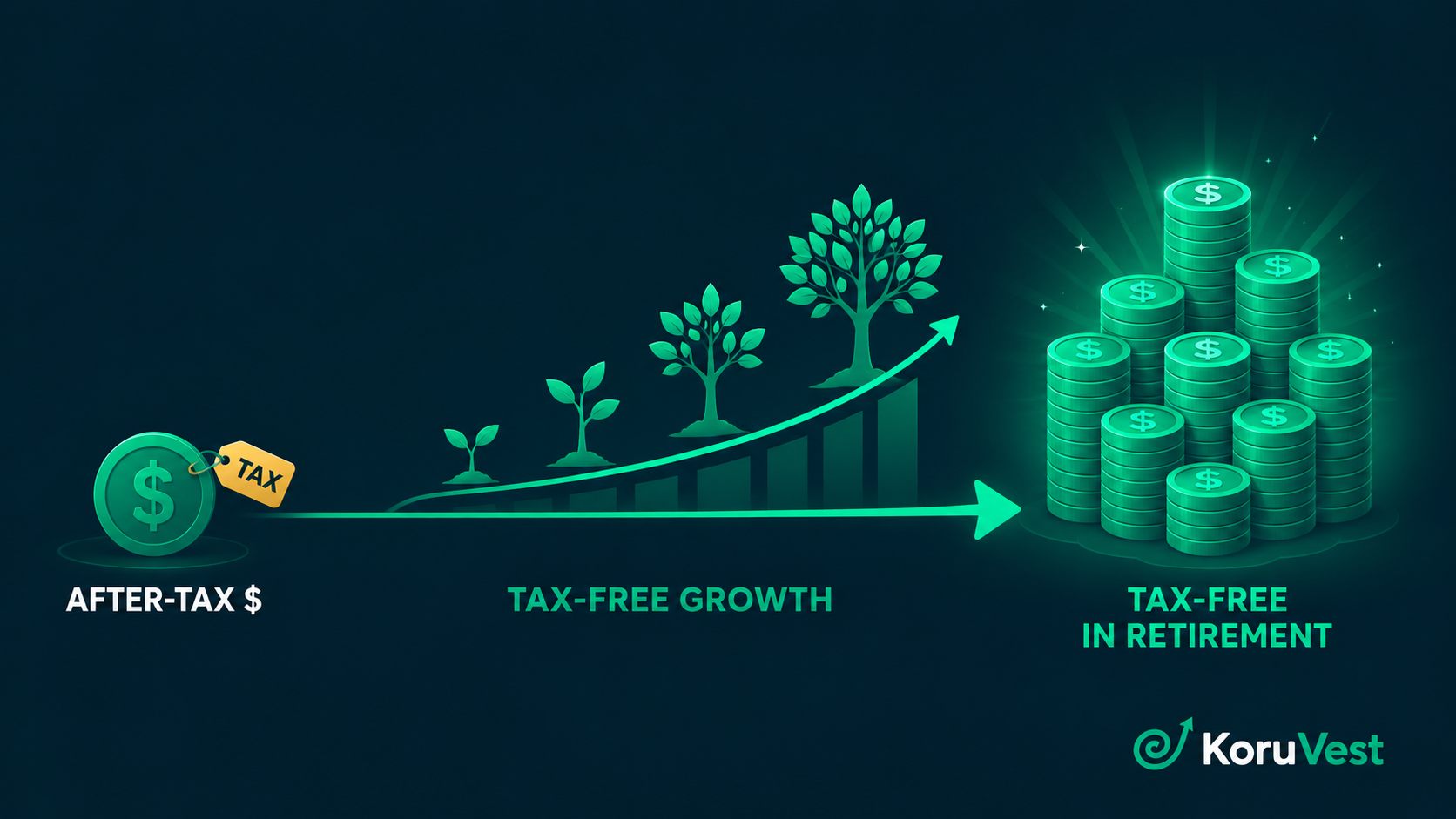
Pay taxes now, then withdraw the money tax-free in retirement.
That is directionally correct.
It is also where many explanations stop just before the rules become important.
A Roth IRA has three different kinds of money inside it — regular contributions, conversion or rollover dollars, and investment earnings. The IRS does not treat all three the same when money comes back out.
There are also two different concepts commonly called “the five-year rule,” income limits that affect whether you can contribute directly, and separate rules governing conversions.
Understanding those distinctions is more useful than simply hearing that a Roth IRA is “tax-free.”
A Roth IRA is a tax-advantaged account, not an investment. Contributions are not deductible. Investments held inside the account can grow without current tax, and qualifying distributions can be completely free of federal income tax. What you actually earn still depends on what you choose to invest in.
This guide explains the Roth IRA rules themselves. If your question is whether a Roth IRA or Traditional IRA fits your situation better, use our Roth vs. Traditional IRA comparison.
Last reviewed: September 12, 2026. IRA contribution limits and income thresholds are indexed periodically, and tax rules can change.
The tax benefit happens at withdrawal, not when you contribute
A regular Roth IRA contribution does not give you a federal income-tax deduction.
If you earn $70,000, contribute $5,000 to a Roth IRA, and otherwise have no special adjustment, you do not simply subtract that $5,000 from taxable income because it went into the Roth.
That is the trade-off.
In return, investment growth inside the account is not taxed year by year, and a qualified distribution from the Roth IRA is excluded from gross income.
Compare that conceptually with a deductible traditional IRA contribution.
A traditional IRA may give an eligible taxpayer a deduction today, while taxable distributions generally create income later.
A Roth IRA generally gives up the contribution deduction in exchange for potentially tax-free qualified withdrawals later.
That does not automatically make one superior.
The better tax result depends on factors such as your current and future marginal tax rates, eligibility for deductions, retirement income, and how long the money remains invested.
We will handle that decision separately in our Roth vs. Traditional IRA comparison. This guide focuses on how the Roth itself works.
The account is only the wrapper
Opening a Roth IRA does not cause your money to grow.
A Roth IRA can hold investments such as:
- mutual funds;
- ETFs;
- stocks;
- bonds;
- cash and cash-equivalent positions; and
- other investments permitted by the account provider and IRA rules.
If you contribute $5,000 and leave the entire balance sitting in a low-yield cash position, the account still receives Roth tax treatment.
But there may be very little investment growth to shelter from tax.
This distinction matters because beginners sometimes complete the contribution and assume the retirement investing process is finished.
It is not.
Opening the Roth IRA, contributing to it, and investing the contribution are three separate actions.
How much can you contribute in 2026?
For 2026, the general IRA contribution limit is $7,500.
If you are age 50 or older by the end of the year, the additional IRA catch-up amount is $1,100, bringing the potential total to $8,600.
But the dollar limit is only one ceiling.
Your regular Roth IRA contribution generally cannot exceed your taxable compensation for the year.
So if a 22-year-old student has $4,000 of qualifying taxable compensation in 2026, the existence of a $7,500 statutory limit does not allow a $7,500 regular IRA contribution based solely on that income.
The compensation amount is the lower ceiling.
| Rule | 2026 amount |
|---|---|
| Under age 50 | Up to $7,500 |
| Age 50 or older | Up to $8,600 |
| Compensation limit | If taxable compensation is lower, that lower amount generally limits the contribution |
| Traditional + Roth IRAs | The annual limit is shared across your regular contributions to both types |
That last row is easy to overlook.
You do not receive a separate $7,500 regular-contribution limit for a traditional IRA and another $7,500 for a Roth IRA.
If a person under 50 contributes $3,000 to a traditional IRA for 2026, only $4,500 of the $7,500 general IRA limit remains for regular Roth contributions, assuming all other requirements are satisfied.
A spouse without their own paycheck may still be able to fund an IRA
The compensation rule has an important exception for married couples filing jointly.
Under the spousal IRA rules, a spouse with little or no taxable compensation may still be able to make an IRA contribution based on the couple’s combined taxable compensation.
Each spouse needs their own IRA. There is no joint Roth IRA account.
The combined contributions are still constrained by the applicable IRA limits and the couple’s qualifying compensation.
This can be important when one spouse temporarily leaves the workforce to care for children, study, or for another reason.
Income can reduce or eliminate your direct Roth contribution
Roth IRAs have another restriction that traditional IRAs do not apply in the same way: high income can reduce the amount you are allowed to contribute directly.
For 2026, the thresholds are based on modified adjusted gross income, or MAGI, and filing status.
| Filing status | Full contribution range | Reduced contribution range | No direct contribution |
|---|---|---|---|
| Single / Head of household | MAGI below $153,000 | $153,000 to under $168,000 | $168,000 or more |
| Married filing jointly / qualifying surviving spouse | MAGI below $242,000 | $242,000 to under $252,000 | $252,000 or more |
| Married filing separately and lived with spouse during the year | Special rules apply at MAGI of $0 | More than $0 but under $10,000 | $10,000 or more |
A married person filing separately who did not live with their spouse at any time during the year is treated differently for this purpose and can fall under the single/head-of-household income range.
Also note that MAGI is not necessarily the same number as salary.
Interest, dividends, IRA distributions, and certain adjustments can affect the calculation.
The most misunderstood Roth IRA rule is what happens when money comes out
The common explanation is:
“You can withdraw contributions anytime. Earnings are locked until 59½.”
The first sentence captures an important feature.
The second is too crude.
For a distribution that is not already a qualified distribution, IRS ordering rules generally treat Roth IRA money as coming out in this sequence:
1. Regular contributions
2. Conversion and rollover contributions, generally oldest first
3. Earnings
This ordering rule is why regular contributions are so flexible.
If you have made $30,000 of regular Roth IRA contributions over the years and the account is now worth $50,000, an ordinary $10,000 distribution would generally be treated first as coming from those regular contributions rather than from the $20,000 of investment earnings.
Returns of regular contributions are not included in gross income.
But that should not be interpreted as “every dollar below my total deposits is always simple.”
Conversions and rollovers have their own rules, which is where the familiar one-line Roth explanation begins to break down.
Think in three layers: regular contributions come out first, conversion/rollover dollars next, and earnings last. That ordering is much more accurate than thinking of a Roth IRA as simply “principal you can touch” plus “growth you cannot.”
There is more than one Roth five-year rule
This is one of the areas most likely to cause confusion.
The first five-year rule determines whether a Roth IRA distribution can qualify for completely tax-free treatment of earnings.
The period begins with the first tax year for which you made a contribution to a Roth IRA established for your benefit.
A qualified distribution generally requires that five-tax-year period to have been satisfied and that the distribution also occur under one of the qualifying circumstances, such as:
- on or after age 59½;
- because of qualifying disability;
- after death to a beneficiary or estate; or
- for a qualifying first-home distribution, subject to the applicable lifetime limit.
The five-year period is measured in tax years, not by counting exactly 1,825 days from the date you clicked “Open Account.”
For example, a person making their first qualifying Roth IRA contribution for tax year 2026 generally begins that five-year period on January 1, 2026, even if the contribution is actually made later.
A Roth conversion can start a different five-year clock
Conversions introduce a second five-year concept.
When taxable amounts are converted from a traditional IRA or eligible retirement account into a Roth IRA, a separate five-year period can apply to that conversion when determining whether the 10% additional tax on an early distribution applies to the converted taxable amount.
Each conversion can have its own period.
This is not the same test as the Roth IRA five-year period used to determine whether earnings are part of a qualified distribution.
That distinction is one reason generic advice such as:
“Anything you put into a Roth can always be taken right back out.”
can become dangerous when conversions are involved.
The first-home rule is also more nuanced than it sounds
IRA rules include an exception for certain first-home distributions.
Up to $10,000 over a lifetime can qualify under the applicable first-home provisions, provided the IRS requirements are met.
Among other things, the money must generally be used for qualifying acquisition costs within the required period.
But the phrase “first-home exception” can refer to two related tax concepts:
one involving the exception from the 10% additional tax on certain early IRA distributions, and another involving whether a Roth distribution satisfies the qualified-distribution rules after the relevant Roth five-year period.
This is not an area where I would withdraw Roth earnings based on a one-sentence social-media explanation.
Why withdrawing regular contributions is allowed but still usually costly
The flexibility of regular Roth contributions is real.
That does not make the Roth IRA a substitute for an emergency fund.
Suppose you contribute $6,000 at age 25 and remove it at age 30 to pay an unexpected expense.
The immediate withdrawal may not create tax or penalty if it is treated as a return of regular contributions.
But you have removed $6,000 from a tax-advantaged account.
You generally cannot simply restore an old annual contribution years later after the original contribution window has closed, except where a specific rollover or repayment rule applies.
You have therefore lost part of the account’s future tax-advantaged compounding capacity.
That opportunity cost can become much larger than the tax bill you avoided.
Roth IRAs have no lifetime RMD for the original owner
This is one of the Roth IRA’s most useful structural differences from a traditional IRA.
The original owner of a Roth IRA is not required to begin taking required minimum distributions simply because they reach the normal RMD age.
That means money can remain inside the Roth IRA throughout the owner’s lifetime if it is not needed.
This can provide flexibility in retirement-income planning and estate planning.
But it does not mean a Roth IRA can pass through generations without distribution rules.
After the original owner dies, beneficiaries can be subject to inherited-IRA distribution requirements, including rules that can require the account to be distributed within a specified period.
So:
No lifetime RMD for the original Roth IRA owner
does not mean:
No distribution rules for beneficiaries.
You can have a Roth IRA and a workplace retirement plan at the same time
Participation in a 401(k), 403(b), or other employer retirement plan does not by itself prevent you from contributing to a Roth IRA.
The accounts have separate contribution systems.
For 2026, an employee can potentially contribute to an employer plan while also making an eligible IRA contribution, subject to each set of rules.
What should not be turned into a universal formula is the frequently repeated:
“401(k) match first, then max the Roth, then return to the 401(k).”
That sequence can be reasonable for some people.
But plan fees, employer contribution rules, available investments, income, current tax bracket, debt, emergency reserves, HSA eligibility, and other factors can change the best allocation.
A retirement-account hierarchy should come from the person’s finances, not from a slogan.
What happens if you contribute too much?
An excess Roth IRA contribution can arise when you:
- contribute above the annual IRA limit;
- contribute more than your eligible compensation allows;
- make a full contribution despite being inside the Roth income phase-out range; or
- contribute directly when your MAGI makes you ineligible.
The IRS can impose a 6% excise tax for each year an excess contribution remains uncorrected, subject to the statutory calculation.
That is why estimating income can matter late in the year for people whose compensation, bonuses, investment income, or filing situation puts them near a Roth phase-out threshold.
If you discover an excess contribution, do not simply withdraw an arbitrary amount and assume the problem is fixed. Corrective distributions, earnings attributable to the contribution, recharacterization possibilities, and reporting depend on timing and facts.
What a “backdoor Roth” actually is
The phrase makes it sound like a special Roth IRA reserved for high earners.
It is not a separate account type.
What people commonly call a backdoor Roth generally involves:
making a nondeductible contribution to a traditional IRA and then converting money from the traditional IRA to a Roth IRA.
Conversions are reported on Form 8606.
The important complication is that the tax calculation does not necessarily let you isolate one small nondeductible contribution while pretending other traditional IRA money does not exist.
Form 8606’s calculation considers the value of your traditional IRAs, which for these instructions generally includes traditional SEP and SIMPLE IRAs.
So someone with a large pre-tax IRA balance can have a very different tax result from someone whose traditional IRA balance consists solely of a recent nondeductible contribution.
Do not interpret the Roth income limit as a conversion limit. Direct Roth contributions and Roth conversions are governed by different rules. But a conversion can create taxable income, Form 8606 reporting, and additional complexity when pre-tax IRA balances already exist.
Conversion is not the same as contribution
This distinction solves several apparent contradictions in Roth IRA discussions.
A regular contribution is new money added under the annual IRA contribution rules.
A conversion moves eligible money from a traditional IRA into a Roth IRA.
Conversions do not use up the ordinary $7,500 or $8,600 annual IRA contribution limit in the same way a regular contribution does.
But the taxable portion of the converted amount is generally included in income for the year of conversion.
And since 2018, a Roth conversion generally cannot simply be recharacterized back to a traditional IRA because you later regret the tax result.
That makes conversion planning meaningfully different from making a normal annual Roth contribution.
A Roth IRA can make sense even if you are not in your twenties
Roth IRAs are frequently marketed as “the account for young people.”
Younger investors can certainly benefit from having decades of potential tax-free growth.
Age alone, however, does not decide whether a Roth is attractive.
A 55-year-old may have reasons to value:
- tax diversification in retirement;
- no lifetime RMD from the Roth IRA;
- tax-free qualified distributions;
- estate-planning flexibility; or
- a temporary year with unusually low taxable income that makes a conversion attractive.
Likewise, a 25-year-old in an unusually high tax bracket should not be told that Roth automatically wins simply because there are many years before retirement.
The tax decision is more nuanced than age.
Visa holders should not treat immigration status as the Roth eligibility test
An F-1, H-1B, or other visa label does not by itself answer whether someone can make a Roth IRA contribution.
For tax purposes, foreign nationals can be classified as resident aliens or nonresident aliens depending on applicable U.S. tax-residency rules.
IRA contributions depend on items such as taxable compensation, MAGI, filing status, and the applicable tax rules.
Brokerage firms can also impose their own account-opening requirements, separate from federal tax eligibility.
This creates two different questions:
Does U.S. tax law allow this contribution?
and
Will this brokerage open and continue to service the account for me?
Those are not always answered the same way.
An international student or visa holder should therefore determine tax residency and eligible compensation before assuming a Roth IRA works exactly as it does for a U.S. citizen.
Leaving the United States does not erase the account’s cross-border issues
A Roth IRA that works cleanly under U.S. federal tax law can become more complicated after its owner establishes tax residence in another country.
The United States may continue to recognize the account’s Roth treatment.
The new country of residence may have its own rules governing:
- investment income inside the account;
- withdrawals;
- foreign-account reporting;
- estate or inheritance treatment; and
- whether the U.S. retirement account receives special recognition under a tax treaty.
Brokerage service can also change after an international move.
So someone on H-1B, F-1, or another temporary status should not evaluate a Roth IRA only by asking whether it is tax-efficient while living in the United States.
The intended destination country can eventually matter too.
What I would check before making a Roth contribution
Do I have enough eligible taxable compensation?
The annual IRS limit is not the only ceiling.
What will my 2026 MAGI likely be?
This matters if income approaches the direct-contribution phase-out.
Have I already contributed to another traditional or Roth IRA for the same year?
The ordinary contribution limit is shared.
Am I making a regular contribution, conversion, rollover, or recharacterization?
Those words describe legally different transactions.
What will I actually invest in after the contribution arrives?
A Roth IRA containing cash is still a Roth IRA, but its tax advantages cannot manufacture investment growth.
If I may move abroad, have I checked the destination country’s treatment and my broker’s residency rules?
This is particularly important for KoruVest’s international readers.
One example shows why the withdrawal rules matter
Suppose Maya has one Roth IRA containing:
- $24,000 of regular contributions;
- $10,000 from an earlier taxable Roth conversion; and
- $16,000 of investment earnings.
The account is worth $50,000.
If Maya takes a nonqualified $15,000 distribution, the Roth ordering rules generally treat that money as coming first from the $24,000 of regular contributions.
Now suppose she eventually withdraws more than all of her remaining regular-contribution basis.
The next dollars can begin entering the conversion layer.
That is where the date and tax character of previous conversions can matter.
Only after the contribution and conversion layers have been exhausted do the ordering rules reach earnings.
This is why a tax professional asking for your contribution and conversion history is not making the situation unnecessarily complicated.
The history actually matters.
What makes a Roth IRA genuinely valuable
The most compelling feature is not one isolated tax trick.
It is the combination of several rules:
- qualified withdrawals can be federally income-tax free;
- regular contributions receive flexible distribution treatment;
- investment activity inside the account does not normally generate annual taxable capital gains or dividend income to the owner;
- the original owner has no lifetime required minimum distributions; and
- the account can hold a broad range of long-term investments.
Those advantages can make a Roth IRA a powerful retirement account.
They do not mean everyone should maximize a Roth IRA before considering every other financial priority.
Tax-advantaged does not mean consequence-free, and flexibility does not eliminate the opportunity cost of withdrawing retirement money early.
Frequently asked questions
Can I withdraw my Roth IRA contributions whenever I want?
Regular Roth IRA contributions are treated as coming out first under the IRS distribution-ordering rules, and returns of those regular contributions are not included in gross income. Conversions and earnings follow different rules, so do not apply the same statement indiscriminately to every dollar that ever entered the Roth.
Does every Roth IRA withdrawal become tax-free at age 59½?
No. A qualified distribution generally also requires satisfaction of the Roth IRA five-tax-year period. Age 59½ is one of the qualifying events, not a substitute for the five-year requirement.
When does the Roth IRA five-year period begin?
For qualified-distribution purposes, it generally begins with the first tax year for which a contribution was made to a Roth IRA established for you. This is separate from the five-year periods that can apply to individual conversions for early-distribution penalty purposes.
Can I contribute to a Roth IRA if I have a 401(k)?
Yes. Participation in an employer retirement plan does not by itself prohibit a Roth IRA contribution. You must still satisfy the Roth IRA compensation, annual contribution, MAGI, and filing-status rules.
Do I have to withdraw money from my Roth IRA at age 73?
Not if you are the original Roth IRA owner. Roth IRAs do not require lifetime RMDs from the original owner. Beneficiaries can face distribution requirements after the owner’s death.
What if I earn too much to contribute directly?
Your direct Roth IRA contribution can be reduced or eliminated under the 2026 MAGI limits. A Roth conversion is governed by different rules, which is why some higher-income taxpayers consider the strategy commonly called a backdoor Roth. Conversions can create taxable income and Form 8606 complications, particularly when other pre-tax IRA balances exist.
Where to go next
If you understand the Roth rules but are deciding whether paying tax now or later makes more sense, continue with Roth vs. Traditional IRA.
If your employer also offers a workplace retirement plan, read What Is a 401(k)?.
If you still need to choose investments inside the account, see Index Funds vs. ETFs and What Is the S&P 500?.
If you are a visa holder or non-U.S. citizen, first confirm your brokerage eligibility with Brokerage Accounts for Non-U.S. Citizens: Eligibility, Documents & How to Open One (2026).
📚 Primary sources
- IRS — Roth IRAs
- IRS Notice 2025-67 — 2026 Retirement and IRA Limits
- IRS Publication 590-A — Contributions to IRAs
- IRS Publication 590-B — Distributions From IRAs
- IRS — Form 8606, Nondeductible IRAs and Roth Conversions
- IRS — Required Minimum Distributions
- IRS Publication 519 — U.S. Tax Guide for Aliens
KoruVest reviewed these primary sources on September 12, 2026. IRA contribution limits, income thresholds, distribution rules, and international tax treatment can change. Tax results depend on the individual’s facts.
✍️ About the Author
David Han is the lead author of KoruVest, covering U.S. financial accounts, investing, tax-related rules, credit, retirement plans, and cross-border financial decisions for newcomers and international readers.
KoruVest articles are researched using official and authoritative sources and follow our standards for source review, fact checking, updates, and editorial independence.
⚠️ Disclaimer
Educational only. This article provides general information and is not personalized tax, investment, financial, immigration, or legal advice.
Roth distributions are fact-specific. Contributions, conversions, rollovers, earnings, five-year periods, and early-distribution exceptions can receive different tax treatment.
Verify current rules. Confirm your eligible compensation, MAGI, filing status, contribution limit, and tax consequences before contributing, converting, or withdrawing money. See our full Disclaimer.
Published: July 12, 2026 · Last updated: September 12, 2026