
Robo-advisors are usually introduced with a single number: 0.25% a year.
It is a real figure, and next to the roughly 1% a traditional advisor often charges, it explains why the category grew. It is also, for someone opening a first account with a few hundred or a few thousand dollars, frequently not the number they will pay.
Several providers price small balances differently. One charges nothing at all below a specific threshold and more than the standard rate above it. Another charges a flat monthly amount until a condition is met. A third charges no advisory fee and recovers the cost somewhere less visible.
The useful comparison, then, is not a ranking. It is a map of where the pricing changes.
A robo-advisor is a management service, not an investment
The name suggests a product. It functions more like a service layer placed on top of ordinary investments.
Underneath nearly every robo-advisor sits a portfolio of index ETFs or index mutual funds — the same building blocks a self-directed investor could assemble. What the provider supplies is the allocation decision, automatic rebalancing, and in some cases tax management, applied without further input from you.
That distinction clarifies what the fee buys. It does not buy access to better investments. It buys the removal of recurring decisions: how much in stocks versus bonds, when to rebalance, what to do when one holding drifts from its target.
For someone who would otherwise leave the money in checking for another year, that can be worth paying for. For someone already comfortable buying a single broad-market fund each month, the value is smaller. Our explainer on how a robo-advisor works covers the mechanics in more detail.
Two decisions come before choosing a provider
Comparing fees first is a natural instinct and usually the wrong starting point, because two earlier decisions eliminate options faster than any fee table.
The first is what the money is for and when you may need it. Money you might need within a couple of years generally belongs in cash rather than an invested portfolio, regardless of how low the management fee is. A robo-advisor does not change the volatility of the underlying investments.
The second is which account type you are opening. A Roth IRA, a Traditional IRA, and an ordinary taxable brokerage account can all hold the same portfolio, but their tax rules differ — and as the section on tax-loss harvesting explains, that difference removes an entire feature category from the comparison in some cases.
Three separate decisions: what the money is for, which account holds it, and which provider manages it. The third question is the one most comparisons start with, and the one that matters least.
The advertised fee is one of two cost layers
Most comparisons quote the advisory fee alone. The amount you actually pay has a second component: the expense ratios of the funds held inside the portfolio.
A 0.25% advisory fee wrapped around funds charging 0.08% comes to roughly 0.33%. In a single year the gap is small. Over decades it is not trivial, and it is the reason one provider on this list can charge nothing in a certain range — Fidelity Go uses proprietary funds with 0.00% expense ratios, which removes the second layer rather than discounting the first.
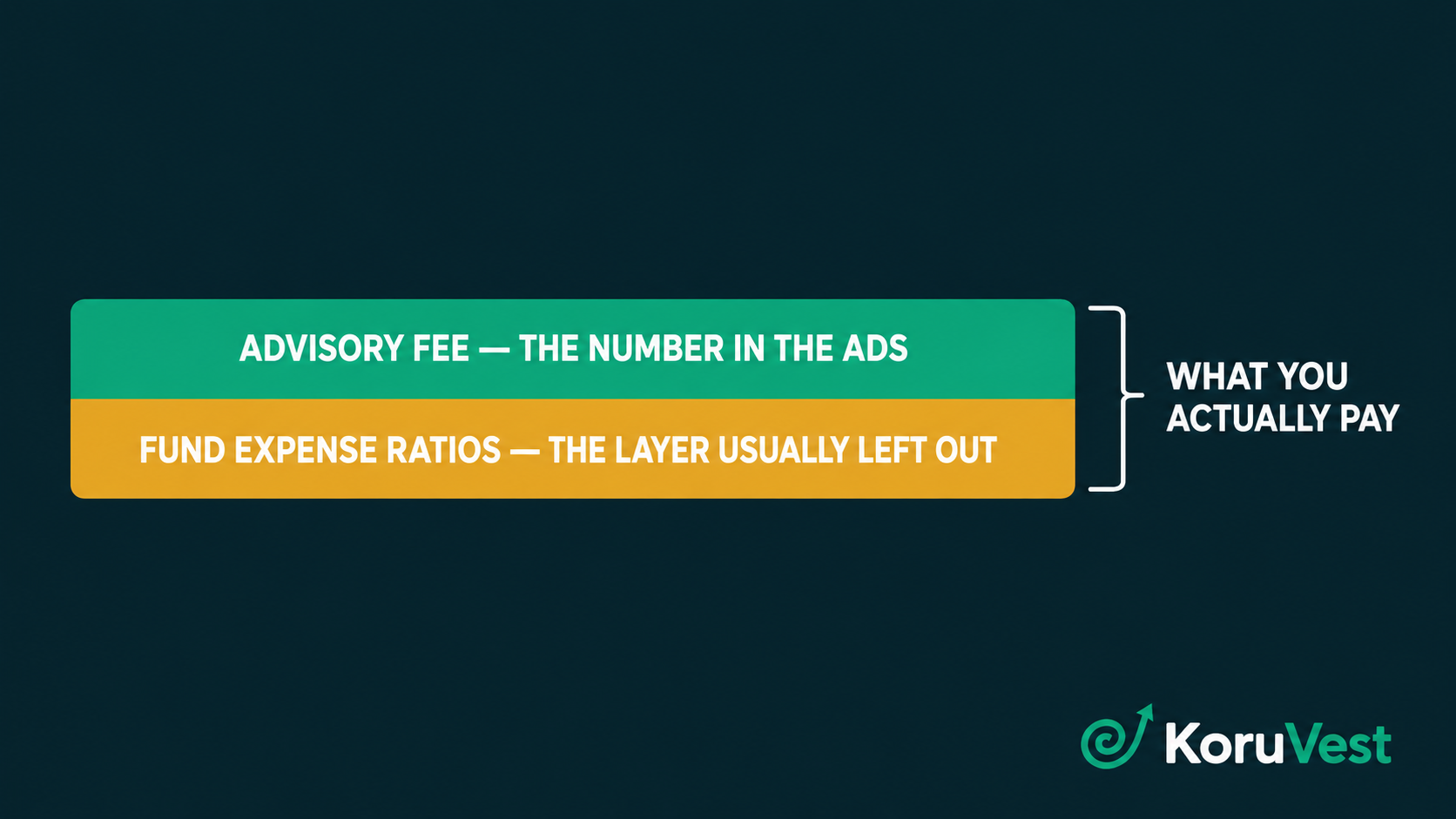
When comparing providers, add both figures. A lower headline rate does not reliably identify the cheaper option.
Fidelity Go is free below $25,000 and more expensive above it
Fidelity Go charges no advisory fee on balances under $25,000, and the Fidelity Flex funds it invests in carry zero expense ratios. Both cost layers are genuinely absent in that range.
Above $25,000 the fee becomes 0.35% a year, which is higher than the 0.25% charged by Betterment and Wealthfront. The change applies at the threshold rather than phasing in gradually.
Fidelity Go does not offer tax-loss harvesting at any balance. Whether that omission matters depends entirely on the account type, which the next section addresses.
Accounts above $25,000 gain access to one-on-one coaching calls with a Fidelity representative. These are portfolio reviews rather than comprehensive financial planning, but including them at that tier is uncommon.
Betterment charges small balances a flat fee, not a percentage
Betterment is generally described as charging 0.25% annually. That is the rate above a threshold, not the rate every account pays.
Below it, smaller accounts pay a flat monthly amount instead, and setting up a recurring monthly deposit can convert the account to the percentage rate regardless of balance. The specific dollar figure and balance threshold are reported inconsistently across sources and have been revised more than once.
Rather than present one version as settled, the accurate summary is this: a small Betterment balance pays a flat monthly fee, and a recurring deposit is what triggers the percentage rate. Confirm the current figures on Betterment’s own pricing page before opening the account.
The arithmetic is worth seeing. A flat charge of roughly $4 a month on a $1,000 balance works out near 4.8% a year. The same charge on a $10,000 balance is closer to 0.48%. The flat structure is heavy at the bottom and unremarkable by the time an account reaches five figures — which is why the recurring-deposit condition exists at all.
The transfer-out fee that comparison tables leave out
Betterment charges $75 to transfer investments out to another brokerage. Cash withdrawals are free; moving the holdings themselves is not.
This rarely appears in beginner comparisons, and it is more useful to know beforehand than afterward. It is not a reason to avoid Betterment — $75 spread across a decade of use is immaterial. It is a reason to avoid opening accounts at several providers to sample them, since exiting is not always free.
Tax-loss harvesting does different work in different accounts
Wealthfront and Betterment both promote automated tax-loss harvesting, which sells positions at a loss to offset realized gains and reduce a tax bill in a taxable account. The mechanism is real.
Two qualifications rarely accompany the marketing.
The first is that a tax-sheltered account has no gains to offset. Inside a Roth or Traditional IRA, there is generally nothing for the feature to act on. If your first automated account is an IRA — a reasonable place for many beginners to start — this entire feature category is largely inactive, and a provider that lacks it is not at a disadvantage on those grounds.
The second is that the benefit scales with the size of the taxable account. Estimates of annual savings in the range of $50 to $250 assume a taxable balance of meaningful size. On a $3,000 taxable balance, harvested losses are correspondingly small and unlikely to offset a difference in fees.
Tax-loss harvesting can be a sound reason to choose Wealthfront or Betterment once a sizable taxable account exists. It is a weaker argument at the start.
Wealthfront offers depth, without human access
Wealthfront charges a flat 0.25% with a $500 minimum and offers the deepest feature set among these providers: daily tax-loss harvesting, direct indexing at higher balances, an automated bond ladder, and commission-free individual stock trading alongside the managed portfolio.
There are no human advisors at any tier. Wealthfront is deliberately software-only, which is an advantage in cost and a limitation if you would want to speak with someone during a market decline. Which of those it is depends on the investor, and it is worth deciding honestly before a difficult quarter rather than during one.
The $500 minimum is modest but not zero. For someone beginning with $100, it is a barrier.
Schwab’s zero advisory fee is paid through cash allocation
Schwab Intelligent Portfolios charges no advisory fee. That is accurate, and stated alone it is incomplete.
Schwab’s portfolios include a required cash allocation — a portion of the account held in cash rather than invested — and Schwab earns on that cash. The investor pays no visible fee and accepts that part of the portfolio sits outside the market, which reduces long-run expected returns without ever appearing on a statement as a charge.
Whether that trade is favorable depends on how large the required allocation is relative to the cash the investor would have held anyway. For a conservative investor it may be close to neutral. For someone intending to be fully invested in equities for thirty years, it is a cost.
Two further specifics: the minimum is $5,000, which excludes many beginners at the outset, and tax-loss harvesting is available only above $50,000. Schwab also discontinued its paid Premium tier in 2026, so planner access through this particular product is no longer offered.
Vanguard’s lower rate asks for more elsewhere
Vanguard Digital Advisor charges an all-in advisory fee of approximately 0.15% — the lowest percentage rate among these providers — with a $100 minimum, reduced from an earlier $3,000. It uses Vanguard’s index ETFs and includes tax-loss harvesting.
What it asks in return is not financial. Access to a Certified Financial Planner requires $50,000, and the digital experience is generally regarded as more utilitarian than Betterment’s or Wealthfront’s. The trade is cost efficiency in exchange for interface polish and support depth.
For an investor who intends to hold for several decades and has no interest in goal-tracking features, a tenth of a percent saved annually compounds into a meaningful figure.
SoFi’s distinguishing feature is a person, not a rate
SoFi Automated Investing has kept its fee low to nonexistent, though this has been revised more than once and should be confirmed at signup rather than taken from any article, including this one.
The more durable feature is access to a Certified Financial Planner at no additional charge — a session for members, with unlimited consultations for SoFi Plus. At this price point that is unusual, and for a first-time investor who wants to ask a person whether the overall plan is sensible, it can be worth more than a fraction of a percent.
SoFi does not offer tax-loss harvesting, and its portfolios are simpler than Wealthfront’s. Integration with SoFi’s banking and savings products is convenient if you already bank there and irrelevant otherwise.
The comparison on one page
| Provider | Advisory fee | Minimum | Tax-loss harvesting | Planner access |
|---|---|---|---|---|
| Fidelity Go | $0 below $25,000, then 0.35% | $0 ($10 to invest) | Not offered | Coaching calls above $25,000 |
| Betterment | Flat monthly at small balances, then 0.25% | $0 ($10 to invest) | Yes | Premium tier only |
| Wealthfront | 0.25% | $500 | Yes, daily | None |
| Vanguard Digital Advisor | ≈0.15% | $100 | Yes | Requires $50,000 |
| Schwab Intelligent Portfolios | $0, with required cash allocation | $5,000 | Above $50,000 only | Premium tier discontinued 2026 |
| SoFi Automated Investing | Low to none — confirm at signup | ≈$50 | Not offered | CFP access included |
Figures verified in 2026. Pricing in this category is revised more frequently than in most parts of retail investing — confirm current terms on each provider’s own pricing page before opening an account.
The threshold map: where the answer changes
Read the table by balance rather than by provider and a different picture emerges. The pricing structures do not simply rank; they swap positions at specific numbers.
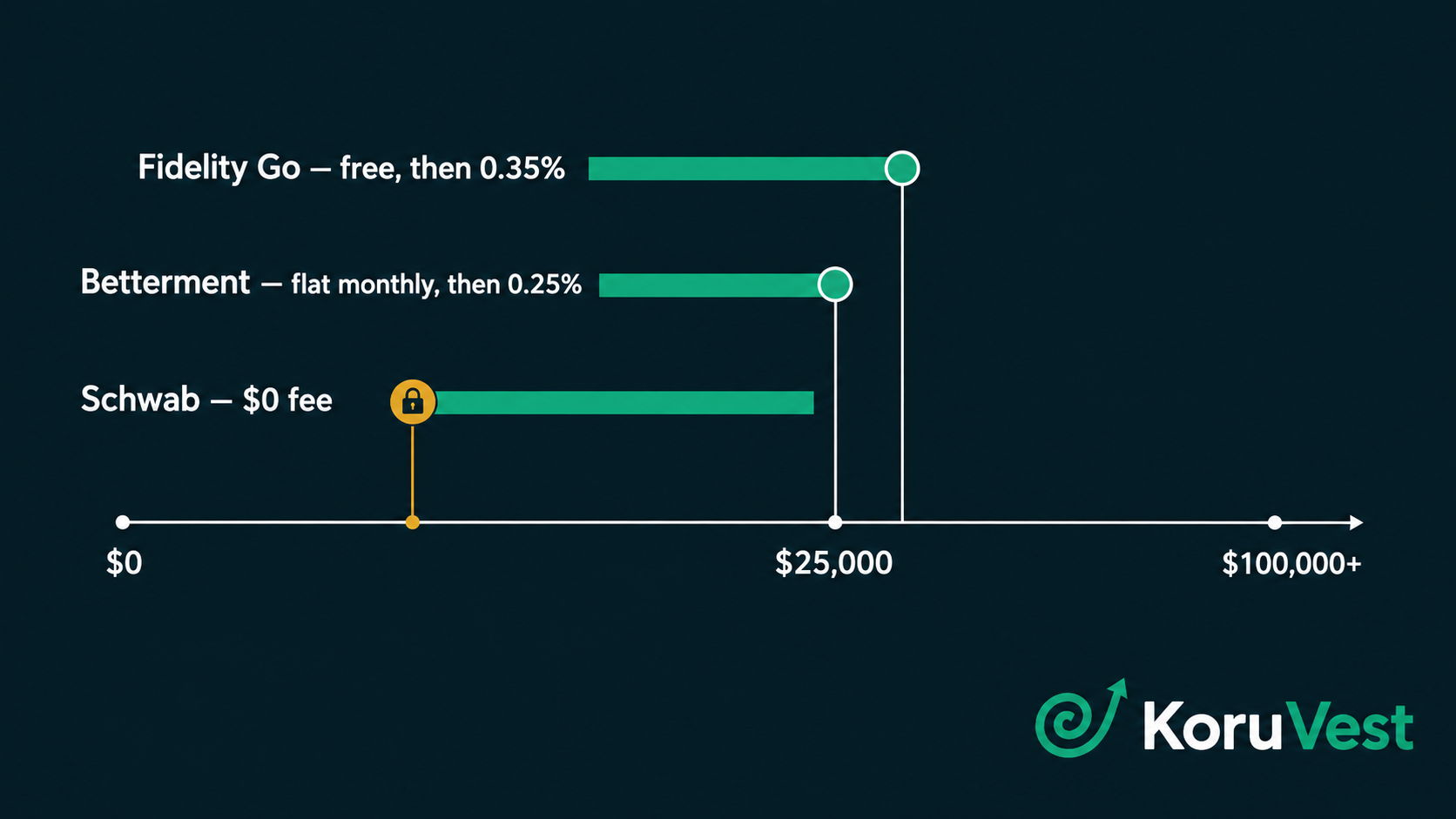
Below $500. Wealthfront and Schwab are unavailable on minimums alone. The realistic field is Fidelity Go, Betterment, and SoFi. In this range Betterment’s flat monthly charge is proportionally heavy, which makes Fidelity Go’s zero cost difficult to argue against on price.
$500 to $5,000. Wealthfront becomes available and its features become relevant in a taxable account. Fidelity Go remains free. Betterment’s structure still depends on whether a recurring deposit has been set up.
$5,000 to $25,000. All six are open. Fidelity Go is still free, which is the strongest single fact in this range, though the absence of tax-loss harvesting begins to matter for a taxable account.
Above $25,000. This is where the ordering inverts. Fidelity Go rises to 0.35%, above Betterment’s and Wealthfront’s 0.25% and well above Vanguard’s approximate 0.15%. The provider that was cheapest becomes the most expensive of the four.
The practical implication is that a first choice does not have to be permanent, but it should be made with the next threshold in view — and with the $75 transfer-out fee noted for anyone considering Betterment as a temporary stop.
What SIPC protection actually covers
Every provider discussed here is SEC-registered and a SIPC member, and the coverage is frequently summarized as $500,000 per account. That summary omits two details worth knowing.
The first is the structure of the limit. SIPC protection is capped at $500,000 in securities and cash combined, and within that total there is a separate $250,000 sub-limit for cash. An account holding a large uninvested cash balance is not protected to $500,000 on that cash.
The second is what triggers it. SIPC applies when a member brokerage firm fails and customer assets are missing. It does not reimburse losses caused by a decline in the market value of investments. The phrase “protected up to $500,000” is often read as insurance against a portfolio falling, and it is not that.
One further distinction: SIPC is a non-profit corporation created by Congress, not a government agency, and it does not carry the explicit federal guarantee that FDIC deposit insurance does.
For a non-U.S. citizen, eligibility is the first question
If you are not a U.S. citizen, one step precedes the entire fee comparison, and robo-advisor reviews rarely mention it.
Most of these platforms require a Social Security Number or an ITIN and a U.S. address to open an account. Someone who has been in the United States long enough to be treated as a resident alien for tax purposes — many H-1B workers, for instance — generally opens these accounts on terms similar to a citizen. Someone recently arrived on an F-1 visa without an SSN may find the application ends before fees ever become relevant.
Two consequences follow. First, confirm eligibility with the specific provider before spending time comparing expense ratios. Second, if leaving the United States is a realistic possibility, it is worth understanding early what happens to an automated account you can no longer contribute to, rather than deciding at short notice.
We cover the account-opening rules in whether a non-U.S. citizen can open a brokerage account, and the departure question in what happens to your U.S. retirement accounts when you leave.
What automation does not resolve
An automated portfolio declines when markets decline. Rebalancing maintains a target allocation; it does not prevent a balance from falling in a difficult year, and the discipline it enforces is only useful if the investor stays invested through one.
Allocation is also one decision among several. The order in which to repay debt, how large a cash reserve should be, whether a Roth or Traditional contribution suits a given tax situation — a robo-advisor answers none of these. It manages the portfolio and leaves the surrounding financial plan to the investor.
And these portfolios are generally constructed to track markets rather than outperform them. That is a design choice rather than a shortcoming, but worth stating plainly, because sophisticated automation can suggest an ambition that is not being pursued.
Frequently asked questions
How much do robo-advisors cost?
The commonly cited figure is 0.25% a year, or roughly $25 annually per $10,000 invested. The full cost is that advisory fee plus the expense ratios of the underlying funds, which often add about 0.04% to 0.11%. Fidelity Go is an exception below $25,000, where both layers are absent.
Is Fidelity Go really free?
Below $25,000 there is no advisory fee, and the Fidelity Flex funds used carry zero expense ratios. Above $25,000 the fee is 0.35% a year, which is higher than Betterment’s or Wealthfront’s standard rate. Tax-loss harvesting is not offered at any balance.
Why does Betterment charge some accounts a monthly amount instead of a percentage?
Smaller balances pay a flat monthly fee rather than 0.25%, and setting up a recurring monthly deposit converts the account to the percentage rate. The exact dollar amount and balance threshold have changed over time and are reported inconsistently, so confirm current terms on Betterment’s pricing page.
Does tax-loss harvesting help inside an IRA?
Generally not. A Roth or Traditional IRA is already tax-sheltered, so there are typically no taxable gains for harvested losses to offset. If the account is an IRA, a provider without the feature is not at a disadvantage on that basis.
Why does Schwab charge no advisory fee?
Schwab’s portfolios include a required cash allocation, and Schwab earns on that cash. The investor pays no stated fee and accepts that a portion of the portfolio remains uninvested, which reduces expected long-term returns without appearing as a charge. The account also requires $5,000 to open.
Is my money protected if the provider fails?
These firms are SIPC members, and SIPC protection is capped at $500,000 in securities and cash combined, including a separate $250,000 limit for cash. It applies when the firm fails and customer assets are missing. It does not cover losses from market declines.
Can I move to a different robo-advisor later?
Yes, though not always without cost. Betterment charges $75 to transfer investments out, and in a taxable account, selling positions rather than transferring them in kind can produce capital gains. Cash withdrawals are generally free.
Can a non-U.S. citizen open a robo-advisor account?
It depends on tax residency and documentation rather than citizenship alone. Most of these platforms require an SSN or ITIN and a U.S. address. A visa holder treated as a resident alien for tax purposes generally opens accounts on terms similar to a citizen; someone recently arrived without an SSN often cannot.
Where to go next
If you are still deciding whether automated management suits you at all, start with what a robo-advisor is and how it works.
If you would rather choose the investments yourself, read how to open a brokerage account and then index funds and ETFs.
If the money is intended for retirement, decide the account before the provider — how a Roth IRA works covers the wrapper this money often belongs in.
If you are investing in the United States on a visa, begin with the account eligibility rules for non-U.S. citizens.
📚 Primary sources
- SIPC — What SIPC Protects
- SIPC — Investors With Multiple Accounts
- U.S. SEC, Investor.gov — Securities Investor Protection Corporation
- U.S. Securities and Exchange Commission — Investor.gov
Provider fees, minimums, and features were verified in 2026 from provider disclosures and are subject to change. Confirm current terms directly with each provider before opening an account.
✍️ About the Author
David Han is the lead author of KoruVest, covering beginner investing, U.S. financial accounts, taxes, and cross-border financial issues for international investors.
KoruVest articles are researched using official and authoritative sources and follow our standards for source review, fact checking, updates, and editorial independence.
⚠️ Disclaimer
Educational only. This article provides general information and is not personalized financial, investment, tax, or legal advice.
Pricing changes. Robo-advisor fees, minimums, and feature tiers are revised more frequently than most retail investing products. Figures here were verified in 2026 and should be confirmed with the provider before you act on them.
Investment risk. Investing involves risk, including possible loss of principal. Automated management does not prevent losses, and past performance does not indicate future results.
Verify current rules. Account eligibility, tax treatment, and investor protection terms can change. See our full Disclaimer.
Published: August 18, 2026 · Last updated: August 18, 2026