
You can arrive in the United States with a graduate degree, a signed job offer, and substantial savings — and still be declined for a credit card with a $500 limit.
That does not necessarily mean a lender thinks you are financially weak. It usually means the lender has very little U.S. credit history with which to judge how you have handled borrowed money.
That distinction matters because a U.S. credit profile is not created by having money in the bank. It is created when lenders or other furnishers report credit-related information to the nationwide credit reporting companies, and a scoring model has enough information to evaluate the resulting file.
For someone who has just moved here, the useful question is therefore not simply “How do I get a credit card?” It is three separate questions: what will create a U.S. credit record, which bureaus will receive it, and when will a scoring model actually be able to produce a score?
Treating those three as one is where most beginner guides become misleading.
The old “26 million credit invisible” statistic was corrected
For years, articles about U.S. credit visibility repeated the same number: roughly 26 million adults were “credit invisible.”
That figure came from a 2015 Consumer Financial Protection Bureau report. In June 2025, the CFPB issued a technical correction after finding that the earlier data had omitted some records containing only deferred student loans, collections, or closed accounts.
After the correction, the estimated share of U.S. adults who were credit invisible in December 2010 fell from 11.0% to 5.8% — from about 25.9 million people to 13.5 million.
Using the updated methodology, the CFPB estimated that 2.7% of U.S. adults, roughly 7.0 million people, were credit invisible in December 2020.
At the same time, 9.8% of adults had a credit record that the scoring model used in the CFPB study did not score. That is an important distinction, and it is the one that matters most to a newcomer: having a file and having a score are not the same thing.
“Credit invisible” and “unscored” are not the same condition
In the CFPB framework, a credit-invisible consumer does not have a credit record with the nationwide credit reporting company represented in the data.
An unscored consumer has a credit record, but the record did not produce a valid score under the model used in the CFPB analysis. The CFPB separates these records into two broad groups:
- Insufficient: there is not enough account or payment-history information for that scoring model.
- Stale: the file exists, but there has not been enough recent reported activity.
There is an extra nuance that matters for newcomers: “unscored” is model-dependent. The CFPB itself notes that a record one model does not score may be scoreable under another model.
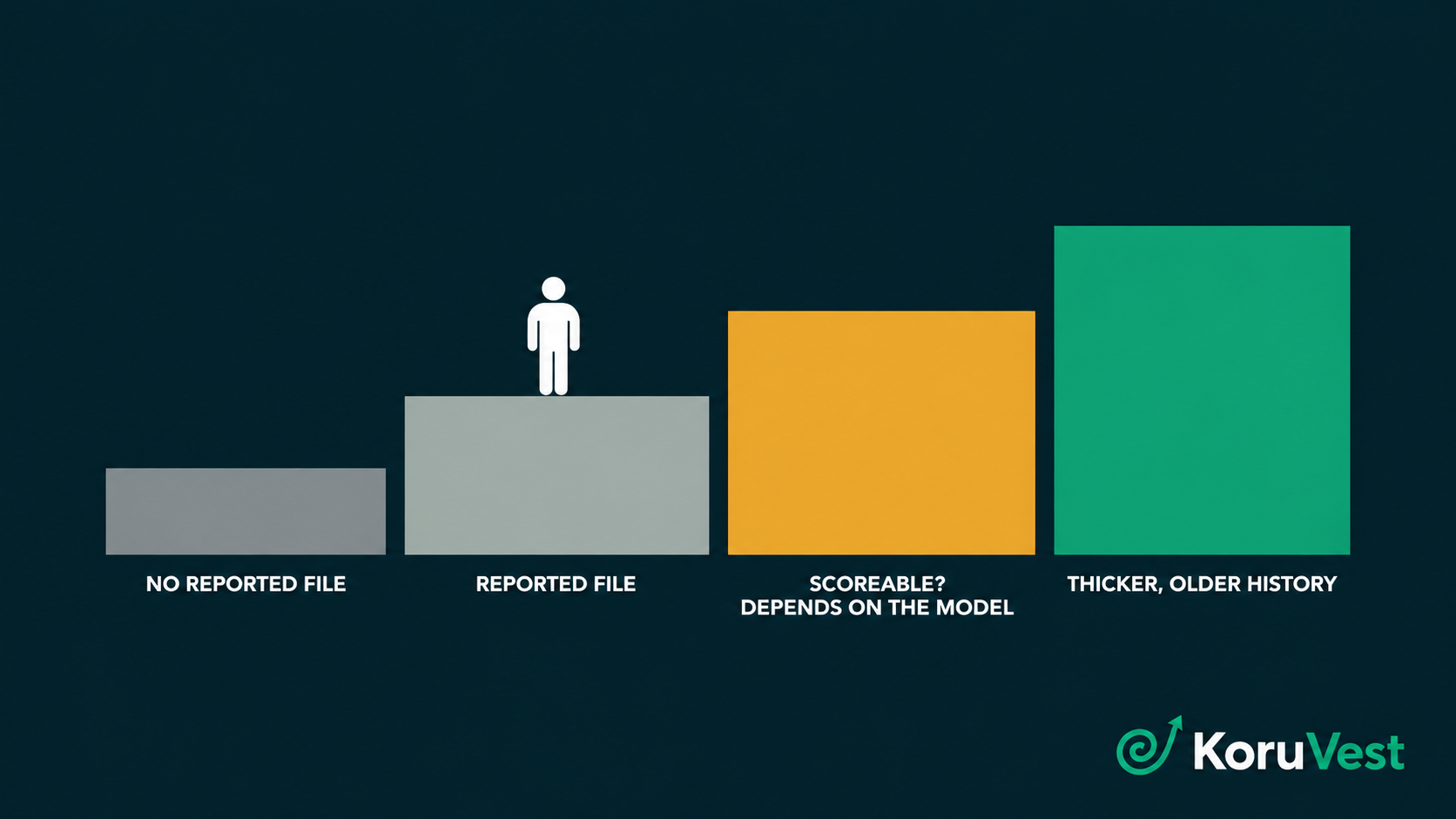
A better mental model is therefore:
No reported file → reported file → model-dependent scoreability → thicker, older credit history. Opening an account can start the process. It does not instantly create a mature credit profile.
There is also no guarantee that all three nationwide credit bureaus will contain identical information. Lenders may report to one, two, or all three, and reporting schedules can differ.
Your foreign credit history usually does not transfer automatically
A strong credit record in another country generally does not become part of your U.S. credit report merely because you move to the United States.
That is why a person with years of successful borrowing in Seoul, Mumbai, Toronto, or London can still look “new to credit” to a U.S. lender.
There are limited cross-border exceptions. Services such as Nova Credit allow participating lenders to use consumer-permissioned credit information from another country as part of an application decision.
But that is different from permanently importing your old foreign file into Equifax, Experian, or TransUnion. The availability of cross-border data, participating lenders, and eligibility rules can change, so the current lender and provider terms should be checked before relying on this route.
The practical lesson is simple: foreign credit may help with a particular application, but do not assume it has created a U.S. bureau history.
An SSN can make the process easier, but it is not what creates a credit file
One of the most important corrections to common newcomer advice is that a U.S. credit file is not simply “keyed to a taxpayer number.”
Experian states that it is possible to have a credit report and credit score without a Social Security Number, and TransUnion says a person without an SSN may still have a TransUnion credit file.
Lenders and credit bureaus use identifying information — such as name, date of birth, address, and sometimes an SSN — to match information to the correct consumer. An SSN often makes that matching and application process easier, but the SSN itself is not the thing that builds credit.
If you are a noncitizen who is authorized to work in the United States, you may be eligible for an SSN depending on your immigration and employment circumstances. F-1 students, for example, generally need qualifying employment authorization and supporting documents before the Social Security Administration will issue an SSN.
An ITIN is different. The IRS issues an Individual Taxpayer Identification Number for federal tax purposes to certain people who need a U.S. taxpayer identification number but are not eligible for an SSN.
An ITIN is not a general-purpose “credit ID,” and the IRS does not issue one solely so a person can open a bank, investment, or credit account. However, if you legitimately have an ITIN, some financial institutions may accept it in place of an SSN for certain products.
If you later become eligible for and receive an SSN, the IRS instructs taxpayers to stop using the ITIN for federal tax purposes and notify the IRS so tax records can be combined under the SSN. At the same time, it is sensible to update your identifying information with your lenders and review your credit reports for accuracy.
Under 21? The income rule is more nuanced than most guides suggest
Credit-card applicants under age 21 face an additional federal rule.
Under Regulation Z, a card issuer generally may not open an account for an applicant under 21 unless the application demonstrates an independent ability to make the required minimum payments, or a qualifying cosigner, guarantor, or joint applicant who is at least 21 agrees to be liable.
That does not mean only wages count.
The regulation allows consideration of the young applicant’s current or reasonably expected income or assets. It also distinguishes between money the applicant merely expects to be able to use and money that is actually available to the applicant.
For example, regular transfers from a parent or another person into the applicant’s own deposit account may be considered by the issuer. Merely knowing that a parent has money somewhere else is different.
For an international student, this means the right answer is not “parental support never counts.” The issuer’s application and underwriting policy, together with the actual structure of the income or assets, matters.
Getting approved is not the same as building a bureau record
This is the most useful product-selection question in the entire article.
A card can be useful for making purchases, but it builds a U.S. credit history only to the extent that the issuer reports the account to one or more nationwide credit bureaus.
That is why the first question before opening a product for credit-building purposes should be:
Which credit bureaus do you report this account to, and how often?
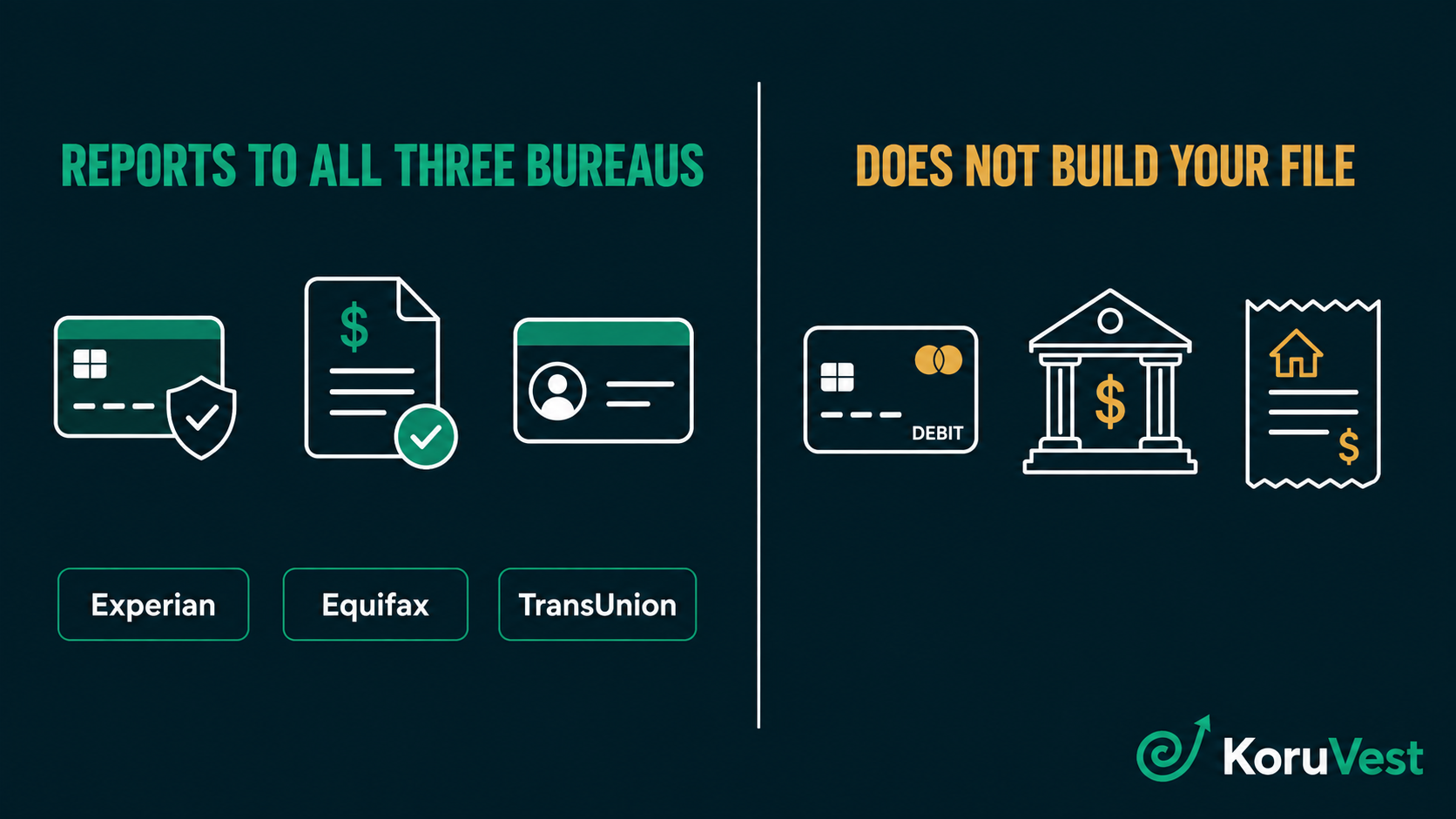
Debit-card purchases and ordinary checking or savings balances generally are not tradelines on a traditional credit report. Rent, utility, and telecom information can sometimes reach credit-reporting or scoring systems through specialized reporting arrangements, but it should not be assumed to happen automatically.
For newcomers, approval is useful. Reported approval is what starts building the record.
Four common ways a newcomer can start reporting credit
| Route | Typical structure | Cash trade-off | What to verify |
|---|---|---|---|
| Secured credit card | Credit line backed by a refundable deposit | Deposit is tied up while secured | Eligibility, fees, bureau reporting, graduation policy |
| Credit-builder loan | Loan proceeds are held while you make payments | Monthly payment plus possible interest/fees | Cost, bureau reporting, release terms |
| Authorized user | You are added to another person’s card account | Often no deposit | Whether issuer reports authorized users and to which bureaus |
| Newcomer-focused card | Underwriting may use alternative information | Varies | Identification rules, fees, bureau reporting, residency requirements |
Issuer eligibility and reporting policies vary and can change. Confirm the current terms before applying.
Why secured cards are often the simplest starting point
A secured credit card is backed by a cash deposit. The deposit reduces the issuer’s credit risk, which is why secured cards are often available to consumers who have little or no credit history.
Approval is still not automatic. Issuers may apply identity, income, residency, banking, sanctions, or other eligibility checks.
After approval, the card works much like an ordinary credit card: you make purchases, receive a statement, and make payments under the card agreement. If the issuer reports the account, those updates can begin building a credit record.
Some secured cards can later “graduate” to an unsecured account and return the deposit while keeping the same account open. That feature can be useful, but it should be confirmed with the issuer rather than assumed.
The financial cost is easy to overlook. A $300 or $500 deposit is cash that is not sitting in your high-yield savings account or available for an emergency.
For someone who has just relocated and is still absorbing moving costs, the right question is not “Is a secured card good?” It is “Is building credit worth tying up this amount of liquidity right now?”
A credit-builder loan can build credit and savings, but do not buy credit mix for its own sake
The CFPB describes a common credit-builder-loan structure this way: a bank or credit union places the loan proceeds in a locked savings account, the borrower makes installment payments over time, and the funds are released at the end of the term.
The arrangement can build savings while reported payments build credit history.
It also creates an installment account rather than revolving credit-card debt. Credit mix is one factor used by some scoring models, including FICO.
But that does not mean a newcomer should pay interest or fees merely to create a second type of account. Payment history, low revolving balances, time, and avoiding unnecessary applications are generally more important than engineering a “perfect” mix.
A credit-builder loan can make sense when its cost is reasonable and its savings structure fits your cash flow. It is a poor substitute for money you may need tomorrow, because the funds are typically restricted until the loan terms are satisfied.
If your emergency reserve is still fragile, compare that trade-off with our guide to building an emergency fund.
Authorized-user status can help, but it depends on the issuer and the primary account
Becoming an authorized user on someone else’s credit card can place information about that account on your credit report if the issuer reports authorized users.
That makes it potentially useful for a newcomer who has a trusted family member or partner with a well-managed account already established in the United States.
But three conditions matter.
The issuer must report the authorized-user relationship. Do not assume every issuer reports it in the same way to every bureau.
The primary account’s condition matters. A high reported balance or delinquency on the account can make the relationship less helpful and potentially harmful to the authorized user’s file.
The primary cardholder remains responsible for the account under the issuer’s terms. This is a financial relationship, not merely a score trick.
Authorized-user status can be a useful bridge. It is not a reason to ignore the value of eventually building credit in your own name.
Two habits deserve most of your attention: never be late, and keep reported balances modest
Credit scoring models differ, but two habits consistently deserve attention.
First, make every required payment on time. In the widely used FICO framework, payment history is the largest category. A payment that becomes at least 30 days late can be reported to the credit bureaus and can hurt a thin file materially.
There is an important distinction between credit scoring and credit-card cost.
You do not need to carry an interest-bearing balance to build credit. Paying the statement balance in full by the due date is usually the cleanest habit because it avoids interest on ordinary purchases when the card’s grace-period rules apply and keeps debt from accumulating.
Second, do not let a small credit limit make you look highly utilized. A $250 balance on a card with a $300 limit is more than 80% utilization even if you intend to pay the card in full. Newcomers are especially exposed to this, because a first secured card often carries a limit equal to a modest deposit.
Many issuers report a statement balance to the bureaus, but reporting dates and practices vary. If your reported utilization is high, paying part of the balance before the issuer reports can reduce the balance that appears on your credit report.
Do not turn this into a daily optimization project. The useful goal is simply to avoid appearing close to maxed out while paying the account reliably.
How long until you have a score? It depends on the scoring model
This is another place where a single “six-month rule” is too simple.
For a valid FICO Score, FICO says the credit report generally needs at least one account that has been open for six months or more and at least one account that has been reported to the bureau within the past six months.
VantageScore can score some consumers much earlier. VantageScore states that its models can generate a score after as little as one month of reported credit activity.
So a newcomer can be in the strange position of having a VantageScore but not yet satisfying the minimum history for a FICO Score. Seeing a number in a free consumer app four months after arriving does not mean a mortgage lender or auto lender will see one.
That matters because lenders choose which bureau, score brand, and score version they use. There is no single day when you “get a credit score” — different bureaus can hold different data, and different scoring models can become usable at different times.
This is why patience matters more than opening several accounts at once. A longer record of well-managed credit gives future lenders more evidence to work with.
Three moves that can slow progress
Applying for several cards in quick succession. A credit-card application typically creates a hard inquiry, and new-credit activity can affect a thin score. If one application fails, pause and understand why before creating a string of new inquiries.
Closing a useful no-fee card just because a better card arrives. Closing a card does not instantly erase its age from your credit history. A closed account in good standing can remain on a credit report for years. But closing a revolving account can reduce available credit and increase utilization, and the account will eventually stop contributing once it falls off the report.
That does not mean every old card should be kept forever. Annual fees, fraud risk, poor service, or issuer terms can justify closing one. The point is simply that “close the starter card to upgrade” is not automatically the best score strategy.
Assuming “paid in full” means the bureaus saw a zero balance. Your payment due date and the issuer’s reporting date are different events. A card can be paid in full every month and still show a balance on your credit report if that was the balance reported earlier in the billing cycle.
If you may leave the United States, the value of building credit depends on your horizon
The strongest reason to build U.S. credit is that you expect to use the U.S. financial system again.
For someone in the country for only a short program with no plan to return, tying up cash in a secured card or paying fees for a credit-building product may have limited value.
For someone who may extend a visa, change status, return for graduate school, buy a car, rent housing, or move back to the United States later, starting earlier can be more useful.
Leaving the country does not make a credit report disappear the next day. But recent activity matters differently across scoring systems. FICO’s minimum criteria, for example, require recent reported activity, while newer scoring models may be able to score more dormant files.
There is another practical issue: the credit card itself and the credit file are separate. An issuer may have residency, address, or international-account policies that change once you move abroad.
Do not maintain an inaccurate U.S. address simply to keep a card open. Instead, check the issuer’s current policy before departure, keep your legitimate contact information current, and decide whether the account can realistically be maintained from abroad.
The broader questions around leaving the United States — including retirement accounts, brokerage accounts, and tax status — are covered in our guide to what happens to U.S. accounts when an H-1B worker leaves the country.
Frequently asked questions
Does my credit history from my home country transfer to the U.S.?
Usually not automatically. U.S. credit bureaus generally build a U.S. file from information reported into the U.S. system. Some cross-border services and participating lenders can use foreign credit information for a particular application, but that is not the same as importing your old file into the U.S. bureaus.
Can I build credit without a Social Security Number?
Yes, in some situations. Experian and TransUnion both indicate that a person can have a credit file without an SSN. Some lenders may accept an ITIN or other identification, but product rules vary. An ITIN itself is an IRS tax-processing number and is not issued solely for the purpose of getting credit.
How long does it take to get a U.S. credit score?
It depends on the scoring model and the information reported to the bureau. FICO generally requires at least one account open for six months or more plus recent reported activity. VantageScore can score some consumers after as little as one month of reported activity. A lender may use a different score from the one you see in a consumer app.
Is a secured card or a credit-builder loan better?
Neither is automatically better. A secured card usually ties up a refundable deposit but gives you a usable revolving credit line. A credit-builder loan may avoid a large upfront deposit but can involve monthly payments, interest, or fees while the loan proceeds remain restricted. Compare total cost, liquidity, and bureau reporting before choosing.
Can an international student on an F-1 visa build credit?
Yes, though the path depends on documentation. F-1 students generally need qualifying employment authorization before the Social Security Administration will issue an SSN. Without one, some issuers accept an ITIN or other identification, and authorized-user status is another route. Applicants under 21 also face the Regulation Z income requirement described above.
What happens to my U.S. credit file if I leave the country?
The file does not disappear immediately, but inactivity can affect scoreability and individual accounts may be subject to issuer residency policies. Before leaving, review your credit reports, update lenders with accurate contact information, and check whether the accounts you want to keep can actually be maintained from your new country.
Where to go next
If tying up $300–$500 for a secured card would weaken your cash cushion, start with how to build an emergency fund and where to keep short-term cash.
If your cash foundation is already in place and you are ready to invest, how to open a brokerage account explains the next account decision.
If you are a visa holder or non-U.S. citizen, continue with whether a non-U.S. citizen can open a U.S. brokerage account, and with our investing guide for F-1 students.
📚 Primary sources
- CFPB — Technical Correction and Update to the CFPB’s Credit Invisibles Estimate
- CFPB — Ways to Start or Rebuild a Good Credit History
- CFPB — Regulation Z § 1026.51, Ability to Pay
- IRS — Individual Taxpayer Identification Number (ITIN)
- IRS — Additional ITIN Information
- Social Security Administration — International Students and Social Security Numbers
- FICO — Minimum Requirements for a FICO Score
- VantageScore — How Credit Scores Work
- TransUnion — Building Credit as an Immigrant
- Experian — Credit Reports and Scores Without an SSN
Issuer identification requirements, bureau-reporting practices, newcomer programs, and scoring-model usage can change. Confirm current product terms before applying.
✍️ About the Author
David Han is the lead author of KoruVest, covering beginner investing, U.S. financial accounts, taxes, and cross-border financial issues for international investors.
KoruVest articles are researched using official and authoritative sources and follow our standards for source review, fact checking, updates, and editorial independence.
⚠️ Disclaimer
Educational only. This article provides general information and is not personalized financial, credit, tax, immigration, or legal advice.
Product rules change. Issuer identification requirements, bureau-reporting practices, newcomer programs, residency rules, and scoring-model usage can differ and may change over time.
Individual circumstances control. Eligibility for an SSN or ITIN depends on your immigration and tax situation, and credit outcomes depend on the information in your individual credit files and the scoring model used.
Verify current rules. See our full Disclaimer.
Published: August 20, 2026 · Last updated: August 20, 2026