
There is a U.S. reporting deadline on October 15, 2026, and it applies to a group of people who often assume it does not concern them.
It is not a tax return. Nothing is owed. Filing is free. The form is FinCEN Form 114, usually called the FBAR, and it reports financial accounts you hold outside the United States.
The reason visa holders miss it is that the obligation does not arrive with a notice. It arrives as a consequence of becoming a U.S. resident for FBAR purposes — and the account it asks about is frequently one you opened years before you ever came to the United States.
If you hold a green card, are working on an H-1B, or have been an F-1 student long enough that your days of presence now count toward U.S. residency, this is worth reading before October.
Mainstream FBAR guidance is written for a different reader
Search for FBAR guidance and most of what you find is addressed to U.S. citizens living abroad. Expat tax firms, accounting practices, guides written for Americans in London or Singapore.
Visa holders face the mirror-image problem. They may live inside the United States while the accounts that create the reporting question remain back home. The residency analysis runs in the opposite direction, the accounts are in the country of origin rather than the country of residence, and the moment the obligation begins is usually a change in status rather than a move.
Content aimed specifically at H-1B holders does exist, and some of it is good. What is harder to find is a clear treatment of the transition — how someone moves from having no obligation to having one, without their money changing at all.
For visa holders, the filing trigger is U.S.-person status, not the visa label
An H-1B visa does not automatically create an FBAR obligation, and an F-1 visa does not automatically prevent one.
The IRS states that a U.S. person — including a citizen, a resident, and various entities — must file an FBAR to report a financial interest in or signature or other authority over at least one financial account located outside the United States, if the aggregate value of those accounts exceeded $10,000 at any time during the calendar year reported.
For a non-U.S. citizen, the operative question is generally whether the individual is a U.S. resident under the residency rules incorporated into the FBAR regulations, which include the green card test and the substantial presence test. Nonresident aliens are generally not required to file.
Two FBAR-specific twists are worth knowing, because both cut against intuition.
A treaty position does not erase FBAR status. Someone who is a U.S. resident under the residency rules but claims treatment as a nonresident for income-tax purposes under a tax treaty generally remains a U.S. person for FBAR purposes. The income-tax result and the FBAR result can diverge.
Electing to file jointly with a U.S. spouse does not create FBAR residency. A nonresident alien who elects under Internal Revenue Code section 6013(g) or 6013(h) to be treated as a resident in order to file a joint return with a U.S. spouse is treated as a resident for income-tax purposes. That election is generally disregarded in determining FBAR residency. Marriage to a U.S. citizen, on its own, does not make you a U.S. person for this filing.
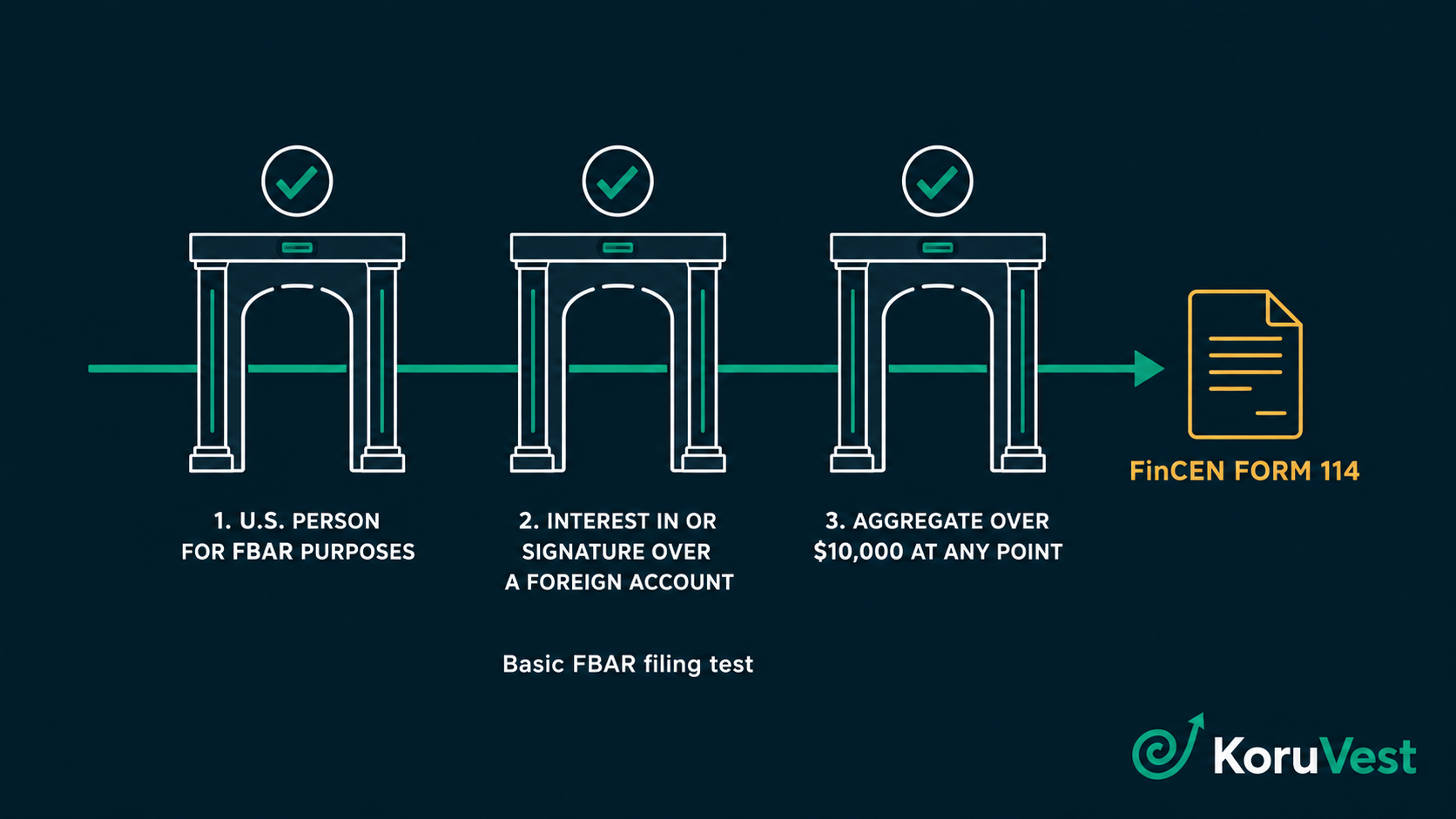
The basic test has three parts: you are a U.S. person for FBAR purposes, you have a financial interest in or signature authority over at least one foreign financial account, and the combined value of those accounts exceeded $10,000 at any point in the calendar year. Statutory exclusions can remove particular accounts from the calculation, which is covered below.
For an F-1 student, the change is in the residency test, not in the accounts
This is the transition that catches people, and it is worth stating precisely rather than simply.
Students in F, J, M, or Q status are generally treated as exempt individuals for the substantial presence test, which means their days of presence in the United States are not counted. The IRS applies this for a limited period — generally the first five calendar years of presence as a student.
What happens after that is not automatic residency. Once the exempt period ends, the days begin to count, and the person becomes a resident alien only if the substantial presence test is then actually satisfied. In limited circumstances, continued exempt-individual treatment can be claimed beyond five years where the specific requirements are met.
So the accurate version is this: after the exempt period, a student who satisfies the substantial presence test generally becomes a resident alien — and a reporting obligation can appear for the first time.
The savings account in Seoul or Mumbai did not change. The residency test did.
Similar discontinuities appear at other transitions — F-1 to H-1B, a change of status partway through a year, receipt of a green card. Each can alter residency, and residency is what drives this filing. We covered the five-year exempt window in more detail in our guide to investing on an F-1 visa.
Where residency begins partway through a calendar year, the interaction between the residency start date and a calendar-year filing is genuinely intricate. If your status changed during the year in question, that fact pattern deserves a professional’s attention rather than a general article’s.
The $10,000 threshold is not what most people assume it is
Two features of the threshold catch people, and both run toward more filing rather than less.
The first is that it is aggregate, not per account. You add together the highest balance of each foreign financial account. The comparison is between that combined figure and $10,000 — not between any single account and $10,000.
The second is that it is a peak, not a year-end balance. If the combined total crossed $10,000 on a single day and fell back the next, the threshold was met. A December statement showing $3,000 does not settle the question.
This is why a lump-sum transfer is such a common trigger. A parent wires a year of tuition into a student’s home-country account in September; the money leaves for the university in October. The account spent six weeks above the threshold.
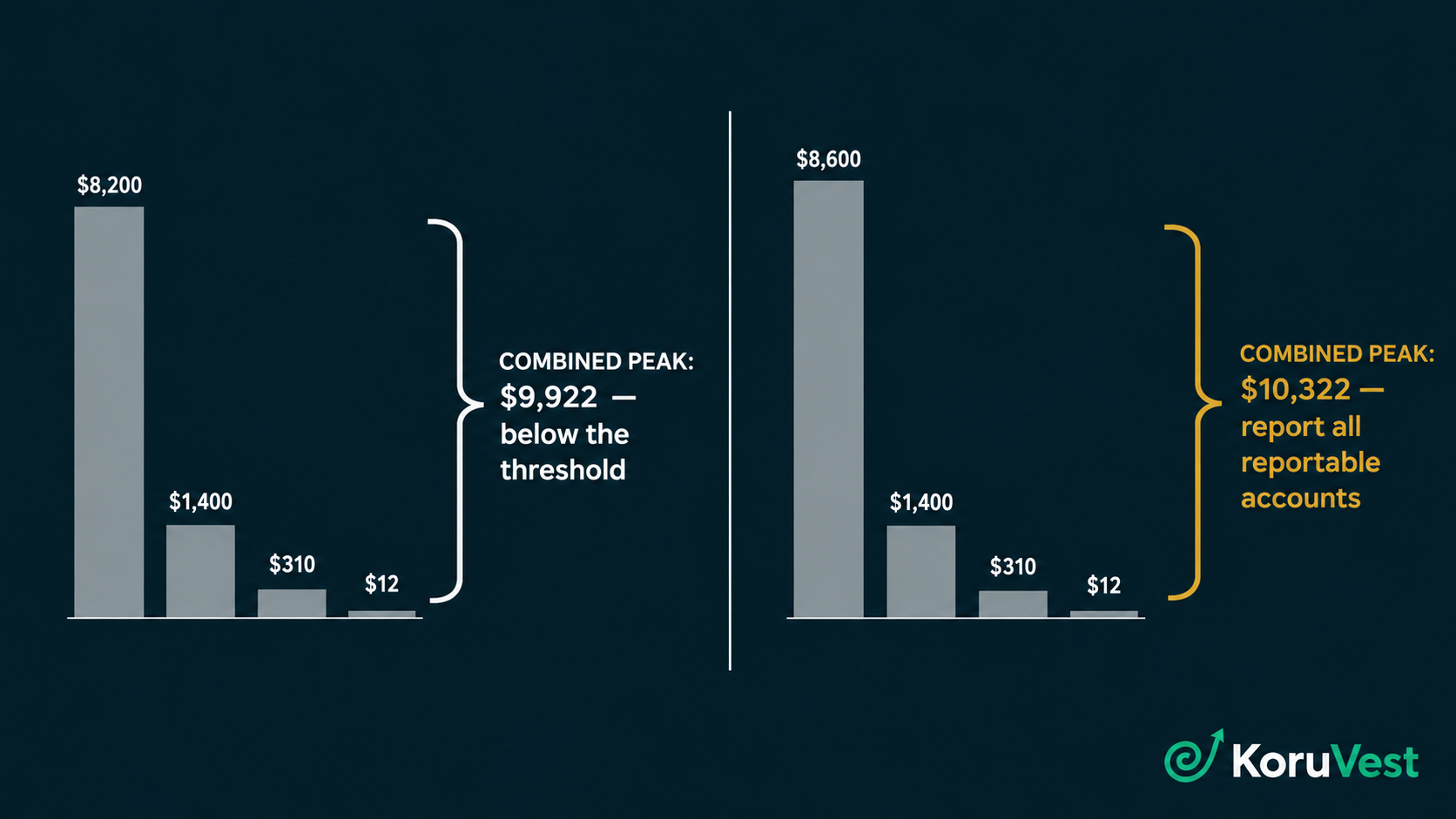
Crossing the threshold once brings the small accounts in too
The $10,000 test decides whether you file. It does not decide what you report.
Once the combined total is exceeded, the filing covers every reportable foreign financial account you held during the year — including a dormant account holding the equivalent of twelve dollars, and including accounts that were closed at some point during the year.
Joint accounts are counted at full value rather than at your share. If your name is on a family account with a parent or sibling, the whole balance enters the aggregate calculation.
A common and avoidable error follows from this: filing correctly for the large account and omitting three small ones, on the reasonable-sounding logic that each was below the threshold. The threshold was never about individual accounts.
Filing a tax return does not satisfy this, and it does not go to the IRS
The FBAR is administered by the Financial Crimes Enforcement Network, a bureau of the U.S. Treasury Department, and it is filed electronically through FinCEN’s BSA E-Filing System. It is not attached to Form 1040.
That structural fact explains a large share of missed filings. Someone uses a tax preparation service, files an accurate return, and reasonably assumes the year’s obligations are complete. The FBAR is a separate filing to a separate agency, and unless it was specifically raised, it may not have been addressed.
A related assumption fails for the same reason: the FBAR is independent of whether you owe tax. The IRS states that whether the account produced taxable income has no effect on whether it is a foreign financial account for FBAR purposes. An account earning nothing, in a year you owed nothing, can still be reportable.
Some accounts are excluded, and one you might expect to report is not foreign
The IRS lists specific exclusions. Accounts held in an individual retirement account of which you are the owner or beneficiary, accounts held in a retirement plan of which you are a participant or beneficiary, and accounts maintained on a U.S. military banking facility do not need to be reported.
There is also a location point that works in your favor: an account at a U.S. branch of a foreign bank is generally treated as domestic. A checking account opened at the New York branch of a Korean or Indian bank is generally not a foreign financial account for this purpose. What matters is where the account is located, not the nationality of the institution’s parent.
Foreign retirement arrangements are less clear-cut than the exclusion list suggests at a glance. The exclusions are framed around U.S.-style IRAs and retirement plans, and whether a particular home-country pension or provident arrangement falls inside or outside them depends on its structure. Practitioners routinely include such arrangements in the initial account inventory precisely because the answer is not obvious. If you hold one, treat it as a question rather than an assumption.
Digital assets require a separate check. Under FinCEN Notice 2020-2, a foreign account holding only virtual currency is not currently treated as a reportable FBAR account. If the account also holds assets that are independently reportable under the FBAR regulations, the result can differ. FinCEN has stated that it intends to amend the rules to address virtual currency, so this is an area where current guidance should be checked before filing rather than recalled from an earlier year.
Signature authority counts even when none of the money is yours
The obligation is not limited to accounts you own.
Having signature or other authority over a foreign account — the ability to direct the disposition of its assets — can create a filing obligation on its own, with no financial interest whatsoever.
For visa holders this appears in two recurring situations. One is a family account back home, where a parent adds you as a signatory for convenience. The other is employment, where an employee or officer holds authority over a foreign company account.
Neither situation involves your money. Both can involve your filing.
October 15 is the automatic extended deadline for most filers
The FBAR is an annual report covering the calendar year, due April 15 of the following year. Filers receive an automatic extension to October 15 — no form, no request, no notification required.
For calendar year 2025 accounts, the report was due April 15, 2026, and the extended deadline is October 15, 2026.
Two clarifications matter. The extension is genuinely automatic, so missing April 15 does not by itself create a problem for the 2025 reporting year provided the filing arrives by October. And unlike an income tax return, there is generally no further extension to request beyond October 15 for an ordinary individual filer.
There are narrow exceptions rather than a general safety net. The IRS notes that FBAR due dates may be further extended for those affected by a natural disaster, and FinCEN has continued to extend the deadline for certain employees and officers with signature authority over — but no financial interest in — specified foreign accounts. Neither applies to a typical visa holder reporting a personal account back home.
The practical constraint is record-gathering rather than form-filling. For each account you will need the institution’s name and address, the account number, the account type, and the maximum value during the year, converted to U.S. dollars using the Treasury’s reporting rate of exchange for the last day of the year. Requesting historical statements from an overseas bank can take weeks.
What the penalties look like, and what the Supreme Court changed
FBAR penalties are severe on paper, which is worth stating plainly rather than softening.
As of August 2026, the current inflation-adjusted maximums listed in 31 CFR 1010.821 apply to penalties assessed on or after January 17, 2025: up to $16,536 for a non-willful violation, and up to the greater of $165,353 or 50% of the account balance for a willful violation, with criminal exposure available in willful cases.
The 2023 Supreme Court decision in Bittner v. United States changed the arithmetic for non-willful violations. The Court held that the non-willful penalty applies on a per-report basis — that is, per annual FBAR — rather than per unreported account. Before that decision, the government’s position had been per account, which produced a very different figure for someone with several accounts across several years.
Two points of perspective belong beside the numbers. These are statutory maximums rather than typical outcomes, and the distinction between willful and non-willful conduct does substantial work in practice. None of that is a reason to be casual. It is a reason not to freeze, which is the more common failure.
If you are behind, there are defined procedures
Discovering a missed obligation covering several years is unsettling, and the instinct to do nothing is understandable and usually the worst available option.
The IRS’s current guidance for delinquent filings is direct: if you have not been contacted by the IRS about a late FBAR and are not under civil examination or criminal investigation, file the delinquent report as soon as possible and include a statement explaining the reason for the late filing.
Where income associated with the accounts was not properly reported and the conduct was non-willful, the Streamlined Filing Compliance Procedures may apply. The domestic version carries a miscellaneous offshore penalty of 5%. That 5% is not calculated on the FBAR accounts alone: under the IRS’s description, the year-end aggregate balance or value of the foreign financial assets subject to the penalty is determined for each year in the covered period, and the penalty applies to the highest of those annual figures. The asset scope can be broader than the accounts on an FBAR.
Willful conduct falls under a separate voluntary disclosure framework.
Two things determine which path fits: the willfulness question, and whether you come forward before the IRS contacts you. Both are reasons this is the point in the article where consulting someone experienced in international reporting is the actual answer rather than a disclaimer.
The FBAR and Form 8938 are two different filings
These are routinely confused, and filing one does not satisfy the other. Many people with foreign assets must file both.
| FBAR (FinCEN Form 114) | Form 8938 (FATCA) | |
|---|---|---|
| Filed with | FinCEN, via BSA E-Filing System | IRS, attached to your tax return |
| Threshold | $10,000 aggregate, any point in the year | Higher, and varies by filing status and residence |
| Covers | Foreign financial accounts | A broader range of specified foreign financial assets |
| Deadline | April 15, automatic extension to October 15 | Follows your tax return deadline |
| Cost to file | None | Part of your return |
Form 8938 thresholds depend on filing status and whether you live in the United States. Confirm the figures applicable to your situation with the IRS comparison of the two requirements.
Records matter more than the form. Keep your filing confirmation and the underlying account records. The filing itself is short; reconstructing years-old overseas balances is not.
Frequently asked questions
Do F-1 students have to file an FBAR?
Generally not while they remain nonresident aliens. Students in F status are typically treated as exempt individuals for the substantial presence test, generally for their first five calendar years, and nonresident aliens are generally not required to file. After the exempt period, a student who then satisfies the substantial presence test generally becomes a resident alien, and the obligation can apply.
Do H-1B workers have to file an FBAR?
If you are a U.S. resident under the residency rules that apply to the FBAR, the same requirements apply as to a citizen. If your foreign accounts exceeded $10,000 in aggregate at any point in the calendar year, the filing requirement generally applies. The visa category itself is not the test.
My account back home has less than $10,000. Do I still need to file?
Possibly. The threshold is the combined highest balance of all your foreign accounts, not the balance of any single one. Add each account’s peak value. If the total crossed $10,000 at any point in the year, the requirement generally applies — and then all reportable accounts are included, even small ones.
I already filed my tax return. Isn’t that enough?
No. The FBAR is filed with FinCEN, a Treasury bureau, through a separate electronic system. It is not part of Form 1040 and is not sent to the IRS. An accurate tax return does not satisfy the FBAR requirement.
I have no U.S. income and owe no tax. Does this still apply?
Yes, if the conditions are met. The IRS states that whether the account produced taxable income has no effect on whether it is a foreign financial account for FBAR purposes.
I filed jointly with my U.S. citizen spouse. Am I a U.S. person for FBAR purposes?
Not necessarily. An election under Internal Revenue Code section 6013(g) or 6013(h) to be treated as a resident for income-tax purposes is generally disregarded in determining FBAR residency. You would need to be a U.S. resident under the residency rules that apply to the FBAR — for example, by meeting the substantial presence test independently.
Do I report cryptocurrency held on a foreign exchange?
Under FinCEN Notice 2020-2, a foreign account holding only virtual currency is not currently treated as a reportable FBAR account. If the same account also holds assets that are independently reportable, the analysis changes. FinCEN has said it intends to amend the rules, so check current guidance before filing.
Is an account at a U.S. branch of a foreign bank reportable?
Generally no. What matters is where the account is located rather than the nationality of the bank. An account at a U.S. branch is ordinarily treated as domestic for this purpose.
I missed prior years. What should I do?
Do not ignore it. The IRS instructs those who have not been contacted about a late FBAR, and who are not under examination or investigation, to file the delinquent report as soon as possible with a statement explaining the delay. Where income was not properly reported, the Streamlined Filing Compliance Procedures may apply for non-willful conduct. Choosing among the available paths depends on a willfulness assessment that warrants professional advice.
Where to go next
If you are unsure whether you are a nonresident alien or a resident alien, that determination drives this and much else — start with the residency tests explained in our brokerage account guide.
If you are on an F-1 visa, our investing guide for F-1 students covers the exempt-individual window in more detail.
If you are planning to leave the United States, reporting is one of several questions that change on departure — see what happens to your U.S. accounts when you leave.
And if withholding on your U.S. investment income is what brought you here, the W-8BEN and the 30% rule is the companion piece to this one.
📚 Primary sources
- IRS — Report of Foreign Bank and Financial Accounts (FBAR)
- FinCEN — Report Foreign Bank and Financial Accounts
- FinCEN Notice 2020-2 — FBAR Filing Requirement for Virtual Currency
- Supreme Court of the United States — Bittner v. United States (2023)
- eCFR — 31 CFR 1010.821, Penalty Adjustment and Table
- IRS — Publication 519, U.S. Tax Guide for Aliens
- IRS — Substantial Presence Test
- IRS — Exempt Individual: Who Is a Student
- IRS — Comparison of Form 8938 and FBAR Requirements
- IRS — Streamlined Filing Compliance Procedures
- U.S. Treasury — Reporting Rates of Exchange
Penalty maximums are subject to inflation adjustment, and deadlines, exclusions, and virtual-asset guidance can change. Confirm current rules at irs.gov and fincen.gov before filing.
✍️ About the Author
David Han is the lead author of KoruVest, covering beginner investing, U.S. financial accounts, taxes, and cross-border financial issues for international investors.
KoruVest articles are researched using official and authoritative sources and follow our standards for source review, fact checking, updates, and editorial independence.
⚠️ Disclaimer
Educational only. This article provides general information and is not personalized tax, legal, or immigration advice. We are not tax professionals or attorneys.
Individual facts control. Whether you are a U.S. person for FBAR purposes, whether a particular account is reportable, and how a mid-year change in residency affects a calendar-year filing all depend on your specific circumstances.
Delinquent filings need advice. If you have missed prior-year filings, the choice among available procedures depends on a willfulness assessment. Speak with a professional experienced in international reporting before filing.
Verify current rules. Penalty maximums, thresholds, and guidance change over time. See our full Disclaimer.
Published: August 24, 2026 · Last updated: August 24, 2026