
Look at your paystub and find two lines: Social Security and Medicare.
For most employees, those deductions are routine. For someone in the United States on an F-1 or H-1B visa, however, the same two lines can mean very different things.
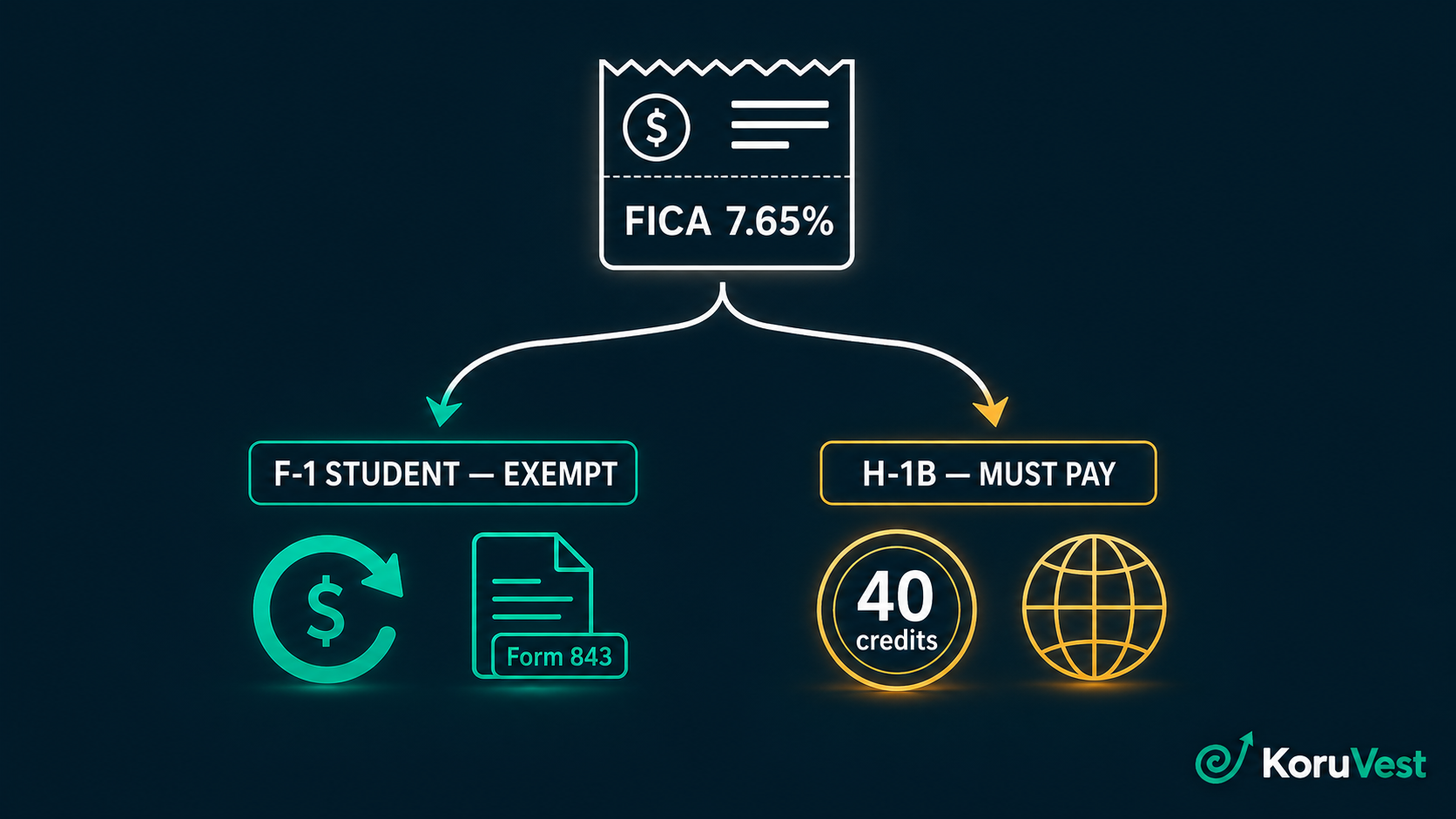
An F-1 student may be paying tax that should never have been withheld. An H-1B worker will usually owe the tax, but the payments can build eligibility for a future U.S. Social Security benefit. And for workers whose careers span two countries, an international Social Security agreement can change both the tax bill today and the benefits available decades later.
So the useful question is not simply, “Can I get my Social Security tax back?”
It is:
Was I supposed to pay it in the first place — and if I was, what did those payments earn me?
The short version: qualifying F-1 nonresident students are often exempt from Social Security and Medicare tax on authorized student employment. H-1B workers are generally subject to both taxes, although a Totalization Agreement can create an exception in some cross-border assignments. Properly paid U.S. Social Security tax is not a personal account that can simply be cashed out when you leave the country.
Last reviewed: August 18, 2026. Immigration status, tax residency, employment circumstances, and international Social Security agreements can change the result.
Start with what is actually coming out of your paycheck
FICA — the Federal Insurance Contributions Act — finances Social Security and Medicare.
For 2026, an employee generally pays:
- 6.2% Social Security tax on covered wages up to $184,500; and
- 1.45% Medicare tax on covered wages, with no equivalent wage ceiling.
The employer generally pays the same 6.2% and 1.45% shares.
Higher earners can also encounter the separate 0.9% Additional Medicare Tax. Employers begin withholding that additional tax after paying an employee more than $200,000 in Medicare wages during the calendar year, although the employee’s ultimate liability depends on filing status.
That is why calling FICA simply “7.65% of your salary” is useful shorthand but not the full story. Social Security stops at the annual wage base, Medicare does not, and high-income employees can face an additional Medicare tax.
More importantly for visa holders, none of those percentages tells you whether your particular wages were subject to FICA in the first place.
For many F-1 students, the first question is whether FICA should be there at all
An F-1 visa does not automatically exempt every paycheck from Social Security and Medicare tax.
The exemption most international students rely on has several pieces.
The IRS generally treats an F-1 student who has been temporarily present in the United States for fewer than five calendar years as a nonresident alien under the special student day-counting rules.
While the student remains a qualifying nonresident alien, wages from employment can be exempt from Social Security and Medicare taxes when the work is authorized by USCIS and performed to carry out the purpose for which the F-1 status was issued.
The IRS specifically includes familiar student situations such as authorized on-campus employment and practical training.
That means a qualifying student working on campus, CPT, or OPT can have federal income tax liability on wages while still being exempt from Social Security and Medicare tax on those same wages.
The five-year rule is useful — but it is not a five-year FICA guarantee
The phrase “F-1 students don’t pay FICA for five years” is common because it is often true in practice. It is still an oversimplification.
The five-calendar-year rule primarily affects whether qualifying days in the United States are excluded when determining tax residency under the Substantial Presence Test.
For a typical F-1 student, that means the person remains a nonresident alien during those calendar years and can qualify for the F-1 FICA exemption on appropriate employment.
But the exemption can disappear earlier if the student’s facts change.
For example, it does not cover unauthorized employment, employment that is not sufficiently connected with the purpose of the visa, or a student who has changed to another immigration status that does not carry the same exemption.
And after the student becomes a resident alien, the special F-1 nonresident exemption generally no longer applies.
There is one wrinkle that is easy to miss: U.S. tax law also has a separate student FICA exception for qualifying students employed by the school, college, or university where they are studying. That rule can potentially apply regardless of tax residency if its requirements are met.
So a student in year six should not simply assume “FICA starts now,” just as a student in year two should not assume “every job is FICA-free.”
The employment and tax status both matter.
Our F-1 student tax and investing guide explains the five-calendar-year residency rule in more detail.
If FICA was withheld from exempt F-1 wages, start with payroll
When Social Security or Medicare tax was withheld from wages that were genuinely exempt, the IRS tells the employee to approach the employer first.
That is the cleanest correction because the employer can refund the employee’s share and correct its own payroll-tax reporting.
Do not begin by assuming that the numbers on your W-2 are automatically wrong. First confirm that you were:
- a nonresident alien during the relevant period;
- in qualifying F-1, J-1, or M-1 status;
- performing authorized employment; and
- within the rules for the visa-related FICA exemption.
If those conditions are satisfied, contact payroll and explain that Social Security and Medicare tax appear to have been withheld from exempt wages.
Keep documentation showing your status and employment authorization. Depending on the case, that may include your passport, visa documentation, Form I-94, Form I-20, EAD or other work-authorization records, and the relevant W-2.
If the employer cannot refund it, there is an IRS claim process
If the employer will not or cannot provide a full refund, the IRS provides a separate procedure for qualifying foreign students.
The two forms you will commonly encounter are:
Form 843, Claim for Refund and Request for Abatement, and Form 8316, which is specifically designed for requests involving Social Security tax erroneously withheld from wages received by certain nonresident aliens in F, J, or M status.
The IRS also requires supporting documentation. The exact package matters, so use the current IRS instructions rather than an old checklist copied from a university website or forum.
Do not leave an old refund sitting indefinitely
The general Form 843 limitation period is three years from the date the original return was filed or two years from the date the tax was paid, whichever is later. Individual circumstances can affect a claim, so old withholding should be reviewed promptly.
One detail worth separating: the 0.9% Additional Medicare Tax has its own tax-return mechanics. Form 843 is not the form used to claim a refund of Additional Medicare Tax. A high-income student dealing with that issue should follow the current Additional Medicare Tax and income-tax-return instructions rather than treating every Medicare-related amount as the same refund claim.
H-1B is almost the opposite starting point
For H-1B workers, U.S. Social Security and Medicare taxes generally apply to wages from services performed in the United States.
And unlike the F-1 rule, this does not depend on whether the H-1B worker is a resident alien or nonresident alien for federal income-tax purposes.
The IRS expressly says that an H-1B worker performing personal services in the United States is generally liable for Social Security and Medicare tax on those wages.
So changing from F-1 OPT to H-1B can produce a very visible change on the first paystub after the new status takes effect: wages that had qualified for the F-1 exemption may become FICA-taxable.
That does not mean every H-1B worker in every situation must pay U.S. FICA, however.
The H-1B exception most summaries miss: Totalization Agreements
The United States currently has bilateral Social Security agreements with 30 countries.
These are commonly called Totalization Agreements.
They solve two different cross-border problems.
The first is double coverage. A worker temporarily sent from one country to another might otherwise be required to pay into both countries’ Social Security systems on the same employment.
A Totalization Agreement can assign that employment to one country’s system instead.
When the foreign system remains applicable, the worker generally needs a Certificate of Coverage from the appropriate foreign social-security authority to establish the exemption from U.S. Social Security and Medicare tax.
Having a passport from an agreement country is not enough. The agreement’s coverage rules must assign your employment to that country’s system, and the exemption generally needs to be documented with a Certificate of Coverage.
This point matters for H-1B employees working in the United States on a temporary cross-border assignment. A Korean H-1B employee, for example, should not simply assume that the U.S.–Korea agreement eliminates FICA because Korea is an agreement country. The employment relationship and agreement rules still determine which country’s system applies.
If you do pay Social Security tax, you are earning credits — not building a cash balance
Social Security is not structured like a 401(k).
There is no individual account containing the exact dollars that you and your employer contributed, waiting for you to withdraw them when you leave the United States.
Instead, covered work builds a U.S. earnings record and Social Security credits.
In 2026, you earn one credit for each $1,890 of covered earnings, up to a maximum of four credits for the year.
Once you have $7,560 of covered earnings in 2026, therefore, you have earned all four credits available for that year. Earning ten times that amount does not give you 40 credits in a single year.
For a standard U.S. retirement benefit, a worker generally needs 40 credits.
Because no more than four can be earned in one year, reaching 40 ordinarily requires at least ten years of covered work.
But credits answer only the eligibility question.
They do not determine the size of your retirement check. SSA calculates retirement benefits from your covered earnings history, so two people with the same 40 credits can receive very different benefits.
Leaving the United States with 28 credits is not the same as losing 28 credits
This is another place where the language matters.
If you leave after seven years of covered work, your Social Security contributions are not refunded simply because you did not reach 40 credits.
But it is also misleading to say that the credits themselves vanish.
Your U.S. credits remain on your Social Security record.
The question is whether those credits, on their own or together with foreign coverage under a Totalization Agreement, are enough to qualify you for a benefit.
If your country has no applicable agreement and you never accumulate enough U.S. credits for retirement eligibility, the payroll taxes you properly paid do not turn into a refundable personal balance.
That is a very different concept from an F-1 student asking for the return of tax that was withheld in error.
South Korea shows how totalization can change the outcome
South Korea and the United States have had a Social Security agreement in force since 2001.
Suppose a worker has some U.S. Social Security credits but not the 40 normally required for a regular U.S. retirement benefit.
Under the U.S.–Korea agreement, the United States can potentially count qualifying Korean coverage to help establish U.S. benefit eligibility.
There is an important floor: the worker generally needs at least six U.S. credits before Korean coverage can be counted for this purpose.
If the person already has enough U.S. credits to qualify for a regular U.S. benefit, SSA does not need to use the Korean credits to establish eligibility.
And totalization does not literally move Korean contributions into the U.S. system.
Each country’s coverage record remains in that country. If the combined rules make you eligible, the United States calculates a partial U.S. benefit based on the U.S. portion of your career, while Korea applies its own rules to the Korean benefit.
| Country | U.S. Totalization Agreement? | Why it matters |
|---|---|---|
| South Korea | Yes | Coverage can potentially be coordinated and credits combined for benefit eligibility |
| Japan | Yes | Similar coordination framework, subject to the U.S.–Japan agreement |
| India | Not on SSA’s current agreement list | Indian coverage cannot currently be totalized under a U.S. bilateral agreement |
| China | Not on SSA’s current agreement list | Chinese coverage cannot currently be totalized under a U.S. bilateral agreement |
| Canada, UK, Germany, Australia | Yes | Each has its own bilateral coverage and benefit rules |
Agreement status can change. SSA’s current agreement list should be checked before making a long-term retirement decision.
One recent change is good news for people who will also receive a foreign pension
For years, people with U.S. Social Security benefits and pensions from work that was not covered by U.S. Social Security had to worry about the Windfall Elimination Provision, or WEP.
That included some people receiving foreign pensions.
The Social Security Fairness Act, signed into law in January 2025, repealed WEP and the related Government Pension Offset.
SSA states that WEP and GPO no longer apply to benefits payable for January 2024 and later.
For a worker who eventually qualifies for both a foreign pension and U.S. Social Security, that removes an old reduction rule from the planning equation.
It does not, however, create Social Security eligibility if you do not otherwise have enough U.S. or totalized coverage.
Qualifying for a benefit and receiving it abroad are two different questions
Another common assumption is that once you reach 40 credits, the United States will automatically send Social Security payments anywhere in the world for the rest of your life.
It is safer not to generalize that way.
SSA has separate rules governing payments to non-U.S. citizens living outside the United States. Citizenship, country of residence, type of benefit, and international agreements can affect whether payments continue after a long absence.
For people covered by the U.S.–Korea agreement, the agreement provides a framework for payment of qualifying U.S. and Korean benefits, with each country paying its own benefit.
For other situations, SSA maintains a Payments Abroad Screening Tool specifically because the answer depends on the individual’s facts.
So retirement planning should answer two questions separately:
Will I qualify for a U.S. benefit?
and
Will that particular benefit be payable where I expect to live?
What I would check before leaving the United States
If you are an F-1 student, start with your paystubs and W-2s.
If Social Security or Medicare tax was withheld, determine whether your wages actually qualified for the F-1 nonresident exemption. If they did, ask the employer for the correction before beginning an IRS refund claim.
If you are on H-1B, open your Social Security record and see how much covered work has actually been posted.
Do not estimate your credits from memory. Employers can make reporting mistakes, and a missing earnings year is easier to investigate while you still have payroll records available.
If your career has involved South Korea, Japan, Canada, the United Kingdom, Germany, Australia, or another agreement country, read the SSA country-specific agreement rather than relying on a generic “40-credit rule.”
And if you are moving home after several years in the United States, review Social Security together with the assets that really do remain yours as individual accounts — particularly your 401(k) and IRA.
Our guide to leaving the U.S. with an H-1B 401(k) covers that side of the decision.
Frequently asked questions
Are F-1 students exempt from Social Security and Medicare tax?
Qualifying F-1 students who remain nonresident aliens are generally exempt from Social Security and Medicare tax on authorized employment performed to carry out the purpose of their student status. The exemption is not based on the F-1 label alone, and resident-alien or unauthorized-employment situations can produce a different result.
Does the F-1 exemption include OPT and CPT?
Authorized practical-training employment can qualify while the student remains within the applicable nonresident-alien FICA exemption and the employment satisfies the immigration requirements. Tax residency and the actual authorization should be checked for the period in question.
How does an F-1 student recover Social Security tax withheld by mistake?
The IRS instructs the employee to ask the employer for a refund first. If the employer will not or cannot provide a full refund, a qualifying nonresident student can file Form 843 with Form 8316 and the supporting documentation required by the IRS.
Do H-1B workers pay Social Security and Medicare tax?
Generally, yes. IRS guidance says H-1B wages for personal services performed in the United States are subject to Social Security and Medicare taxes regardless of whether the worker is a resident or nonresident alien for income-tax purposes. A Totalization Agreement or another employment-specific exception can change that result in qualifying cases.
Can an H-1B worker get FICA back when leaving the United States?
There is no general cash-out or refund of properly paid Social Security contributions simply because the worker leaves the country. Social Security tax builds covered earnings and credits rather than an individual refundable account.
How many Social Security credits do I need for retirement?
A worker generally needs 40 credits for a regular U.S. retirement benefit. In 2026, one credit is earned for each $1,890 of covered earnings, with no more than four credits available in one year.
I worked in the United States for seven years. Are those credits wasted?
No. They remain on your U.S. Social Security record. But 28 credits alone would not ordinarily satisfy the 40-credit requirement for a regular retirement benefit. If you later earn additional U.S. credits or have coverage in a country with a Totalization Agreement, those existing credits can still matter.
Can Korean National Pension coverage help me qualify for U.S. Social Security?
Potentially. Under the U.S.–Korea Social Security Agreement, someone without enough U.S. credits for a regular benefit may be able to use qualifying Korean coverage to establish eligibility for a partial U.S. benefit. The worker generally needs at least six U.S. credits before Korean coverage can be counted for the U.S. benefit.
Does India have a U.S. Social Security Totalization Agreement?
India is not on SSA’s current list of U.S. Social Security agreement countries as of August 18, 2026. China is also absent from the current list. Because agreements can change, check SSA’s current International Programs page rather than relying on an old article.
Where to go next
If you are an F-1 student and are unsure whether you are still a nonresident alien, read Can F-1 Students Invest in Stocks?.
If you are preparing to leave the United States after H-1B employment, continue with Leaving the U.S. on an H-1B: What Happens to Your 401(k)?.
And if your tax status itself is unclear, start with Can a Non-US Citizen Open a Brokerage Account?.
📚 Primary sources
- IRS — Foreign Student Liability for Social Security and Medicare Taxes
- IRS — Taxation of Alien Individuals by Immigration Status: H-1B
- IRS — Instructions for Form 843
- IRS — Form 8316
- Social Security Administration — 2026 Contribution and Benefit Base
- Social Security Administration — Social Security Credits
- Social Security Administration — U.S. International Social Security Agreements
- Social Security Administration — U.S.–Korea Social Security Agreement
- Social Security Administration — Payments Outside the United States
- Social Security Administration — Social Security Fairness Act and WEP/GPO Repeal
KoruVest reviewed the primary sources above on August 18, 2026. Visa status alone does not determine FICA liability or future benefit eligibility; tax residency, the nature of the employment, covered earnings, and international agreement rules can all matter.
✍️ About the Author
David Han is the lead author of KoruVest, covering beginner investing, U.S. financial accounts, taxes, and cross-border financial issues for international investors.
KoruVest articles are researched using official and authoritative sources and follow our standards for source review, fact checking, updates, and editorial independence.
⚠️ Disclaimer
Educational only. This article provides general information and is not personalized tax, immigration, retirement, financial, or legal advice.
FICA rules are fact-specific. Visa status, federal tax residency, work authorization, employer type, and a Totalization Agreement can change whether wages are subject to Social Security and Medicare tax.
For a material refund or international-benefit decision, confirm the current rules with the IRS, SSA, or an appropriately qualified professional. See our full Disclaimer.
Published: July 24, 2026 · Last updated: August 18, 2026